
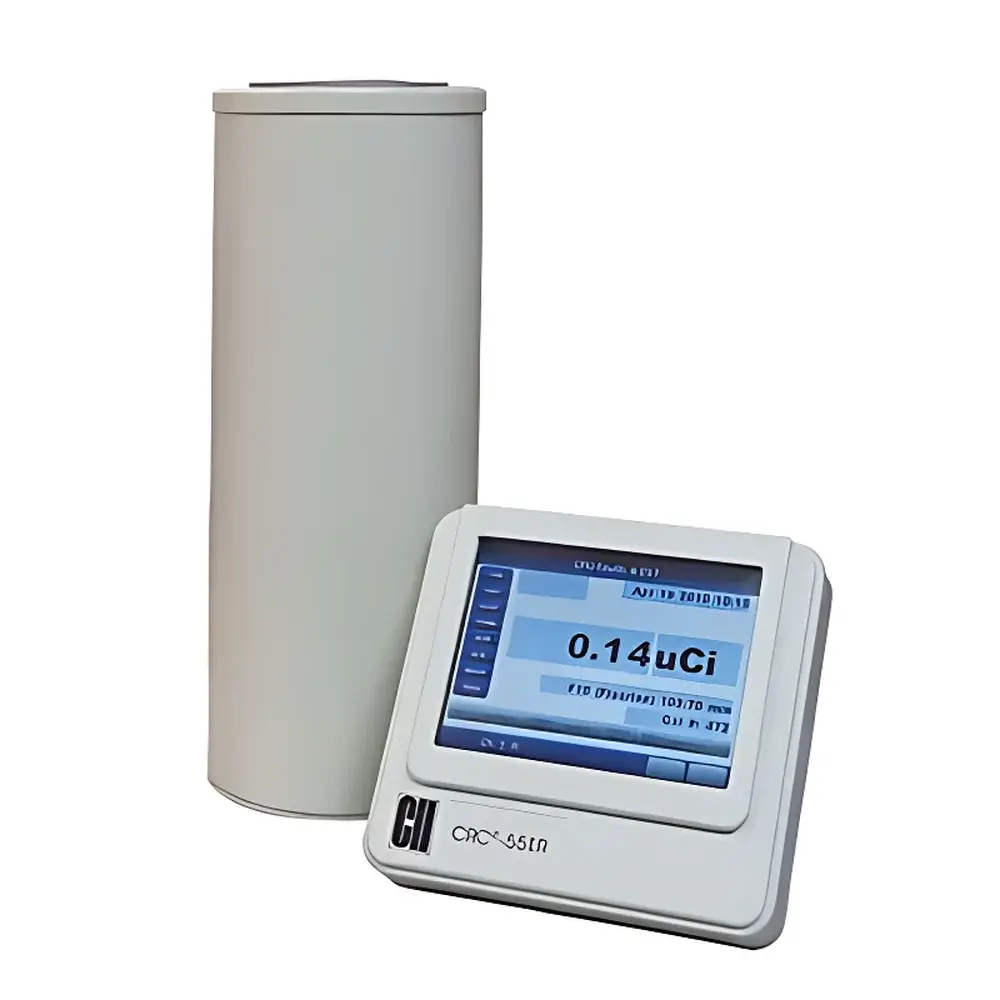
Capintec CRC55tR Touchscreen Dose Calibrator
| Brand | Capintec |
|---|---|
| Origin | USA |
| Model | CRC55tR |
| Instrument Type | Portable Dose Calibrator |
| Measurement Principle | Ionization Chamber (Thin-Walled, High-Pressure Argon-Filled Well Chamber) |
| Max Activity Range | 250 GBq (6 Ci) |
| Minimum Detectable Activity | 0.001 MBq (0.01 µCi) |
| Display | 8" VGA Color Touchscreen |
| Accuracy | ±2% |
| Linearity | ±2% |
| Response Time | ≤2 s (standard), 4–16 s (low-activity samples) |
| Chamber Fill Gas | Ultra-High-Purity Argon at 12 atm |
| Well Dimensions | Ø6.1 cm × Depth 25.4 cm |
| Console Dimensions | 42 × 23 × 27 cm |
| Console Weight | 3.4 kg |
| Chamber Weight | 13.6 kg |
| Power | 100–240 VAC, 50/60 Hz, 90 mA |
| Interfaces | RS-232, USB |
| Compliance | Meets NIST-traceable calibration requirements for nuclear medicine |
Overview
The Capintec CRC55tR Touchscreen Dose Calibrator is a high-precision, portable radioactivity measurement system engineered for quantitative activity determination of radionuclides used in diagnostic and therapeutic nuclear medicine applications. It operates on the fundamental principle of ionization chamber physics: radioactive emissions ionize ultra-pure argon gas under elevated pressure (12 atm) within a thin-walled, deep-well cylindrical chamber. The resulting ion current is linearly proportional to radiation flux and is converted into activity values (Bq or Ci) using nuclide-specific calibration factors stored in non-volatile memory. Designed for clinical radiopharmacy labs, PET cyclotron facilities, and mobile radiopharmaceutical distribution centers, the CRC55tR delivers NIST-traceable accuracy with minimal operator dependency—enabling rapid, repeatable measurements of short-lived isotopes including 99mTc, 18F, 68Ga, 177Lu, and 99Mo eluate.
Key Features
- 8-inch VGA color touchscreen interface with intuitive, menu-driven navigation—no external keyboard or mouse required
- Dual-chamber compatibility support via firmware architecture (optional upgrade path for future multi-chamber configurations)
- Automated quality assurance suite: real-time auto-zeroing, background subtraction, linearity verification, geometry testing, and daily stability checks
- Pre-programmed nuclide library with >28 user-definable keys for rapid selection of common isotopes and custom radiopharmaceuticals
- High-pressure (12 atm) argon-filled thin-wall well chamber optimized for high sensitivity and low energy dependence across 20 keV–3 MeV photon range
- Integrated diagnostics engine performing continuous RAM/ROM integrity validation, HV supply monitoring, and electrometer drift compensation
- Compact console design (3.4 kg) with detachable chamber (13.6 kg) for flexible deployment in hot labs, clean rooms, or transport vehicles
Sample Compatibility & Compliance
The CRC55tR accommodates standard nuclear medicine sample geometries—including vials (1–30 mL), syringes (up to 20 mL), and CAPMAC metal cartridges—within its 6.1 cm diameter × 25.4 cm depth well. It complies with regulatory expectations outlined in U.S. NRC 10 CFR Part 35 Subpart I, AAPM Task Group 181, and ISO/IEC 17025 for accredited dose calibrator testing. All factory calibrations are traceable to NIST Standard Reference Materials (SRMs), and the system supports GLP/GMP audit trails when paired with compliant data management software. Routine QA tests—including constancy, linearity, geometry, and reproducibility—are fully automated and documented per IAEA Human Health Reports No. 7.
Software & Data Management
The embedded operating system enables local storage of ≥1,000 measurement records with timestamp, operator ID, nuclide, activity, uncertainty, and QC status. Data export is supported via RS-232 or USB to LIS/RIS/PACS environments using ASTM E1384-compliant HL7 messaging or CSV format. Optional Capintec DoseCal™ PC software provides advanced reporting (PDF/Excel), trend analysis, electronic signature capture, and 21 CFR Part 11 compliance modules—including role-based access control, audit log retention, and electronic record integrity verification. Printer integration supports Epson roll-feed, flat-bed, and Okidata dot-matrix models for hardcopy generation of full QA reports or single-measurement receipts.
Applications
- Pre-administration dose verification of 99mTc-labeled agents (e.g., MDP, HMPAO, Sestamibi) and PET tracers (18F-FDG, 68Ga-DOTATATE)
- Eluate assay and 99Mo/99mTc generator yield calculation
- Radiochemical purity validation through sequential decay-corrected measurements
- Quality control of radiolabeled antibodies, peptides, and nanoparticles in translational research settings
- Field-based environmental monitoring of airborne or filtered gaseous radionuclides (e.g., 131I, 133Xe) when used with approved gas-tight sample holders
- Regulatory submission support for IND/IDE applications requiring documented metrological traceability
FAQ
Does the CRC55tR require annual recalibration by an accredited laboratory?
Yes. Capintec recommends annual NIST-traceable recalibration performed by an ISO/IEC 17025-accredited service provider, with interim constancy checks conducted daily per AAPM TG-181 guidelines.
Can the system measure beta-emitting isotopes like 32P or 90Y directly?
No. The CRC55tR is optimized for photon-emitting radionuclides. Beta-only emitters require dedicated liquid scintillation or ionization chamber systems with appropriate window thickness and shielding configuration.
Is firmware update capability available over USB without third-party tools?
Yes. Firmware updates are distributed as signed .bin files and installed directly via USB flash drive using the built-in bootloader—no proprietary dongles or network dependencies required.
What is the typical warm-up time before first measurement?
Less than 30 minutes after power-on, during which the high-voltage supply stabilizes and internal temperature equilibrates to minimize electrometer drift.
How does the system handle cross-calibration between different radionuclides?
Each nuclide is assigned a unique calibration factor derived from chamber response curves measured against NIST-traceable standards; no interpolation or extrapolation is applied—the system uses only empirically validated coefficients stored in protected memory.







