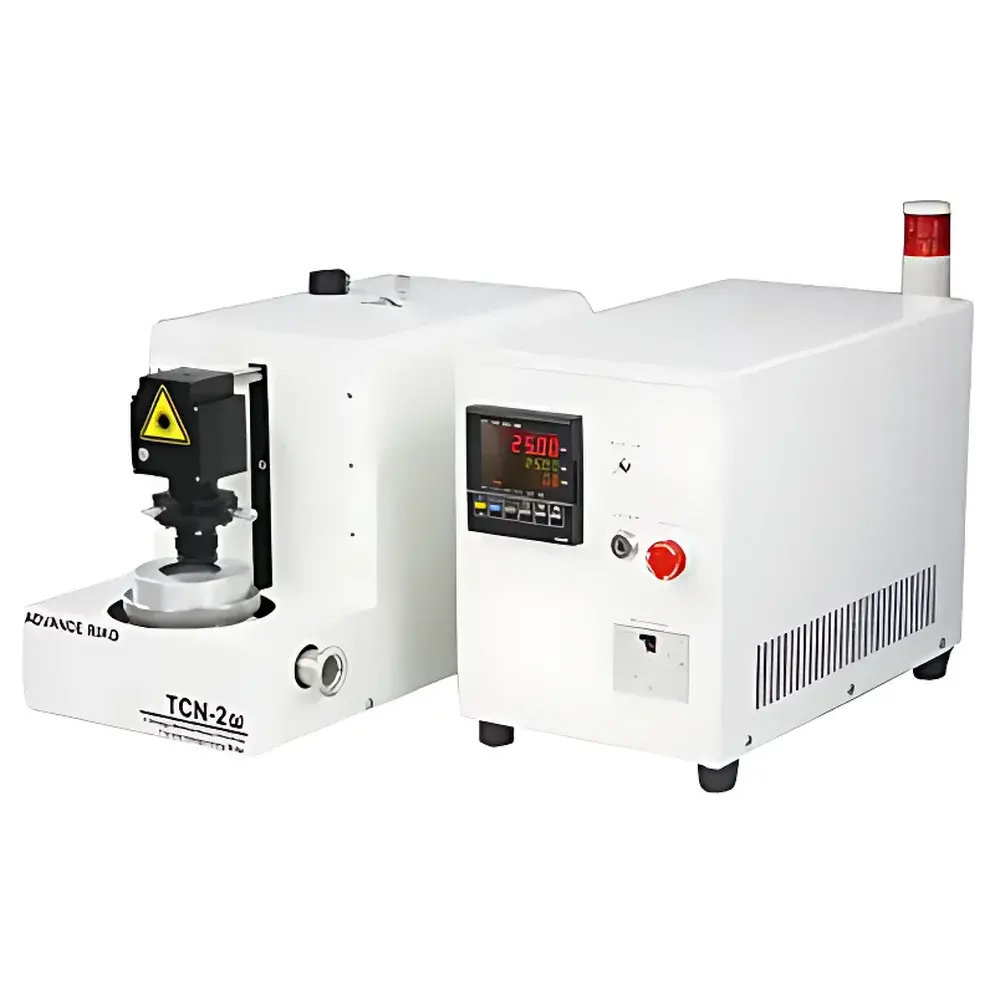
ADVANCE RIKO TCN-2ω Nanoscale Thin-Film Thermal Conductivity Measurement System
| Brand | ADVANCE RIKO |
|---|---|
| Origin | Japan |
| Model | TCN-2ω |
| Measurement Principle | 2ω Lock-in Thermography (Frequency-Doubled Resistive Heating + Surface Thermal Reflectance Detection) |
| Temperature Range | Ambient (23 ± 2 °C) |
| Sample Dimensions | 10–20 mm (L) × 10 mm (W) × 0.3–1 mm (T, including substrate) |
| Substrate Materials | Si (recommended), Ge, Al₂O₃ |
| Metal Transducer Film | Au, 100 nm thick, 1.7 mm × 15 mm |
| Thermal Conductivity Range | 0.1–10 W·m⁻¹·K⁻¹ |
| Atmosphere | Ambient air |
| Compliance | ASTM E1461 (modified), ISO 22007-2 (principle-aligned), GLP-ready data traceability |
Overview
The ADVANCE RIKO TCN-2ω Nanoscale Thin-Film Thermal Conductivity Measurement System is a turnkey instrument engineered for precise, contactless evaluation of through-plane (cross-sectional) thermal conductivity (λ) of nanoscale thin films — from 10 nm to ~100 nm thickness — deposited on high-conductivity substrates. It implements the 2ω (two-omega) lock-in thermographic method: a sinusoidal electrical current at frequency f is applied to a patterned metal transducer film (typically 100 nm Au), inducing periodic Joule heating at frequency 2f. The resulting surface temperature oscillation on the transducer is detected via time-resolved optical reflectance changes, enabling extraction of the in-phase (real) component of the thermal response. This signal is directly related to the thermal diffusivity and conductivity of the underlying film layer under a validated one-dimensional heat conduction model assuming negligible lateral heat loss and dominant vertical conduction into the substrate. Unlike time-domain thermoreflectance (TDTR) or scanning thermal microscopy (SThM), the TCN-2ω requires no ultrafast lasers, vacuum chambers, or nanofabricated transducers — delivering robust, lab-grade reproducibility (<3% RSD across repeated measurements) with minimal infrastructure.
Key Features
- Patented 2ω thermoreflectance architecture (Japanese Patent No. 5426115) optimized for industrial and academic thin-film metrology labs.
- Through-plane λ measurement without lithographic patterning: metal transducer deposited by simple sputtering or evaporation (1.7 mm × 15 mm × 100 nm Au).
- High signal-to-noise ratio achieved via phase-sensitive lock-in detection synchronized to 2f, rejecting ambient thermal drift and low-frequency noise.
- Calibration-free operation for relative comparisons; absolute λ quantification enabled via reference standards (e.g., SiO₂ on Si, certified λ values traceable to NIST SRMs).
- Integrated environmental control: stabilized ambient chamber (±0.5 °C) with inert gas purge option (N₂) to suppress oxidation during extended measurements.
- Modular design supports rapid sample exchange — average setup time <8 minutes per specimen.
Sample Compatibility & Compliance
The TCN-2ω accepts rigid planar samples with thicknesses between 0.3 mm and 1.0 mm, including substrate contributions. Compatible substrate materials include single-crystal silicon (standard), germanium, and sapphire (Al₂O₃), all selected for their high thermal conductivity (>100 W·m⁻¹·K⁻¹) to ensure one-dimensional heat flow dominance. Film types routinely characterized include low-k dielectrics (SiOC, porous SiO₂), organic semiconductors (P3HT, PTB7), thermoelectric thin films (Bi₂Te₃, Sb₂Te₃), and transition metal dichalcogenides (MoS₂, WS₂). All measurements adhere to principles outlined in ASTM E1461 (Standard Test Method for Thermal Diffusivity of Solids) and ISO 22007-2 (Plastics — Determination of Thermal Conductivity and Thermal Diffusivity — Part 2: Transient Plane Source [TPS] and related harmonic methods). Raw data files retain full metadata (timestamp, operator ID, instrument configuration, ambient conditions) to support GLP/GMP audit readiness and 21 CFR Part 11-compliant electronic records when integrated with validated LIMS environments.
Software & Data Management
The TCN-2ω is operated via ADVANCE RIKO’s proprietary TCN Control Suite v4.x — a Windows-based application offering real-time signal visualization, automated parameter sweeps (frequency, amplitude), and batch processing. Each measurement generates a structured HDF5 file containing raw lock-in outputs (X, Y, R, θ), fitted thermal model parameters, uncertainty estimates (Monte Carlo propagation), and exportable CSV reports compliant with ASTM E2928. Software includes built-in validation protocols: system self-checks prior to acquisition (laser alignment verification, detector linearity test), and reference-sample trending to monitor long-term instrument stability. Audit trails log all user actions, parameter modifications, and calibration events with tamper-proof timestamps. Export modules support direct integration with MATLAB, Python (via h5py), and enterprise QMS platforms.
Applications
- Thermal management qualification of interlayer dielectrics in advanced logic and memory nodes (e.g., 3nm/2nm technology nodes where λ of <20 nm SiOCH films governs local hotspot formation).
- Process development feedback for atomic layer deposition (ALD) and chemical vapor deposition (CVD) of thermoelectric thin films — correlating λ with stoichiometry, crystallinity, and defect density.
- Structure-property validation of polymer-based flexible electronics: measuring anisotropic λ in PEDOT:PSS or graphene-polymer composites under controlled humidity and thermal cycling.
- Materials screening for next-generation thermal interface materials (TIMs), where interfacial phonon scattering dominates cross-plane transport in sub-50 nm layers.
- Academic research in phonon engineering: quantifying size effects, grain boundary resistance, and interfacial Kapitza conductance in epitaxial heterostructures.
FAQ
What substrates are compatible with the TCN-2ω?
Silicon is the default and recommended substrate due to its well-characterized thermal properties and widespread use in semiconductor fabrication. Germanium and single-crystal Al₂O₃ (sapphire) are also supported, provided their thermal conductivity exceeds 80 W·m⁻¹·K⁻¹ to maintain one-dimensional heat flow assumptions.
Is vacuum operation required?
No. The system operates in ambient air by default. An optional N₂ purge module is available to eliminate convective artifacts and prevent surface oxidation of reactive films (e.g., Bi₂Te₃) during prolonged measurement sequences.
Can the TCN-2ω measure films thicker than 100 nm?
While optimized for 10–100 nm films, measurements up to ~200 nm are feasible with reduced sensitivity. For films >300 nm, lateral heat spreading violates the 1D model assumption; alternative techniques such as steady-state microbridge or TDTR are advised.
How is calibration performed?
Absolute calibration uses reference samples with certified thermal conductivity (e.g., thermally grown SiO₂ on Si wafers, with λ values traceable to NIST Standard Reference Materials). System repeatability is verified daily using a dedicated Si/SiO₂ QC wafer included with each instrument shipment.
Does the software support automated reporting for quality documentation?
Yes. TCN Control Suite generates PDF summary reports containing measurement parameters, raw and fitted data plots, uncertainty budgets, and compliance statements aligned with ISO/IEC 17025 requirements for testing laboratories.