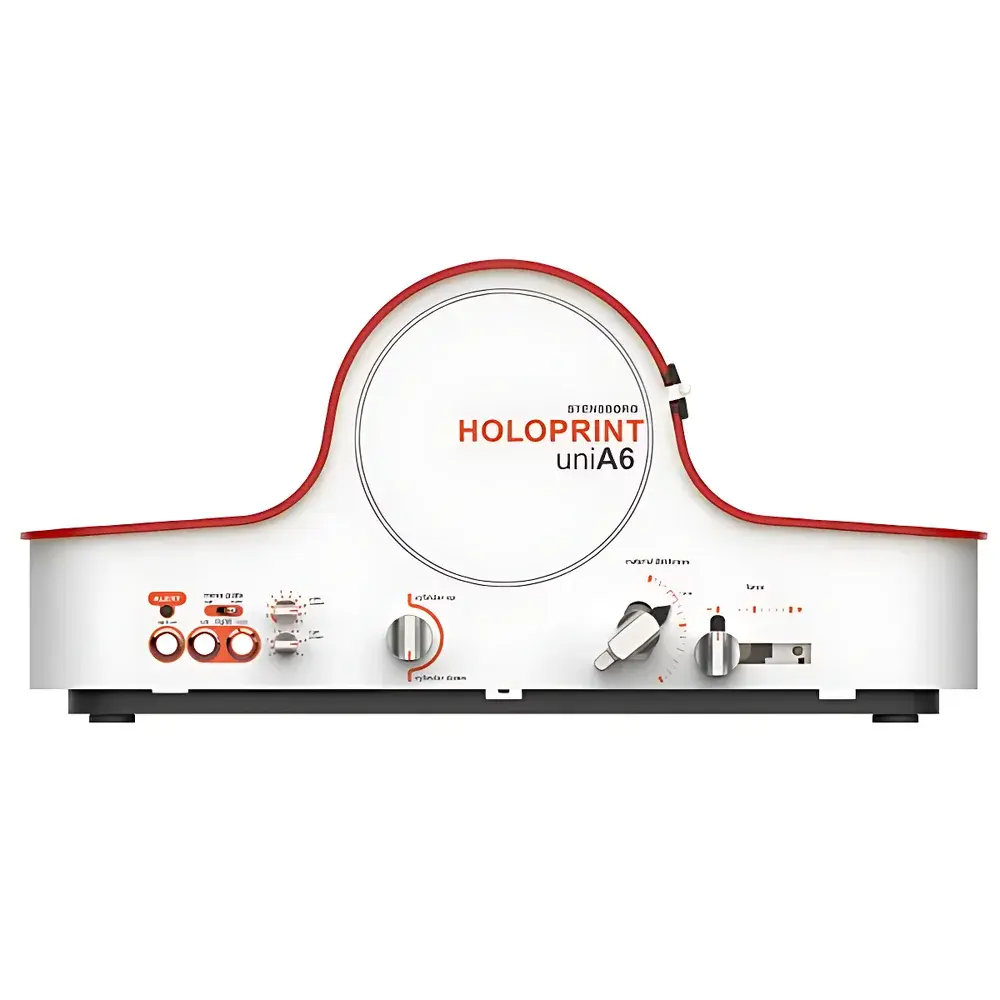
PolyPico UniA6 Desktop Nanoimprint Lithography System
| Brand | PolyPico |
|---|---|
| Origin | Denmark |
| Model | UniA6 |
| Imprint Methods | Thermal, UV (365 nm), Vacuum-assisted |
| Max Substrate/Stamp Diameter | 210 mm (8″) |
| Chamber Height | 20 mm |
| Max Imprint Pressure | 11 bar |
| Thermal Range | Up to 200 °C (optional 250 °C module) |
| UV Wavelengths | 365 nm (standard), 405 nm (optional) |
| Vacuum Level | ≤ 0.1 mbar |
| Control | Fully automated via laptop-based software |
| Form Factor | Benchtop, modular, plug-and-play |
Overview
The PolyPico UniA6 Desktop Nanoimprint Lithography System is a compact, research-grade platform engineered for high-fidelity replication of micro- and nanoscale patterns onto planar substrates using three complementary imprint modalities: thermal nanoimprint lithography (T-NIL), ultraviolet nanoimprint lithography (UV-NIL), and vacuum-assisted NIL. Based on the principle of mechanical pattern transfer—where a rigid stamp with predefined topographic features is brought into conformal contact with a deformable resist layer—the UniA6 enables sub-50 nm feature resolution under controlled temperature, pressure, and ambient conditions. Its benchtop architecture integrates precision motion control, uniform thermal management, and real-time process monitoring, making it suitable for prototyping photonic crystals, metasurfaces, diffractive optical elements, and functional polymer nanostructures in academic labs and semiconductor R&D facilities.
Key Features
- Benchtop footprint (≤ 0.5 m²) with modular design—enables rapid reconfiguration between thermal, UV, and vacuum imprint modes without hardware modification.
- Thermal imprint capability up to 200 °C (standard); optional high-temperature module extends operational range to 250 °C for high-Tg thermoplastic resists and glass transition studies.
- UV-NIL subsystem with 365 nm LED source (standard), delivering uniform irradiance (> 30 mW/cm² at substrate plane); optional 405 nm upgrade supports broader resist compatibility including acrylate-based formulations.
- Vacuum chamber (≤ 0.1 mbar) minimizes air entrapment during stamp-substrate contact—critical for defect-free replication of high-aspect-ratio features and large-area patterning.
- Hydraulic pressure actuation system delivering up to 11 bar nominal imprint force with closed-loop feedback, ensuring repeatable mechanical compliance across wafer-scale substrates.
- Uniform heating plate with ±0.5 °C spatial temperature homogeneity over 210 mm diameter; integrated Pt100 sensors provide traceable calibration per ISO/IEC 17025 guidelines.
- Laptop-controlled operation via dedicated Windows-based software with recipe-driven workflow, real-time parameter logging (pressure, temperature, vacuum, UV dose), and exportable CSV/TXT data archives.
Sample Compatibility & Compliance
The UniA6 accommodates circular substrates and stamps up to 210 mm (8-inch) diameter and 20 mm maximum height—compatible with standard silicon wafers, fused silica, quartz, glass, PET, and flexible polymer foils. Stamp materials include silicon, SiO₂, Ni, and quartz; resist chemistries span thermoplastic polymers (e.g., PMMA, PS), thermoset epoxies, and UV-curable acrylates. The system meets core requirements for GLP-compliant process development: full audit trail functionality (user login, parameter changes, execution timestamps), electronic signature support, and data integrity aligned with FDA 21 CFR Part 11 principles. All thermal and UV subsystems comply with IEC 61000-6-3 (EMC) and IEC 61000-6-2 (immunity) standards; vacuum components conform to ISO 2859-1 sampling plans for leak integrity verification.
Software & Data Management
The UniA6 Control Suite provides deterministic, scriptable process orchestration through a role-based interface. Users define multi-step imprint protocols—including pre-heating ramp rates, dwell times, pressure profiles, UV exposure sequences, and cooldown stages—with parameter constraints enforced by embedded safety interlocks. All process variables are timestamped and logged at ≥ 1 Hz resolution. Raw datasets are stored in vendor-neutral formats (CSV, HDF5) with metadata headers describing instrument configuration, calibration status, and environmental conditions. Optional integration with LabArchives ELN or MATLAB via TCP/IP API enables automated post-processing, statistical process control (SPC), and DOE-driven optimization workflows.
Applications
- Rapid prototyping of plasmonic biosensor arrays requiring <100 nm line/space fidelity.
- Development of anti-reflective moth-eye structures on solar cell encapsulants.
- Manufacturing of nanostructured polymer waveguides for integrated photonics.
- Replication of master templates for roll-to-roll NIL tool qualification.
- Fundamental studies of interfacial adhesion, viscoelastic relaxation, and residual stress evolution during thermal imprinting.
- Process validation per ASTM E2981 (Standard Guide for Nanoimprint Lithography Process Characterization).
FAQ
Is the UniA6 compatible with standard semiconductor cleanroom environments?
Yes—the system operates at Class 1000 (ISO 6) particulate levels when used with laminar flow hoods; all internal surfaces are non-outgassing stainless steel or anodized aluminum.
Can the system be upgraded from thermal-only to full multimodal capability after purchase?
Yes—modular architecture allows field installation of UV and vacuum modules with minimal downtime and full firmware integration.
What level of pattern fidelity can be achieved with the UniA6?
Sub-30 nm half-pitch resolution has been demonstrated using optimized Si stamps and low-viscosity UV resists under vacuum-assisted UV-NIL conditions.
Does PolyPico provide application support and training?
Yes—comprehensive remote and on-site training packages include system commissioning, resist selection guidance, stamp handling protocols, and failure mode analysis workshops.
How is temperature calibration verified and maintained?
Each unit ships with NIST-traceable calibration certificate; users may perform periodic verification using embedded dual-sensor redundancy and external reference thermocouples per ISO/IEC 17025 procedures.