
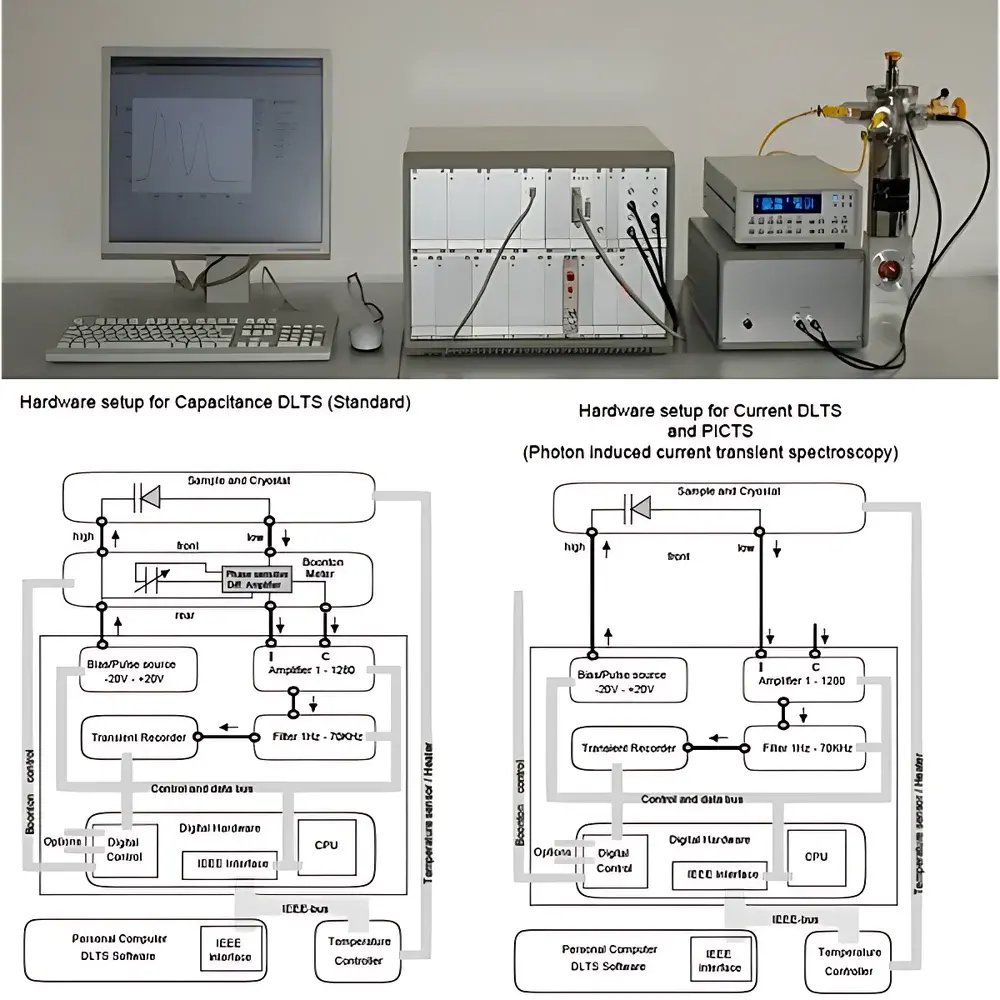
SEMETROL HERA-DLTS Deep Level Transient Spectroscopy System
| Brand | AML |
|---|---|
| Origin | USA |
| Manufacturer Type | Authorized Distributor |
| Origin Category | Imported |
| Model | SEMETROL HERA-DLTS |
| Price Range | USD 120,000 – 280,000 |
| Instrument Class | Semiconductor Defect Characterization System |
Overview
The SEMETROL HERA-DLTS is a high-precision deep level transient spectroscopy system engineered for quantitative defect characterization in semiconductor materials and devices. Based on the fundamental principle of thermally stimulated capacitance or current transients—arising from carrier emission from electrically active deep-level traps—the HERA-DLTS platform enables sub-meV energy resolution in trap level identification. First introduced by SEMETROL LLC (USA) in 1990 as the industry’s first fully digital DLTS system, it leverages modern computational power to execute real-time multi-exponential transient analysis, Laplace transform inversion, and advanced signal deconvolution techniques. Unlike analog predecessors, HERA-DLTS implements synchronized digital sampling with hardware-triggered temperature ramping, ensuring phase-coherent acquisition across wide thermal ranges (typically 10 K to 450 K). Its architecture supports both cryogenic probe stations and industrial-grade temperature controllers, making it suitable for R&D labs, process development centers, and failure analysis facilities requiring traceable, GLP-compliant defect profiling.
Key Features
- Automated contact integrity verification prior to measurement initiation
- Digital C-DLTS, CC-DLTS, I-DLTS, DD-DLTS, Zerbst-DLTS, O-DLTS, and FET/MOS-specific transient analysis modes
- Real-time automatic capacitance compensation for high-accuracy baseline stabilization
- Triple-terminal FET current transient acquisition with sub-picoampere sensitivity
- Wide dynamic range: supports samples from ultra-low-doped epitaxial layers (1e18 cm⁻³), and capacitances up to 100 nF
- Fully modular hardware design—scalable detector front-ends, programmable pulse generators, and configurable low-noise preamplifiers
- Integrated support for commercial cryostats (e.g., Janis, BlueFrog), closed-cycle refrigerators, and PID-controlled hot stages
- Fourier-DLTS (F-DLTS) implementation with user-definable windowing functions and proportional baseline correction
- DLTFS (Deep Level Transient Fourier Spectroscopy) module for direct emission transient spectral reconstruction
- 28 parallel correlation functions executable per single temperature scan—enabling simultaneous extraction of activation energy, capture cross-section, and concentration for multiple trap species
Sample Compatibility & Compliance
The HERA-DLTS accommodates standard semiconductor geometries including Schottky diodes, p-n junctions, MOS capacitors, HEMTs, and vertical GaN/SiC power devices. It interfaces seamlessly with industry-standard probe stations (e.g., Cascade Microtech, Micromanipulator) and vacuum-compatible cold fingers. All firmware and software modules comply with ISO/IEC 17025 calibration traceability requirements for transient measurement systems. Data acquisition protocols are structured to meet FDA 21 CFR Part 11 electronic record and signature criteria when deployed in regulated environments; audit trails, user access control, and electronic signature workflows are configurable via optional validation packages. The system supports ASTM F1336-22 (Standard Guide for DLTS Measurements) and IEC 60747-12 (Semiconductor devices — Discrete devices — Part 12: Power transistors) test methodologies.
Software & Data Management
HERA-DLTS operates under Windows-based SEMETROL Control Suite v5.x—a deterministic, multi-threaded application built on .NET Framework with native HDF5 data storage. Raw transients are stored with full metadata (pulse parameters, temperature setpoint, bias history, hardware configuration). Built-in tools include ITS (Isothermal Transient Spectroscopy) signal superposition, TSC/TSCAP deconvolution, PITS (Photon-Induced Transient Spectroscopy) spectral alignment, and Richardson plot generation for thermionic emission analysis. All mathematical operations—including Laplace inversion, multi-exponential fitting (Levenberg-Marquardt + singular value decomposition), and DLOS (Defect Level Optical Spectroscopy) correlation—run locally without cloud dependency. Export formats include CSV, MATLAB (.mat), and ASCII-compatible spectra for third-party modeling (e.g., Synopsys Sentaurus, Silvaco Atlas). Software validation documentation (IQ/OQ/PQ templates) and 21 CFR Part 11 compliance add-ons are available upon request.
Applications
- Identification and quantification of deep-level traps in Si, SiC, GaN, GaAs, InP, and emerging wide-bandgap semiconductors
- Correlation of electrical defects with crystallographic imperfections observed via TEM or XRD
- Process-induced defect monitoring in ion implantation, rapid thermal annealing, and epitaxial regrowth
- Reliability assessment of power devices under high-field stress (e.g., TDDB, NBTI, hot-carrier injection)
- Interface state density profiling at SiO₂/Si, Al₂O₃/GaN, and high-k dielectric interfaces
- Trap-assisted tunneling analysis in tunnel FETs and resonant tunneling diodes
- Calibration of TCAD simulation parameters (e.g., trap energy distribution, capture cross-section anisotropy)
FAQ
What cooling systems are compatible with HERA-DLTS?
HERA-DLTS supports liquid nitrogen cryostats, closed-cycle helium refrigerators (4 K–450 K), and resistive heating stages with ±0.1 K stability. Integration requires standard analog/digital I/O ports and RS-232/USB temperature feedback channels.
Does the system support automated temperature scanning with real-time data acquisition?
Yes—hardware-synchronized temperature ramping with programmable dwell times, pulse repetition rates, and adaptive sampling intervals ensures phase-consistent transient capture across full thermal sweeps.
Can HERA-DLTS measure traps in non-Schottky structures such as MOSCAPs or FinFETs?
Yes—dedicated MOS-Analysis and FET-Analysis modules provide gate-controlled transient acquisition, flatband voltage tracking, and interface trap density (Dit) extraction using high-frequency CV and low-frequency CV difference methods.
Is Laplace DLTS (LDLTS) functionality included?
Yes—Laplace inversion is implemented via fixed-point regularization and singular value decomposition, enabling continuous trap energy distribution (TED) mapping without prior assumption of exponential decay models.
What level of technical support and calibration services does AML provide?
AML offers factory calibration certificates traceable to NIST standards, annual performance verification, on-site application training, and remote diagnostics via secure VNC. Extended warranty and service-level agreements (SLA) are available globally.
Related Products





