
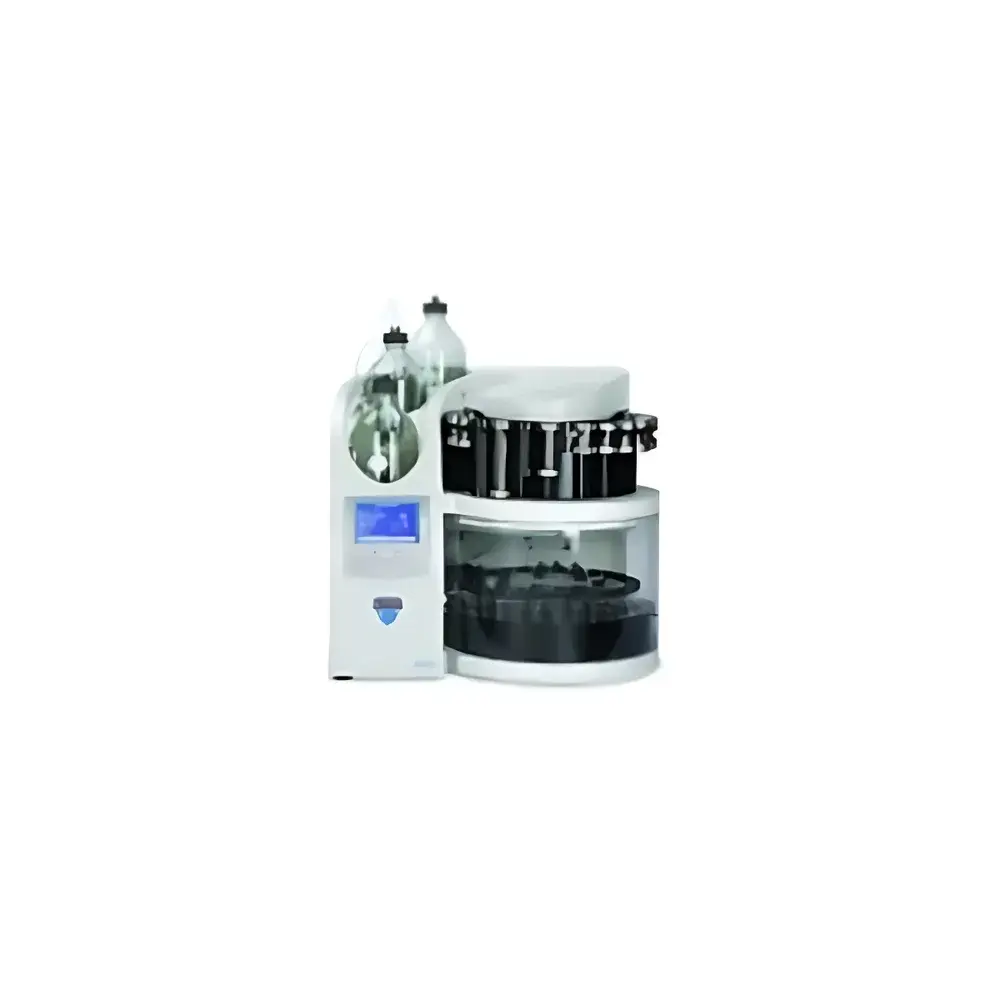
Thermo Fisher Dionex ASE 350 Accelerated Solvent Extractor
| Brand | Thermo Fisher |
|---|---|
| Origin | Shanghai, China |
| Manufacturer Type | Authorized Distributor |
| Country of Origin | China |
| Model | Thermo Fisher Dionex ASE 350 |
| Quotation | Upon Request |
| Sample Capacity | 1–100 g |
| Throughput | Up to 24 unattended extractions |
| Operating Temperature | Up to 200 °C |
| Maximum Pressure | 1500 psi (10 MPa) |
| Pump Flow Rate | 70 mL/min |
| Solvent Compatibility | Organic and aqueous solvents |
| Extraction Cell Volumes | 1, 5, 10, 22, 34, 66, and 100 mL |
| Collection Vial Options | 60 mL and 250 mL |
| Dimensions (W × D × H) | 67.3 × 69.3 × 61.7 cm |
| Weight | 65 kg |
| Power Supply | 240 V, 50/60 Hz, ≤500 VA |
| Pneumatic Requirements | Air at 400–827 kPa (60–120 psi) |
Overview
The Thermo Fisher Dionex ASE 350 Accelerated Solvent Extractor is an automated, high-pressure, high-temperature extraction system engineered for rapid, reproducible isolation of analytes from solid and semi-solid matrices. Based on the principle of accelerated solvent extraction (ASE®), it utilizes elevated temperature (up to 200 °C) and pressure (up to 1500 psi / 10 MPa) to enhance solvation power, reduce surface tension, and increase diffusion rates—thereby significantly shortening extraction time while maintaining quantitative recovery. Unlike conventional Soxhlet or ultrasonic methods, ASE technology delivers complete extractions in 12–20 minutes per sample, with solvent consumption reduced by 50–90% compared to traditional techniques. The system’s chemically inert fluid path—constructed with Thermo Scientific™ Dionium™ components—ensures compatibility with aggressive acidic or basic sample pretreatments and a broad spectrum of solvents, including chlorinated hydrocarbons, alcohols, acetone, ethyl acetate, and water-miscible mixtures.
Key Features
- Automated batch processing of up to 24 samples without operator intervention, supported by intelligent cell positioning and auto-sensing of original cell placement.
- Seven standardized extraction cell volumes (1, 5, 10, 22, 34, 66, and 100 mL) accommodate diverse sample masses (1–100 g), enabling method scalability from trace analysis to bulk characterization.
- Precise thermal control via a proprietary furnace design ensures ±1 °C temperature stability across the full operating range (ambient to 200 °C), critical for method robustness and inter-laboratory reproducibility.
- Integrated solvent delivery module supports gradient mixing and sequential delivery of up to three solvents per run—ideal for complex matrix clean-up or polarity-driven fractionation.
- SmartRun™ software automatically validates cell volume and collection vial size compatibility before each run, preventing mechanical mismatch and ensuring optimal solvent-to-sample ratio.
- High-flow pump (70 mL/min) enables rapid solvent delivery and pressurization, minimizing cycle time without compromising extraction efficiency.
- Solvent-saving mode dynamically adjusts flush volume based on cell size and matrix type, further reducing waste and operational cost—e.g., <50 mL solvent required for a 20 g soil sample using 100 mL cell.
Sample Compatibility & Compliance
The ASE 350 is validated for use with environmental, food, pharmaceutical, and polymer samples—including soils, sediments, sludges, plant tissues, animal feed, tablets, and plastic packaging. Its Dionium™-lined fluid path resists corrosion from hydrochloric acid (up to 6 M), sodium hydroxide (up to 2 M), and oxidizing agents, supporting EPA Methods 3545A, 3546, and ASTM D7699 for pesticide residue, PAHs, PCBs, and dioxin analysis. The system architecture complies with GLP and GMP documentation requirements when paired with Thermo Scientific™ Chromeleon™ CDS software, which provides full 21 CFR Part 11 audit trails, electronic signatures, and secure user access controls. All hardware components meet IEC 61010-1 safety standards for laboratory equipment.
Software & Data Management
Controlled via Thermo Scientific™ ASE Console Software, the system supports method development, sequence programming, real-time monitoring, and event logging. Method templates are exportable and version-controlled, facilitating SOP harmonization across multi-site laboratories. Integrated data export to CSV, XML, or direct LIMS upload ensures seamless integration into enterprise-wide QA/QC workflows. When deployed with Chromeleon Chromatography Data System, users gain full traceability—from extraction parameters (temperature ramp, static/dynamic time, flush volume) to final vial identification—enabling full regulatory compliance for ISO/IEC 17025-accredited testing labs.
Applications
- Environmental analysis: Extraction of persistent organic pollutants (POPs), herbicides, and heavy metal chelates from contaminated soils and sediments.
- Food safety: Recovery of mycotoxins, veterinary drug residues, and fat-soluble vitamins from cereals, dairy, and meat products.
- Pharmaceutical QC: Isolation of active pharmaceutical ingredients (APIs) and degradation products from solid dosage forms prior to HPLC or LC-MS analysis.
- Materials science: Leaching studies of additives (e.g., plasticizers, flame retardants) from polymeric materials under simulated aging conditions.
- Forensic toxicology: Efficient cleanup of biological tissues (liver, adipose) for post-mortem drug screening protocols.
FAQ
What sample types are compatible with the ASE 350?
Solid and semi-solid matrices including soils, sludges, plant matter, foodstuffs, polymers, and pharmaceutical tablets—provided they are dry or pre-dried to <10% moisture content.
Can the ASE 350 perform sequential extractions with different solvents?
Yes—the integrated solvent controller enables up to three solvent channels with programmable mixing ratios and stepwise delivery, supporting multi-step clean-up or polarity-based fractionation.
Is the system compliant with EPA or ISO regulatory methods?
Yes—it is explicitly referenced in EPA Method 3545A (for organics) and ASTM D7699 (for polymer additives), and supports full validation per ISO/IEC 17025 and FDA 21 CFR Part 11 when used with compliant software.
How does ASE compare to microwave-assisted extraction (MAE)?
ASE offers superior reproducibility and lower risk of thermal degradation due to precise pressure containment and uniform conductive heating, whereas MAE relies on dielectric heating that may cause localized hot spots.
What maintenance is required for long-term reliability?
Routine checks include O-ring replacement every 500 cycles, annual calibration of temperature and pressure sensors, and periodic verification of solvent delivery accuracy using gravimetric flow testing.
Related Products



