
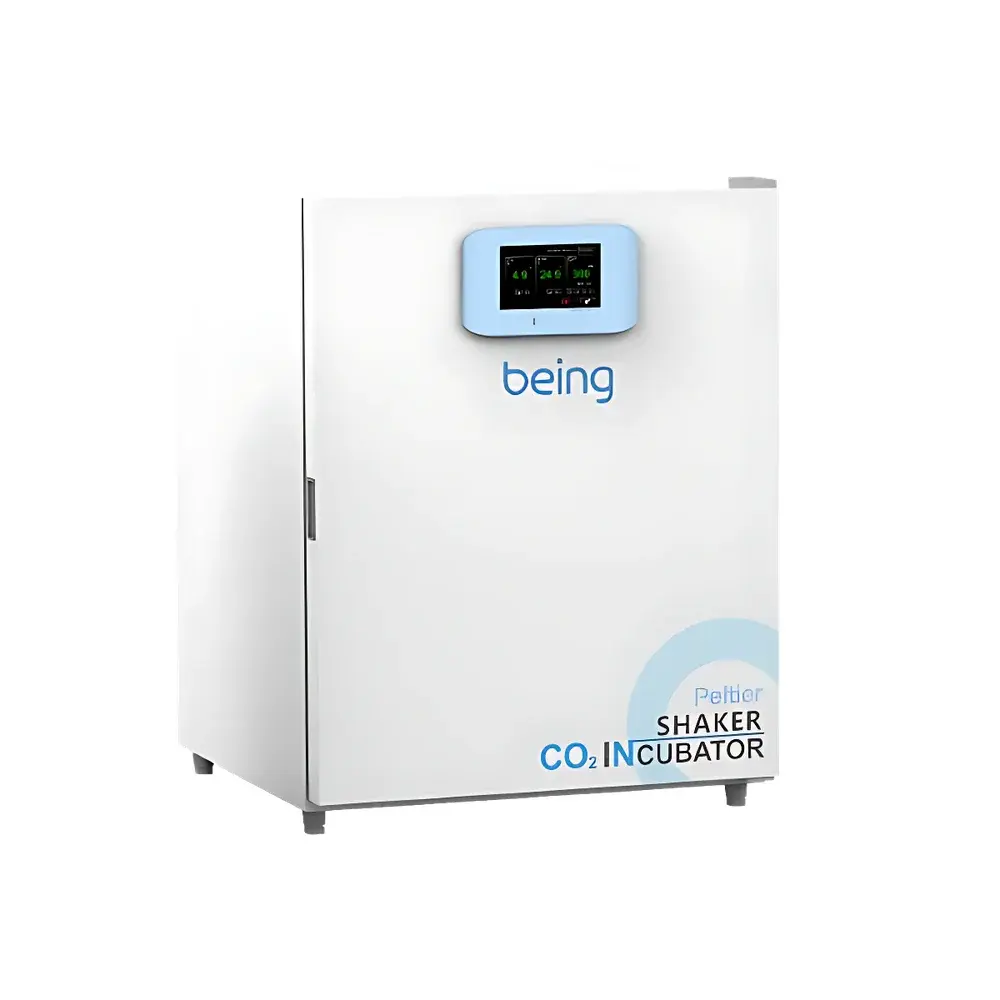
Yiheng BIOS-301E Peltier-Cooled CO₂ Orbital Incubator Shaker
| Brand | Yiheng |
|---|---|
| Origin | Jiangsu, China |
| Manufacturer Type | OEM Manufacturer |
| Country of Origin | China |
| Model | BIOS-301E |
| Cooling Method | Peltier Thermoelectric Cooling |
| Temperature Range | 10–65 °C |
| Temperature Accuracy | ±0.1 °C |
| Temperature Uniformity | ≤±0.5 °C (@37 °C) |
| Chamber Dimensions (W×D×H) | 520×610×620 mm |
| External Dimensions (W×D×H) | 820×800×852 mm |
Overview
The Yiheng BIOS-301E Peltier-Cooled CO₂ Orbital Incubator Shaker integrates precise environmental control with dynamic culture agitation in a single compact platform engineered for mammalian cell culture, microbial fermentation, hybridization assays, and biochemical kinetics studies. Unlike conventional compressor-based incubator shakers, the BIOS-301E employs solid-state Peltier thermoelectric cooling—enabling bidirectional temperature regulation (cooling and heating) without refrigerants, compressors, or oil-lubricated moving parts. This architecture delivers rapid thermal response, minimal vibration transmission to samples, and intrinsic compliance with ISO 14001 energy efficiency benchmarks. The chamber operates under tightly regulated CO₂ (0–20% range, default 5%), optional O₂ (1–90%), and relative humidity (up to 95% RH at 37 °C), all maintained via feedback-controlled IR-based gas sensing and PID-driven actuation. Its six-sided heating system, combined with internal preheating logic and ambient temperature compensation, eliminates condensation on the double-glazed inner door—a critical feature for maintaining sterility during long-term cultures.
Key Features
- Peltier thermoelectric cooling module: Achieves >85% lower power consumption versus equivalent compressor-cooled systems; enables silent, oil-free operation with no maintenance intervals for cooling components.
- Infrared (IR) CO₂ sensor (imported): Provides long-term stability (>5 years typical lifespan), immunity to cross-sensitivity from humidity or temperature fluctuations, and CO₂ recovery to setpoint within 3 minutes after 30-second door opening.
- Zirconia-based O₂ sensor (optional): Delivers linear, drift-free measurement across 1–90% O₂; supports hypoxic (e.g., 1–5%), normoxic (21%), and hyperoxic (≥40%) culture protocols per ISO 8573-1 Class 2 air purity standards.
- Triple-eccentric-axis orbital drive: Ensures uniform motion distribution across full-load trays (max. 12 kg); eliminates amplitude decay at high speeds (50–300 rpm) and maintains mechanical resonance isolation per ASTM E2567-22 vibration criteria.
- 90 °C high-humidity sterilization cycle: Fully automated chamber decontamination—including sensors, fans, shelves, and brackets—validated to achieve ≥6-log reduction of Mycoplasma, bacteria, and fungal spores per EN 14885 Annex A guidelines.
- HEPA H14 filtration (ISO 14644-1 Class 3 compliant): Integrated recirculation filter removes ≥99.995% of particles ≥0.3 µm; CO₂ inlet fitted with hydrophobic 0.2 µm microbiological filter meeting USP requirements.
Sample Compatibility & Compliance
The BIOS-301E accommodates standard multiwell plates (6–96-well), Erlenmeyer flasks (up to 2 L), Petri dishes, and custom bioreactor vessels via interchangeable stainless-steel platforms (304 grade). All interior surfaces feature radius-rounded corners and electropolished finish to support cleaning validation per FDA 21 CFR Part 11 Annex 11 requirements. The system meets IEC 61010-1 safety standards for laboratory equipment and includes dual independent temperature limiters—primary PID controller and secondary hardware cutoff—for GLP/GMP-aligned operational integrity. Optional RS485 interface supports audit-trail-capable data logging compliant with 21 CFR Part 11 electronic records provisions when paired with validated third-party software.
Software & Data Management
- 7-inch capacitive touchscreen with multilingual UI (English/Chinese selectable); password-protected access with three-tier permission levels (Administrator, Operator, Guest).
- Onboard USB port for direct export of time-stamped temperature, CO₂, O₂, RPM, and humidity logs in CSV format.
- Optional RS485 Modbus RTU interface enables integration into centralized lab monitoring systems (e.g., LabVantage, Thermo Fisher SampleManager).
- Mobile app (iOS/Android) provides real-time alarm push notifications, remote parameter adjustment, and historical trend visualization—data encrypted in transit using TLS 1.2.
Applications
This instrument is routinely deployed in academic core facilities, biopharmaceutical QC labs, and contract research organizations for: suspension cell expansion under controlled hypoxia; high-yield recombinant protein expression in E. coli fermentations; synchronized hybridoma culture for monoclonal antibody production; oxygen-sensitive stem cell differentiation assays; and kinetic studies of enzyme-catalyzed reactions requiring simultaneous gas exchange and mixing. Its low-vibration profile and thermal stability make it suitable for live-cell imaging workflows where stage-mounted microscopes require minimal external perturbation.
FAQ
What is the maximum load capacity for orbital shaking?
The unit supports up to 12 kg distributed evenly across the platform, verified per ISO 10816-1 vibration severity thresholds at 300 rpm.
Does the system comply with FDA 21 CFR Part 11 for electronic records?
Yes—when configured with RS485 connectivity and validated third-party LIMS software, full audit trail, electronic signature, and data integrity controls are achievable.
How often must the HEPA and CO₂ inlet filters be replaced?
HEPA filter replacement interval is 12 months under continuous operation; CO₂ inlet filter should be replaced every 6 months or after 200 sterilization cycles, whichever occurs first.
Can the unit operate unattended for extended periods (e.g., 72+ hours)?
Yes—the brushless DC motor, redundant thermal protection, and self-diagnostics enable uninterrupted operation with alarm-triggered SMS/email escalation via optional IoT gateway.
Is calibration documentation available for regulatory submissions?
Factory calibration certificates (NIST-traceable Pt100, IR CO₂, zirconia O₂) are provided; IQ/OQ protocol templates compatible with ISO/IEC 17025 are available upon request.




