
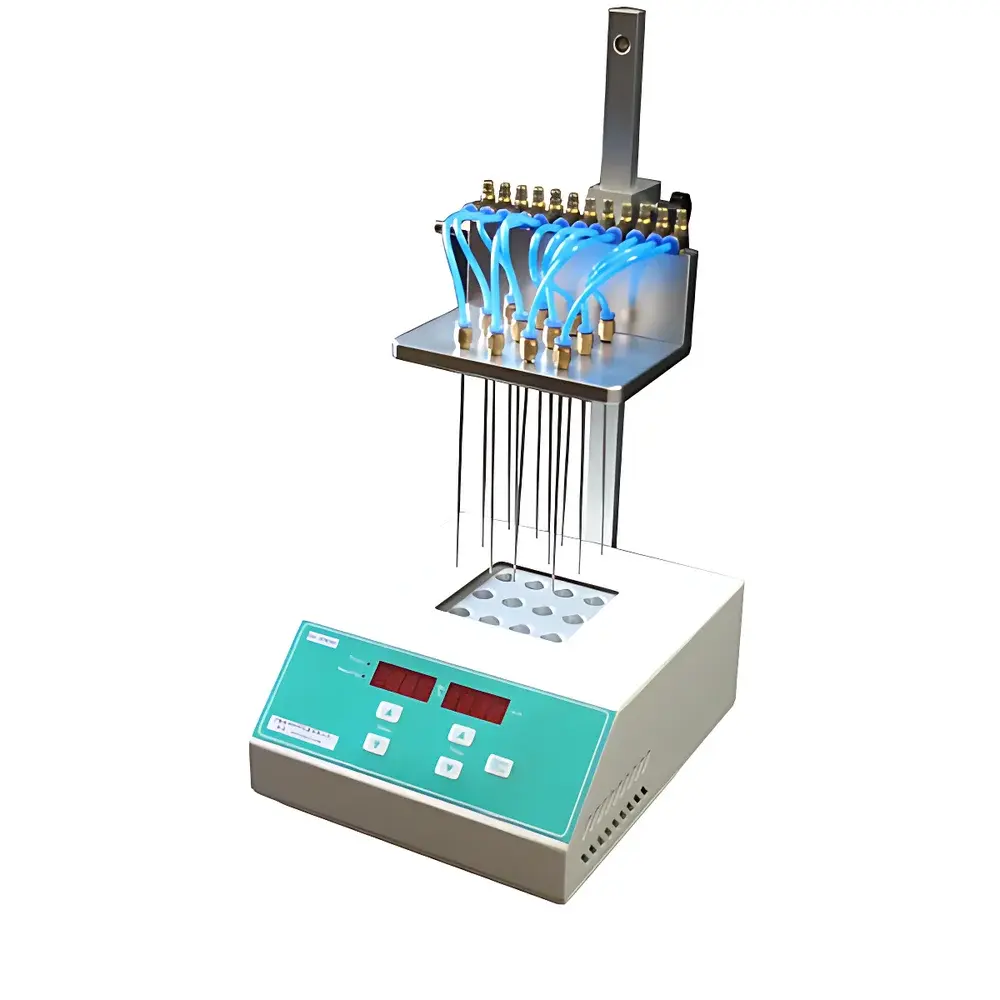
BenAng NBI-12W Water-Bath Nitrogen Evaporator
| Brand | BenAng |
|---|---|
| Origin | Shanghai, China |
| Model | NBI-12W |
| Heating Method | Water Bath |
| Temperature Range | Ambient to 100 °C |
| Temperature Stability | ±1 °C |
| Sample Capacity | 12 positions |
| Tube Diameter Compatibility | 10–29 mm |
| Nitrogen Flow Rate | 0–5 L/min |
| Heating Power | 150 W |
| Control System | 4-digit LED Display with PID Temperature Regulation |
| Safety Features | Over-Temperature Alarm & Cut-Off |
| Construction Materials | 316 Stainless Steel Gas Manifold, Anodized Aluminum Housing, Solvent-Resistant Coated Surfaces |
| Power Supply | 220 V, 50 Hz |
Overview
The BenAng NBI-12W Water-Bath Nitrogen Evaporator is a precision-engineered sample concentration system designed for reproducible, inert-atmosphere solvent removal in analytical laboratories. It operates on the principle of gentle, controlled nitrogen gas sweeping across the surface of heated liquid samples—accelerating solvent evaporation while minimizing thermal degradation, oxidation, or analyte loss. Unlike rotary evaporation—which subjects samples to vacuum-induced foaming and bumping—the NBI-12W employs low-pressure, laminar nitrogen flow over individual tubes immersed in a thermally uniform water bath. This configuration ensures consistent heat transfer, precise temperature control (ambient to 100 °C), and high inter-sample reproducibility—critical for quantitative workflows in regulated environments such as pharmaceutical QC, clinical toxicology, and environmental residue analysis.
Key Features
- Water-bath heating architecture delivering superior thermal homogeneity across all 12 sample positions—eliminating hot spots common in dry-block or aluminum-block evaporators.
- PID-controlled digital temperature regulation with 4-digit LED display, ±1 °C stability, and programmable over-temperature cutoff for unattended operation.
- Adjustable gas distribution manifold: height-adjustable needle holder allows vertical positioning optimization for varying tube lengths; individual gas channel shutoff valves enable selective activation of any position without flow redistribution.
- Chemically resistant construction: 316 stainless steel gas manifolds, anodized aluminum frame, and solvent-resistant powder-coated surfaces ensure long-term durability against acetonitrile, methanol, chloroform, and other aggressive organic solvents.
- Universal tube compatibility: spring-loaded, adjustable aperture design accommodates round-bottom and flat-bottom tubes from 10 mm to 29 mm outer diameter—supporting standard 13 × 100 mm, 16 × 150 mm, and 20 × 150 mm formats without adapters.
- Integrated flow control: calibrated needle valves per channel allow fine-tuned nitrogen delivery (0–5 L/min total, distributed across active positions) to balance evaporation rate and analyte integrity.
Sample Compatibility & Compliance
The NBI-12W supports aqueous, organic, and mixed-phase extracts commonly generated in solid-phase extraction (SPE), QuEChERS, LLE, and derivatization workflows. Its inert nitrogen environment prevents oxidation of labile compounds—including catecholamines, fatty acid methyl esters (FAMEs), pesticide metabolites, and steroid hormones. The instrument meets foundational requirements for GLP-compliant laboratories: temperature calibration traceability (NIST-traceable reference thermometer compatible), stable thermal performance per ISO 17025 clause 5.4.2, and mechanical robustness aligned with IEC 61010-1 safety standards for laboratory equipment. While not inherently 21 CFR Part 11 compliant (as it lacks electronic audit trail functionality), its analog/digital hybrid interface supports integration into validated workflows when paired with external data loggers or LIMS-linked environmental monitoring systems.
Software & Data Management
The NBI-12W operates via standalone hardware controls—no embedded software or connectivity ports. This architecture eliminates cybersecurity vulnerabilities, reduces validation burden, and ensures operational continuity during IT infrastructure updates. All critical parameters (setpoint, actual bath temperature, elapsed time) are displayed in real time on the front-panel LED. For regulated applications requiring electronic records, users may deploy external USB or RS-232 data loggers (e.g., Omega OM-DAQPRO-5300) interfaced with calibrated PT100 probes immersed in the water bath. Such configurations support full audit trails, electronic signatures, and report generation compliant with FDA guidance on computerized system validation (CSV).
Applications
- Pharmaceutical development: Concentration of HPLC fractions prior to LC-MS/MS analysis; residual solvent removal from API intermediates per ICH Q3C guidelines.
- Clinical diagnostics: Pre-concentration of urine or plasma extracts for urinary organic acid profiling, therapeutic drug monitoring (TDM), and newborn screening assays.
- Food & environmental testing: Final concentration step in multi-residue pesticide analysis (e.g., EN 15662, AOAC 2007.01); cleanup of PCB and dioxin extracts prior to HRGC-HRMS.
- Forensic toxicology: Gentle evaporation of immunoassay-positive specimens prior to GC-FID or LC-MS confirmation—preserving thermally sensitive opioids and benzodiazepines.
- Academic research: Parallel processing of metabolomics samples under reproducible, low-oxygen conditions to prevent artifactual oxidation during sample prep.
FAQ
What is the maximum recommended operating temperature for continuous use?
The unit is rated for sustained operation up to 95 °C to ensure long-term seal integrity and bath fluid stability; 100 °C is specified as absolute upper limit for short-duration protocols.
Can the NBI-12W be used with corrosive gases such as chlorine or hydrogen sulfide?
No—only inert, non-reactive gases (nitrogen, argon, helium) are permitted. Corrosive or oxidizing gases will degrade 316 stainless steel components and invalidate safety certifications.
Is calibration documentation provided with the instrument?
A factory calibration certificate (ambient to 100 °C at three points) is included. Users must perform periodic verification using a NIST-traceable thermometer per internal SOP or ISO/IEC 17025 requirements.
Does the water bath require deionized water?
Yes—use of deionized or distilled water is mandatory to prevent mineral scaling, heater corrosion, and inconsistent thermal conductivity.
How often should the O-rings and gas tubing be replaced?
Inspect quarterly; replace gas tubing every 12 months and silicone O-rings every 6 months under typical usage (8 hrs/day, 5 days/week) to maintain leak-free nitrogen delivery.



