
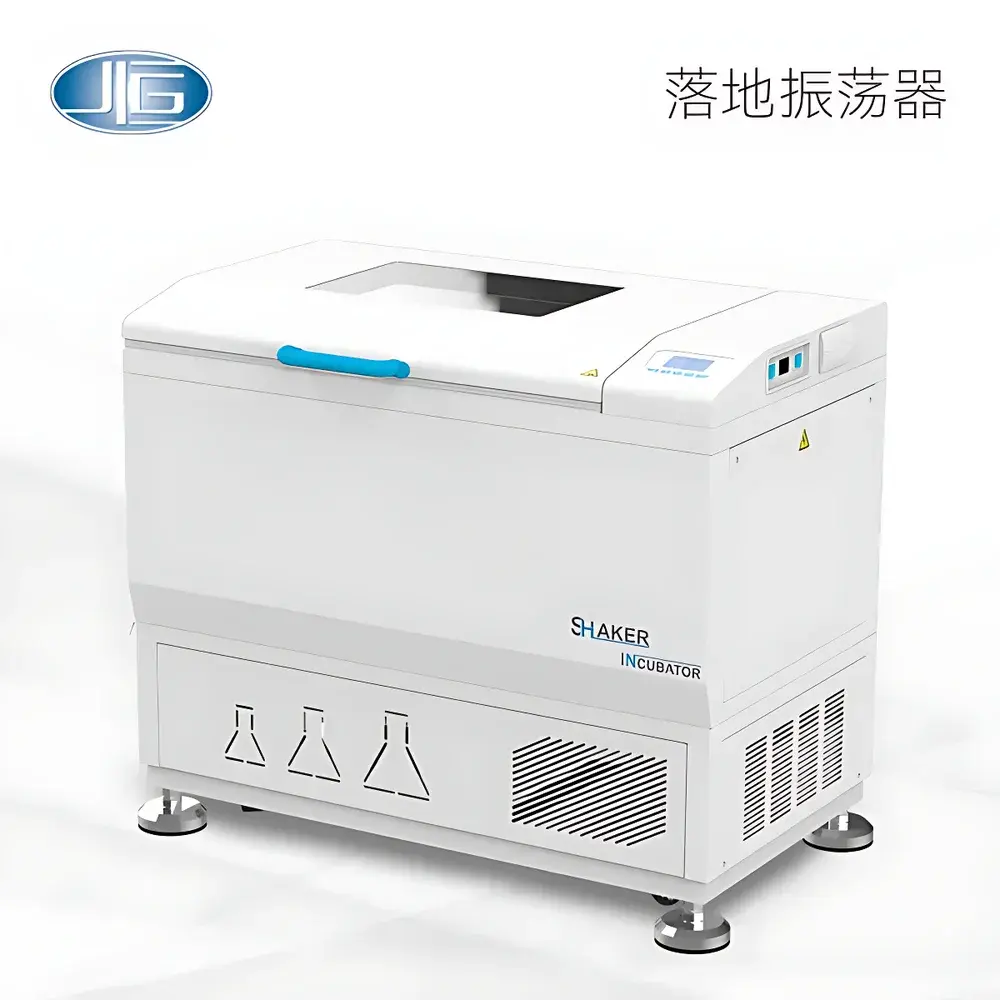
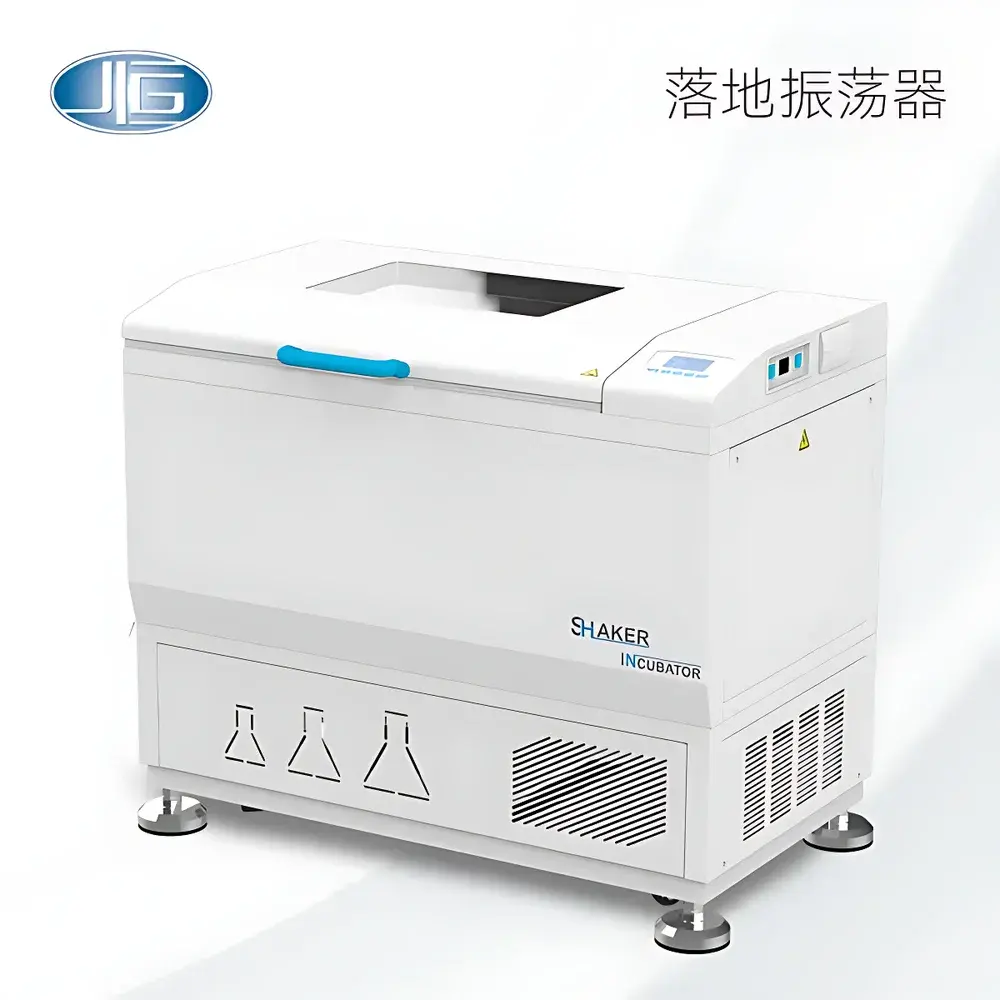
YIHENG HZQ Series Floor-Standing Orbital Shaker with LCD Display
| Brand | YIHENG |
|---|---|
| Origin | Shanghai, China |
| Manufacturer Type | Direct Manufacturer |
| Model Variants | HZQ-211, HZQ-311, HZQ-211C, HZQ-311C |
| Timer Range | 0–5999 min |
| Oscillation Frequency | 40–300 rpm |
| Oscillation Amplitude | 26 mm |
| Temperature Range | RT+5°C to 65°C (HZQ-211/311) or 4°C to 65°C (HZQ-211C/311C) |
| Shelf Quantity | 1 platform |
| Drive Mechanism | Triple-Eccentric Shaft Balanced Drive |
| Motor Type | Brushless DC Motor |
| Control System | Microprocessor-Based PID for Temperature & Speed |
| Safety Features | Independent Over-Temperature Cut-off, Auto-Stop on Door Opening, Splash-Resistant Start Control |
| Interface Options (Optional) | RS-485, USB Data Export (U-disk), Multi-Stage Programmable Control (Temp/Speed/Time), Illumination Module, Humidity Monitoring & Control |
Overview
The YIHENG HZQ Series Floor-Standing Orbital Shaker with LCD Display is an integrated air-jacketed incubator shaker engineered for precision cell culture, microbial growth, and biochemical reaction support in academic, pharmaceutical, and industrial life science laboratories. Combining thermostatic control with orbital shaking in a single-floor-standing unit, the HZQ series eliminates spatial inefficiency without compromising payload capacity or thermal uniformity. Its operational principle relies on triple-eccentric shaft balanced drive technology—ensuring consistent 26 mm orbital motion across the entire stainless-steel platform, regardless of load distribution or speed setting (40–300 rpm). The system maintains temperature stability within ±0.3°C across the working chamber (RT+5°C to 65°C for standard models; 4°C to 65°C for refrigerated variants), enabled by a fluorine-free refrigeration circuit, high-efficiency centrifugal circulation fan, and microprocessor-driven PID algorithms for both temperature and rotational speed regulation.
Key Features
- Triple-eccentric shaft balanced drive mechanism ensures uniform orbital motion and mechanical stability—even at maximum speed (300 rpm) and full load—minimizing vibration transmission to adjacent equipment and enhancing long-term reproducibility.
- Brushless DC motor delivers high starting torque, wide-speed controllability, and maintenance-free continuous operation—validated for unattended 72+ hour runs under GLP-compliant conditions.
- Large backlit LCD interface with menu-driven navigation displays real-time values for temperature, speed, remaining time, and setpoints—all simultaneously visible—supporting intuitive parameter adjustment and immediate status verification.
- Robust construction includes electropolished 304 stainless-steel inner chamber, reinforced tempered glass observation window, and seamless platform surface—designed for repeated sterilization (autoclave-compatible accessories available) and compliance with ISO 14644 cleanroom handling protocols.
- Comprehensive safety architecture includes door-interlocked shutdown (halting heating, cooling, and oscillation upon opening), independent over-temperature alarm cutoff (adjustable limit), and acceleration-limited start logic to prevent splashing during initiation of high-viscosity cultures.
Sample Compatibility & Compliance
The HZQ series accommodates standard microbiological vessels—including Erlenmeyer flasks (50–5000 mL), baffled flasks, deep-well plates, and custom bioreactor sleeves—on its single 450 × 450 mm platform (max. load: 25 kg). Chamber dimensions (W×D×H: 520 × 480 × 500 mm) allow vertical stacking of multi-layer flask racks. All models comply with IEC 61010-1:2010 for laboratory electrical safety and meet EMC requirements per EN 61326-1. Refrigerated variants (HZQ-211C/311C) conform to ISO 8573-1 Class 3 compressed-air cleanliness standards for internal cooling circuits. Optional RS-485/USB interfaces support audit-trail-capable data logging aligned with FDA 21 CFR Part 11 Annex 11 expectations when paired with validated third-party software.
Software & Data Management
While the base unit operates via embedded firmware, optional connectivity modules enable integration into centralized lab infrastructure. The RS-485 port supports Modbus RTU protocol for SCADA or LIMS linkage; USB export (via FAT32-formatted U-disk) records timestamped CSV logs of temperature, speed, elapsed time, and alarm events at user-defined intervals (1 s to 60 min). Multi-stage programmable mode (optional) allows up to 16 segments of synchronized temperature/speed/duration profiles—enabling complex fermentation ramps or circadian rhythm simulations. All parameter changes are logged with operator ID (when authenticated via external system) and retain power-failure resilience via non-volatile EEPROM storage.
Applications
This shaker serves critical roles in upstream bioprocessing (E. coli, yeast, mammalian suspension culture), antibiotic susceptibility testing (AST), enzyme kinetics assays, solubility screening, and protein expression optimization. Its stable low-noise operation (<55 dB[A] at 1 m) makes it suitable for shared core facilities. The refrigerated configuration extends utility to psychrophilic organism studies, cold-adapted enzyme characterization, and RNA stabilization workflows. When equipped with illumination (optional LED array, 0–10,000 lux), it supports photobioreactor development and algal growth studies under controlled diurnal cycles.
FAQ
What is the temperature uniformity specification across the chamber?
Temperature uniformity is ±0.8°C at 37°C (measured per ASTM E145-20 Annex A3 methodology using 9-point probe mapping).
Can the HZQ series be validated for GMP environments?
Yes—IQ/OQ documentation templates are provided; PQ execution requires user-defined acceptance criteria aligned with USP Analytical Instrument Qualification.
Is humidity control available as a factory-installed option?
Humidity monitoring (capacitive sensor) is standard on C-series models; active humidification (±5% RH control, 30–95% RH range) is available as a configured option with integrated steam generator.
Does the unit support external temperature probes for sample-level monitoring?
Yes—two auxiliary Pt100 inputs are accessible via terminal block for external probe integration; readings are displayed alongside chamber temperature in dual-channel mode.
What is the mean time between failures (MTBF) for the brushless motor under continuous 250 rpm operation?
MTBF exceeds 25,000 hours per MIL-HDBK-217F prediction, validated through accelerated life testing at 40°C ambient and 85% load duty cycle.




