
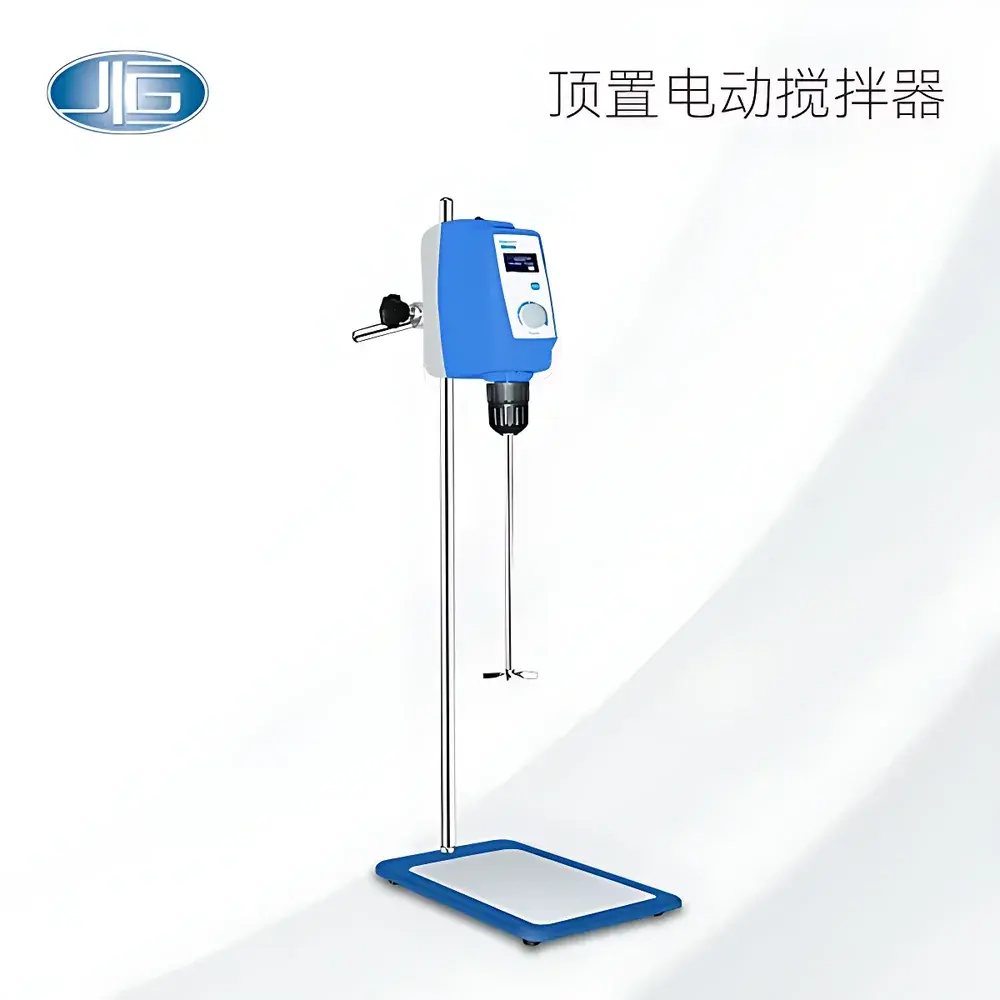
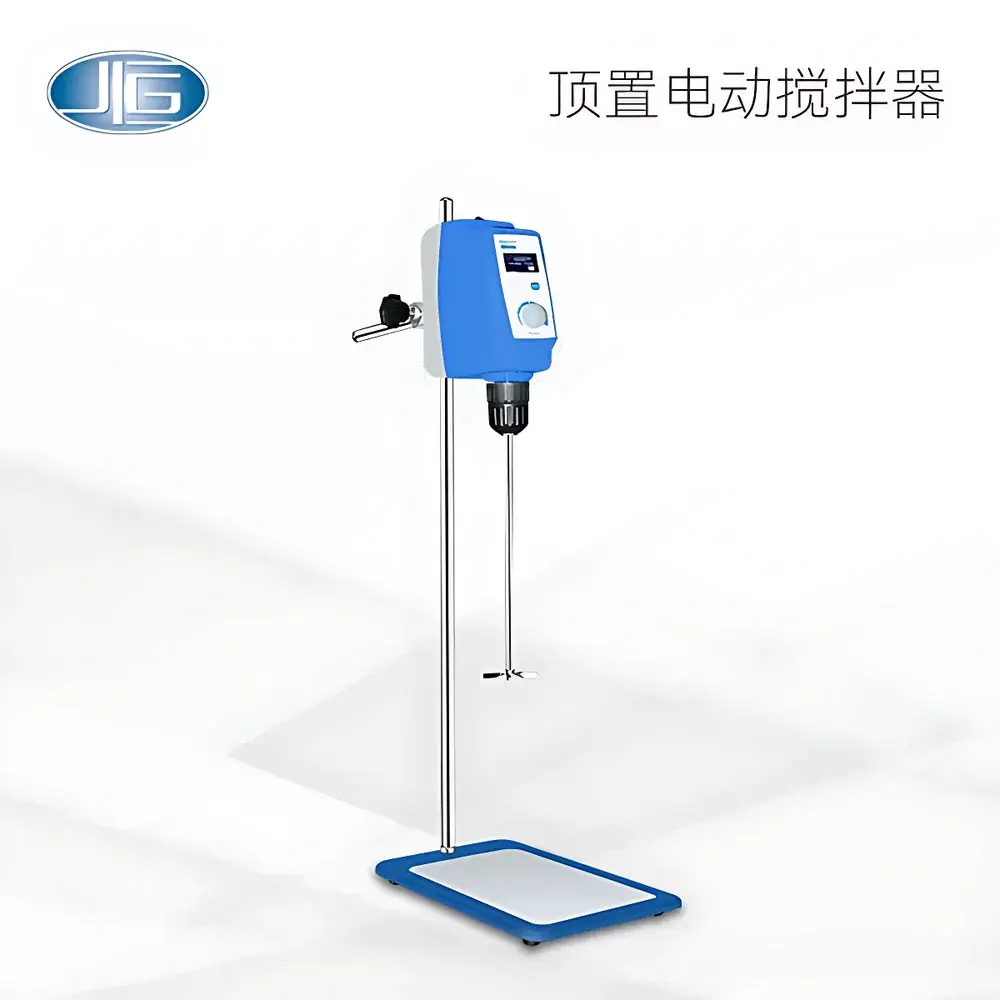
Yiheng BD50 / BD100 Top-Mount Electric Stirrer
| Brand | Yiheng |
|---|---|
| Origin | Shanghai, China |
| Manufacturer Type | Direct Manufacturer |
| Product Category | Domestic (China-made) |
| Model | BD50 / BD100 |
| Instrument Type | Electric Stirrer |
| Max. Mixing Volume | 20 L (BD50) / 40 L (BD100) |
| Speed Range | 30–2200 rpm |
| Motor Type | Brushless DC Motor |
| Interface | RS232 Serial Port |
| Safety Features | Overload, Overcurrent, Overtemperature Protection |
| Accessories Included | Protective Sleeve for Chuck, Safety Clip, Non-slip Base Mat |
Overview
The Yiheng BD50 and BD100 Top-Mount Electric Stirrers are precision-engineered laboratory mixing systems designed for consistent, reproducible agitation of low- to medium-viscosity liquids in glass or stainless-steel vessels. Operating on the principle of direct-drive rotational torque transmission via a vertically aligned shaft, these stirrers deliver controlled hydrodynamic shear to facilitate homogeneous blending, dissolution, suspension stabilization, and temperature equilibration. Their top-mount configuration eliminates mechanical coupling constraints associated with magnetic stirrers—enabling reliable operation across wide volume ranges (up to 40 L for the BD100 model) and accommodating both narrow-neck and open-top containers. The brushless DC motor architecture ensures minimal electromagnetic interference, zero carbon dust generation, and extended service life under continuous duty cycles—critical for unattended overnight reactions or long-term QC batch processing.
Key Features
- High-resolution LCD display with intuitive menu-driven interface and rotary encoder control—enabling real-time monitoring and on-the-fly adjustment of speed (30–2200 rpm) and timer settings without interrupting operation.
- Digital closed-loop speed regulation with torque compensation: maintains setpoint accuracy ±1% across varying fluid viscosities and load conditions, eliminating drift during exothermic reactions or polymer dissolution.
- Top-access chuck design with integrated through-hole for rapid impeller exchange—no vertical repositioning of the drive head required; supports standard ISO 22679-compliant stirring rods (6–10 mm diameter) and custom geometries including paddle, propeller, and anchor types.
- IP20-rated sealed housing with splash-resistant front panel—prevents electrolyte ingress from accidental spills and protects internal electronics against corrosion in humid or solvent-rich environments.
- Multi-layer safety architecture: soft-start ramping (0–10 s adjustable), thermal cutoff at ≥85 °C, current-limiting circuitry (max. 3.5 A), and automatic shutdown with error code display upon overload or stall detection.
- Integrated self-locking chuck mechanism (imported high-tolerance collet) ensures axial runout <0.15 mm at full speed—minimizing vibration-induced vessel resonance and improving measurement repeatability in gravimetric or calorimetric workflows.
Sample Compatibility & Compliance
These stirrers are validated for use with aqueous buffers, organic solvents (e.g., ethanol, acetone, THF), dilute acid/base solutions, and low-concentration polymer dispersions (≤15% w/w). Vessel compatibility includes borosilicate glass (Duran®, Pyrex®), polypropylene, and 316 stainless-steel reactors up to 300 mm internal diameter. The system complies with IEC 61010-1:2010 for electrical safety in laboratory equipment and meets EMC requirements per CISPR 11 Group 1 Class B. While not certified for hazardous area use (ATEX/IECEx), its brushless motor and non-sparking design support operation in general-purpose chemical labs under ISO/IEC 17025-accredited quality management systems.
Software & Data Management
Equipped with an RS232 serial interface (DB9 female), the BD50/BD100 supports bidirectional communication with host PCs running Windows-based control software (supplied separately). This enables remote start/stop, programmable multi-step speed profiles, real-time logging of rotational speed and motor current (proxy for relative torque), and timestamped export to CSV for traceability. Audit trail functionality—including operator ID tagging and parameter change history—is configurable to align with FDA 21 CFR Part 11 requirements when deployed in GLP/GMP-regulated environments such as pharmaceutical stability testing or raw material qualification.
Applications
- Preparation of calibration standards and reference solutions in analytical chemistry labs (e.g., HPLC mobile phase blending, ICP-MS diluent homogenization).
- Controlled dissolution testing per USP using USP Apparatus 2 (paddle) configurations mounted on custom adapter plates.
- Cell culture media conditioning and pH buffer equilibration in bioprocessing R&D.
- Emulsion formation and nanoparticle dispersion in colloidal formulation studies (e.g., lipid nanoparticles, microemulsions).
- Accelerated aging experiments requiring sustained agitation under thermostatic bath immersion (with optional water-resistant mounting bracket).
FAQ
What is the maximum viscosity this stirrer can handle effectively?
While optimized for Newtonian fluids up to ~500 mPa·s (e.g., 1% CMC solution), performance depends on impeller geometry and vessel dimensions; for non-Newtonian or highly viscous systems (>1000 mPa·s), consult torque curves in the technical manual prior to selection.
Can the BD50/BD100 be integrated into automated lab platforms?
Yes—via RS232 command protocol (ASCII-based SCPI-like syntax); third-party integration with LabVIEW™, Python (pySerial), or PLC-based control systems is documented in the developer’s guide.
Is calibration required, and does it support metrological traceability?
Speed calibration is factory-performed using NIST-traceable tachometry; users may verify accuracy annually with an optical tachometer—no user-serviceable calibration potentiometers are present.
What maintenance is recommended for long-term reliability?
No scheduled lubrication or brush replacement is needed; periodic inspection of chuck grip integrity and cleaning of ventilation grilles with dry compressed air every 6 months is sufficient.
Are explosion-proof versions available?
Standard units are not rated for Class I Div 1 environments; however, custom intrinsically safe variants with barrier-protected motor drivers can be commissioned subject to minimum order quantity and lead time confirmation.
Related Products



