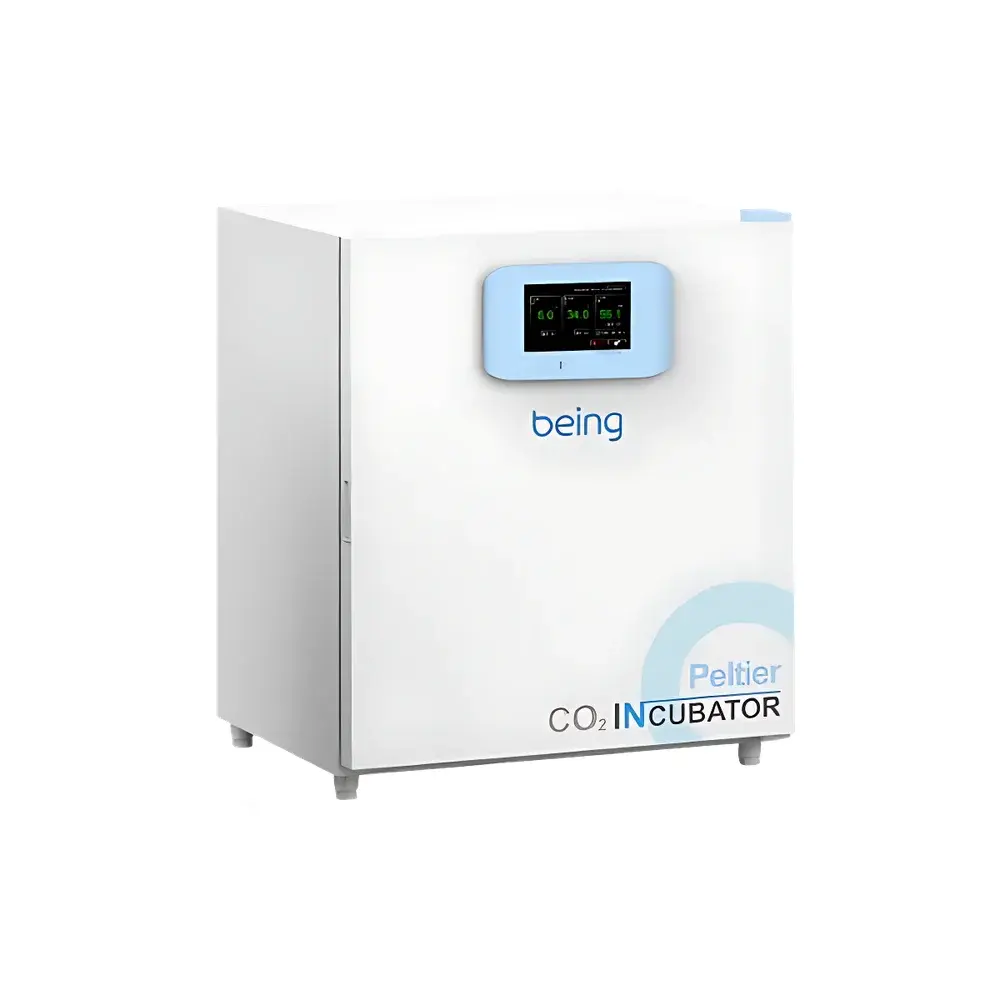
Yiheng BIO-300E Peltier-Cooled CO₂ Incubator with Integrated Humidity and O₂ Control
| Brand | Yiheng |
|---|---|
| Origin | Jiangsu, China |
| Manufacturer Type | Direct Manufacturer |
| Cooling Method | Thermoelectric (Peltier) |
| Temperature Range | 10–65 °C |
| Temperature Accuracy | ±0.1 °C |
| Temperature Uniformity | ≤±0.3 °C (@37 °C) |
| Chamber Dimensions (W×D×H) | 520×610×620 mm |
| External Dimensions (W×D×H) | 820×800×852 mm |
| CO₂ Sensor | NDIR Infrared (IR) |
| O₂ Control (Optional) | Zirconia-based Sensor, 1–90% O₂ |
| Humidity Control | Integrated Evaporative System |
| Sterilization | 90 °C High-Humidity Cycle |
| Filtration | Internal HEPA + CO₂ Inlet Microbial Filter (≥0.3 µm, 99.99% efficiency) |
| Data Interface | USB Port (standard), RS485 (optional) |
| Access Control | Three-Tier Permission Levels (Admin/Operator/Visitor) |
Overview
The Yiheng BIO-300E is a precision-engineered, thermoelectric-cooled CO₂ incubator designed for demanding life science applications requiring stable, low-temperature cell culture environments—particularly where ambient laboratory temperature fluctuates significantly or sub-physiological temperatures (down to 10 °C) are essential. Unlike conventional CO₂ incubators relying solely on resistive heating, the BIO-300E integrates bidirectional thermal control via solid-state Peltier modules, enabling active cooling without compressors, refrigerants, or oil-lubricated mechanical components. This architecture delivers superior energy efficiency—reducing power consumption by over 85% compared to compressor-based systems—while eliminating vibration transmission and condensation risks associated with traditional refrigeration cycles. The system maintains strict environmental control across temperature, CO₂ (0–20%), relative humidity (up to 95% RH), and optionally O₂ (1–90%), supporting diverse models including hypoxic, hyperoxic, and microaerophilic cultures. Its design adheres to core principles of GLP-compliant cell culture infrastructure: contamination mitigation, parameter traceability, and operational reproducibility.
Key Features
- Thermoelectric (Peltier) cooling system enabling precise 10–65 °C operation with ±0.1 °C accuracy and ≤±0.3 °C uniformity at 37 °C
- NDIR infrared CO₂ sensor with rapid recovery (<3 min to 5% setpoint after 30-sec door opening) and immunity to cross-sensitivity from humidity or temperature drift
- Zirconia-based O₂ sensor (optional) offering linear, long-life performance across 1–90% O₂ range for physiologically relevant oxygen modulation
- Integrated humidity control via evaporative water reservoir with real-time RH feedback; supports sustained high-humidity operation without condensation on optics or sensors
- 90 °C high-humidity sterilization cycle validated to eliminate bacteria, fungi, mycoplasma, and spores from internal surfaces, sensors, fans, and shelving—fully automated with one-touch initiation
- HEPA filtration (ISO Class 5 equivalent) within chamber airflow path plus microbial filter (≥0.3 µm, 99.99% retention) on CO₂ gas inlet line
- Six-sided heating with pre-heated inner glass door to prevent cold condensation and microbial ingress at the door seal interface
- Pt100 platinum resistance temperature sensor with independent ambient temperature monitoring for adaptive thermal compensation
Sample Compatibility & Compliance
The BIO-300E accommodates standard T-flasks (up to 175 cm²), multi-well plates, Petri dishes, and roller bottles within its 195 L usable chamber volume (520 × 610 × 620 mm). Its stainless-steel 304 interior—electrochemically passivated and featuring radius-corner construction—resists corrosion from repeated ethanol, hydrogen peroxide, and autoclave-grade disinfectants. All wetted components (including CO₂ sensor housing and humidity reservoir) are compatible with ISO 13485-aligned cleaning protocols. The unit complies with IEC 61010-1 (Safety Requirements for Laboratory Equipment) and supports audit-ready documentation for FDA 21 CFR Part 11 when paired with optional RS485 data logging and electronic signature-enabled software. It meets ASTM E1977-22 requirements for incubator performance verification and is suitable for USP cell therapy manufacturing environments when operated under defined SOPs.
Software & Data Management
The incubator features a 7-inch capacitive color touchscreen with intuitive menu navigation, bilingual (English/Chinese) UI, and password-protected access tiers: Administrator (full configuration), Operator (routine run control), and Visitor (view-only mode). All critical parameters—including temperature, CO₂, O₂ (if installed), RH, door status, sterilization cycle logs, and alarm history—are timestamped and stored internally. Data export is supported via USB flash drive in CSV format for offline analysis. Optional RS485 serial interface enables integration into centralized lab management systems (LIMS) or SCADA platforms, supporting Modbus RTU protocol for remote parameter readout and event-triggered alerts. Audit trails record user ID, timestamp, parameter change, and reason code—meeting GLP/GMP data integrity requirements for regulated workflows.
Applications
- Low-temperature mammalian cell culture (e.g., primary neurons, chondrocytes, adipocytes) requiring extended incubation below 37 °C
- Hypoxia research using controlled O₂ gradients (1–5% O₂ for stem cell expansion; <1% for ischemia modeling)
- Microbial culture of psychrotolerant strains and cryopreserved bacterial stocks
- Co-culture systems requiring differential thermal setpoints across compartments (e.g., epithelial–immune cell interfaces)
- Bioprocess development for biologics where temperature ramping profiles impact protein folding and secretion kinetics
- Regenerative medicine workflows involving mesenchymal stromal cells (MSCs) under normoxic vs. hypoxic preconditioning
FAQ
Does the Peltier cooling system require routine maintenance or refrigerant replenishment?
No. The solid-state thermoelectric modules contain no moving parts, lubricants, or volatile refrigerants—eliminating scheduled servicing beyond periodic calibration verification and filter replacement.
Can the 90 °C sterilization cycle damage the CO₂ or O₂ sensors?
No. Both NDIR CO₂ and zirconia O₂ sensors are rated for continuous operation up to 95 °C and are thermally isolated during the sterilization sequence to preserve long-term stability.
Is the humidity control system capable of maintaining >95% RH without condensation?
Yes. The evaporative humidification system employs dynamic vapor pressure regulation and chamber-wall temperature mapping to suppress dew-point formation—even at 95% RH and 37 °C.
How does the system ensure CO₂ concentration stability during frequent door openings?
The IR sensor’s millisecond-level response time, coupled with a high-flow gas injection manifold and optimized chamber air circulation, achieves <3-minute recovery to setpoint following standardized 30-second door-open events.
What cybersecurity measures are implemented for the optional App-based remote monitoring?
Remote access uses TLS 1.2–encrypted MQTT communication with device-specific authentication tokens; no default credentials are shipped, and all firmware updates require signed digital signatures verified at boot.