
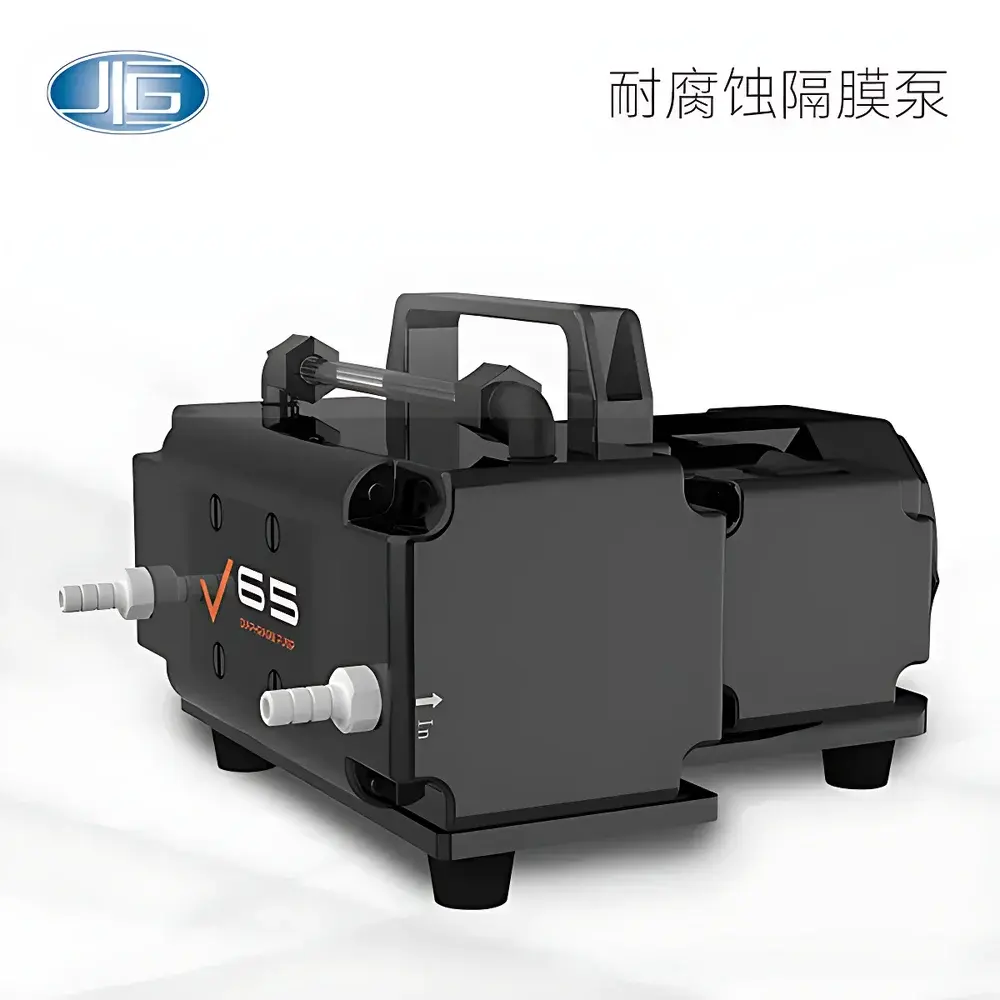
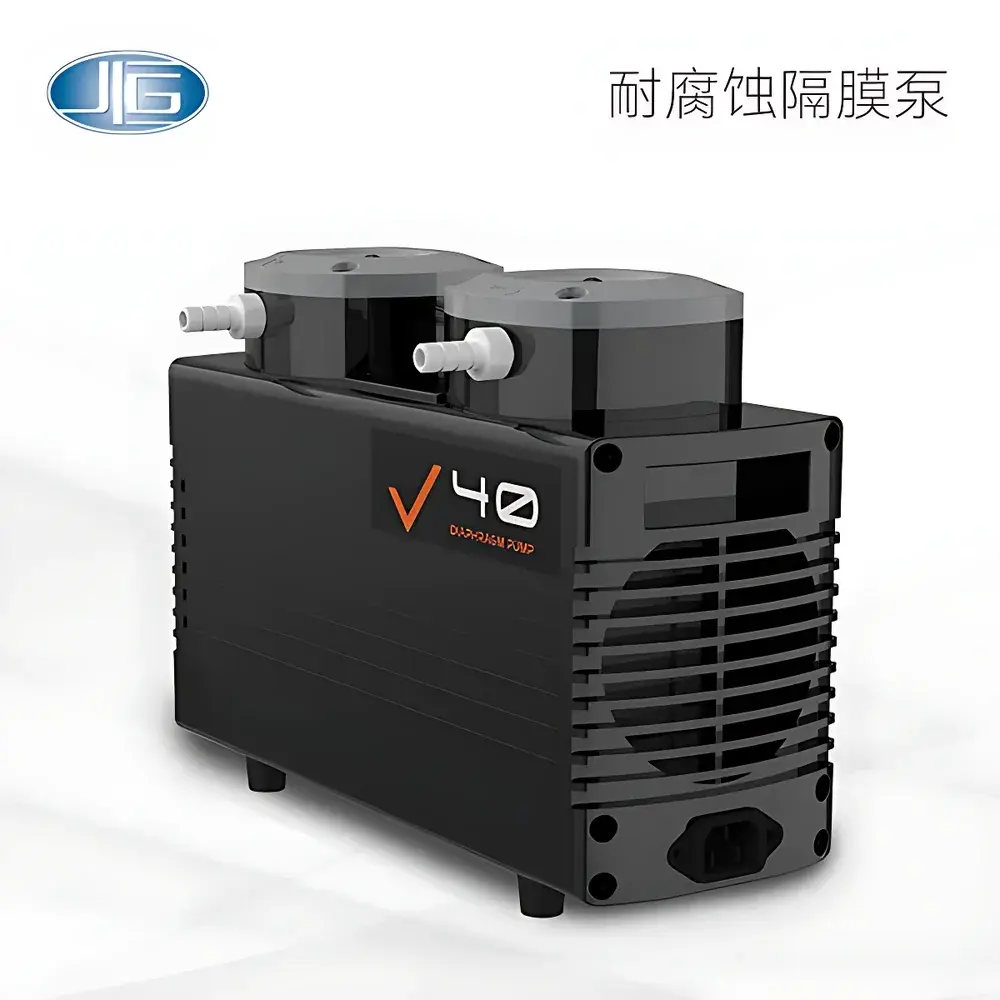
Yiheng VB-Series Corrosion-Resistant Diaphragm Vacuum Pump
| Brand | Yiheng |
|---|---|
| Origin | Jiangsu, China |
| Manufacturer Type | Direct Manufacturer |
| Origin Category | Domestic (China) |
| Models | VB-20 / VB-40 / VB-65 |
| Pricing Range | USD 1,050 – 2,400 (FOB) |
| Pump Type | Diaphragm Vacuum Pump |
| Oil-Free Design | Yes |
| Ultimate Vacuum | 15–20 mbar (abs) |
| Pumping Speed | 20 L/min (VB-20), 40 L/min (VB-40), 65 L/min (VB-65) |
| Motor Power | 120 W / 240 W / 400 W |
| Net Weight | 9.6 kg (VB-20), 11.2 kg (VB-40), 13.8 kg (VB-65) |
| Dimensions | See Technical Datasheet |
| Certifications | CE, ISO 9001, RoHS Compliant |
Overview
The Yiheng VB-Series Corrosion-Resistant Diaphragm Vacuum Pump is an engineered solution for laboratories and pilot-scale facilities requiring reliable, oil-free vacuum generation in chemically aggressive environments. Unlike conventional rotary vane or water aspirator pumps, the VB-Series employs a sealed, dry diaphragm displacement mechanism—eliminating lubricants, condensate traps, and vapor backstreaming risks. Its core operational principle relies on reciprocating PTFE-coated elastomeric diaphragms driven by precision-matched eccentric shafts, generating consistent volumetric flow under variable inlet pressure conditions. Designed specifically for continuous duty in analytical chemistry, solvent recovery, vacuum filtration, rotary evaporation, and inert gas purging applications, this pump meets the functional demands of ISO/IEC 17025-accredited labs where trace contamination, maintenance downtime, and chemical compatibility are critical constraints.
Key Features
- Chemical resistance architecture: All gas-path components—including diaphragm (PTFE-laminated EPDM), valve plates, pump head housing, inlet/outlet fittings, and internal tubing—are constructed from or fully lined with high-purity, USP Class VI-certified PTFE. This ensures compatibility with HCl, HNO₃, HF (dilute), Cl₂, SO₂, organic halides, esters, ketones, and mixed-solvent vapors.
- Hermetically isolated drive train: The motor assembly features corrosion-inhibiting coatings on stator windings, encapsulated PCBs, and airtight housing gaskets. No exposed copper, steel, or aluminum surfaces contact ambient laboratory air—enabling stable operation even in fume hood sumps or humid corrosive atmospheres.
- Multi-stage sealing system: Three independent dynamic seals per diaphragm chamber (primary diaphragm seal, secondary valve seat interface, tertiary housing O-ring) minimize gas leakage and extend service life beyond 12,000 operating hours—validated per ASTM D412 tensile fatigue testing of diaphragm material.
- Thermal safety integration: Each unit incorporates a bimetallic thermal cutoff switch (resettable, Class B insulation rating) that interrupts power at ≥95 °C internal temperature. Automatic restart occurs only after passive cooling to ≤65 °C, ensuring compliance with IEC 61000-4-11 voltage dip immunity requirements.
- Low-noise, low-vibration operation: Direct-coupled brushless DC motor design eliminates gearboxes and belts. Typical sound pressure level: 48–52 dBA at 1 m (per ISO 3744); vibration amplitude < 1.2 mm/s RMS (ISO 10816-1).
Sample Compatibility & Compliance
The VB-Series is validated for use with corrosive and condensable process gases across pH 0–14 and vapor pressures up to 200 mbar (e.g., methanol, THF, dichloromethane, acetic acid). It complies with EN 61000-6-3 (EMC emission limits), EN 61000-6-2 (immunity), and carries CE marking under the EU Machinery Directive 2006/42/EC. For regulated environments, its closed-loop design supports 21 CFR Part 11-compliant data logging when paired with optional analog/digital output modules (0–10 V / 4–20 mA / RS485 Modbus RTU). All models conform to GLP documentation standards for maintenance logs, calibration intervals, and failure mode tracking.
Software & Data Management
While the base VB-Series operates as a standalone analog device, optional digital control modules enable integration into centralized lab infrastructure. Firmware-upgradable controllers support real-time monitoring of motor current draw, runtime hours, thermal status, and vacuum setpoint deviation. Logged data (CSV export via USB or Ethernet) includes timestamps, vacuum stability metrics (±0.5 mbar over 60 min), and thermal event history—facilitating root-cause analysis during QA audits. Audit trails meet ALCOA+ principles (Attributable, Legible, Contemporaneous, Original, Accurate, Complete, Consistent, Enduring, Available).
Applications
- Vacuum-assisted solvent recovery in rotary evaporators handling chlorinated or acidic reaction mixtures
- Acid digestion fume extraction in ICP-MS sample preparation workflows
- PTFE-lined filtration manifolds for pharmaceutical API crystallization under inert atmosphere
- Gas sampling systems for stack emissions monitoring (H₂S, NOₓ, VOCs)
- Enclosed glovebox purge cycles requiring hydrocarbon-free vacuum integrity
FAQ
Is the VB-Series suitable for vacuum drying ovens containing acidic vapors?
Yes—provided oven exhaust is routed through a cold trap to prevent condensate ingress; the pump’s PTFE-wetted path tolerates intermittent exposure to HCl/HF vapors below 60 °C.
Does it require periodic oil changes or filter replacements?
No—this is a true oil-free, maintenance-free design. Only annual visual inspection of diaphragm integrity and inlet filter cleaning (if installed externally) is recommended.
Can multiple VB units be manifolded for higher throughput?
Yes—parallel configuration is supported using stainless-steel vacuum manifolds with individual isolation valves and calibrated orifice plates to balance flow distribution per ISO 21873.
What is the expected service life under continuous 24/7 operation?
Based on accelerated life testing (IEC 60068-2-64), mean time between failures exceeds 18,000 hours at 70% load, assuming ambient temperature ≤35 °C and relative humidity ≤80% non-condensing.
Is firmware update capability available for field calibration adjustments?
Yes—via secure USB interface using Yiheng Calibration Suite v3.2 (Windows/Linux), supporting user-defined vacuum ramp profiles and PID parameter tuning within defined regulatory boundaries.



