
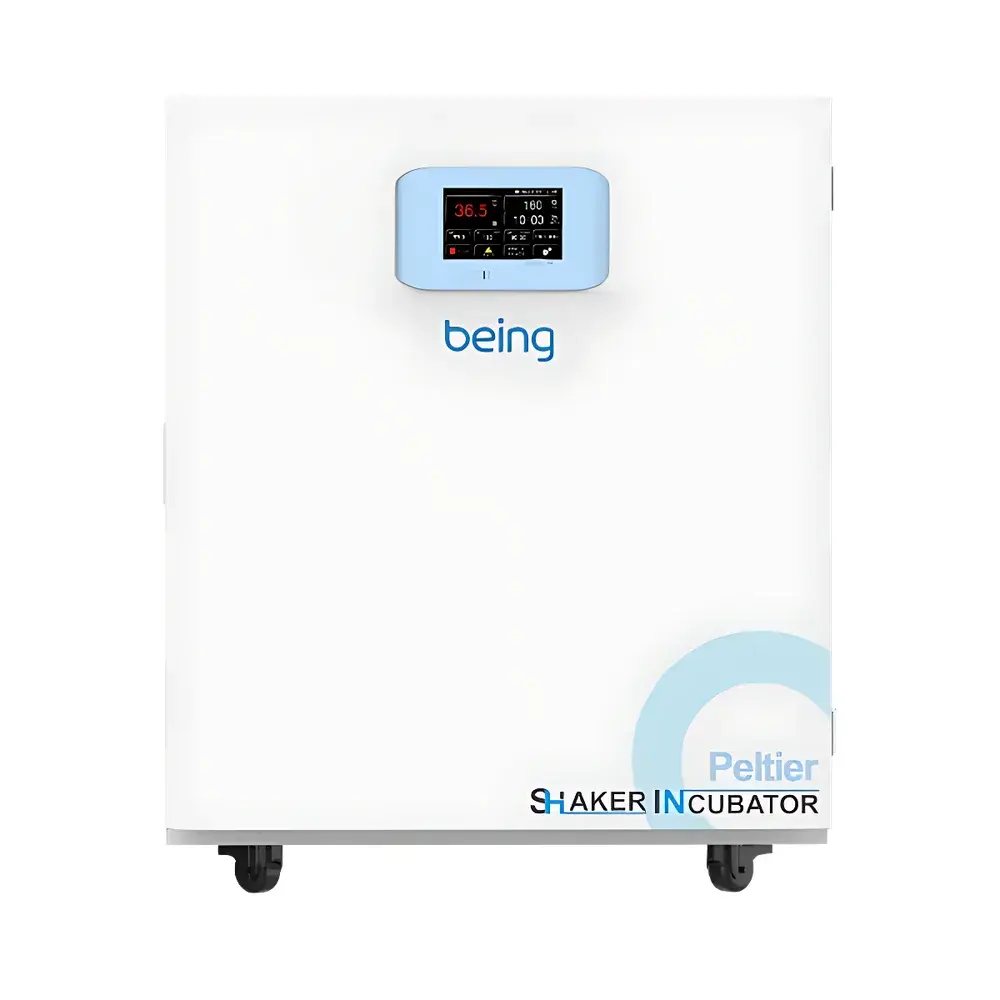
YiHeng BSI-9E Peltier-Cooled Orbital Shaking Incubator
| Brand | YiHeng |
|---|---|
| Origin | Jiangsu, China |
| Manufacturer Type | OEM Manufacturer |
| Country of Origin | China |
| Model | BSI-9E |
| Cooling Method | Peltier Thermoelectric Cooling |
| Temperature Range | 10–65 °C |
| Temperature Accuracy | ±0.2 °C |
| Temperature Uniformity | ≤±0.5 °C (@37 °C) |
| Chamber Dimensions (W×D×H) | 420×480×610 mm |
| External Dimensions (W×D×H) | 725×680×800 mm |
Overview
The YiHeng BSI-9E Peltier-Cooled Orbital Shaking Incubator integrates precise temperature control with consistent orbital agitation in a single compact platform, engineered for demanding life science applications requiring simultaneous thermal regulation and mechanical stimulation. Unlike conventional compressor-based incubators, the BSI-9E employs solid-state Peltier thermoelectric modules for bidirectional (heating and cooling) temperature management—enabling rapid thermal response, high energy efficiency, and silent operation without refrigerant gases or moving compressors. Its orbital shaking mechanism utilizes a three-eccentric-axis balanced drive system to ensure uniform motion distribution across the entire platform, minimizing vibration-induced shear gradients and supporting reproducible culture conditions for sensitive biological samples. Designed for GLP-compliant laboratories, the unit maintains stable setpoints under variable ambient conditions and supports continuous unattended operation—critical for long-term microbial fermentation, suspension cell expansion, enzyme kinetics assays, and hybridization protocols.
Key Features
- Intelligent touchscreen interface with dual-language (English/Chinese) menu navigation and password-protected parameter locking to prevent unauthorized modifications
- Microprocessor-based PID control for independent regulation of temperature (10–65 °C), shaking speed (20–300 rpm), and time (1 min–999 h), with real-time display of both set and actual values
- Peltier cooling technology reduces power consumption by >85% compared to equivalent compressor-cooled units, eliminating CFCs and minimizing heat dissipation into laboratory environments
- Stainless steel 304 interior chamber with radius-rounded corners and seamless welding for easy decontamination and compliance with ISO 14644 cleanroom-compatible maintenance practices
- Dual-stage overtemperature protection: primary PID-controlled heating cutoff + secondary independent mechanical thermostat with audible/visual alarm
- Low-heat, brushless DC motor with high starting torque and wide-speed range ensures maintenance-free operation over extended cycles—even at maximum load and speed
- Integrated UV germicidal lamp (254 nm) for periodic chamber sterilization, reducing airborne microbial contamination during cell culture workflows
- Configurable multi-segment programming for synchronized ramping of temperature, speed, and duration—supporting complex cultivation protocols such as diauxic shifts or temperature-triggered protein expression
Sample Compatibility & Compliance
The BSI-9E accommodates standard culture vessels including Erlenmeyer flasks (50–2000 mL), deep-well plates, test tubes, and custom bioreactor bags via interchangeable stainless steel or autoclavable polymer clamps and shelf adapters. Its chamber geometry (420 × 480 × 610 mm) allows up to 12 × 1000 mL flasks at 25 mm orbital diameter. The unit complies with IEC 61010-1:2010 safety standards for laboratory equipment and incorporates electrical protections including overcurrent, overtemperature, and overload safeguards on all critical circuits. Optional RS485 serial interface supports integration into centralized lab monitoring systems compliant with FDA 21 CFR Part 11 requirements when paired with validated data logging software. Internal UV irradiation cycles meet ASTM E3134-18 guidelines for surface disinfection validation in controlled environments.
Software & Data Management
Standard USB port enables direct data export to USB flash drives—including runtime logs (temperature, speed, time stamps), alarm history, and program execution records—with CSV formatting compatible with Excel, MATLAB, and LIMS platforms. An optional RS485 interface permits remote readout and configuration via Modbus RTU protocol, enabling integration into facility-wide SCADA or ELN ecosystems. Firmware supports audit trail functionality with timestamped user login events, parameter changes, and alarm acknowledgments—essential for GMP/GLP traceability. When equipped with the optional mobile application module, users receive push notifications upon fault detection (e.g., door open, temperature deviation >±1 °C, motor stall), allowing immediate remote diagnostics and intervention without physical access.
Applications
The BSI-9E is routinely deployed in academic research labs, biopharmaceutical QC/QA facilities, and contract development organizations for: aerobic microbial growth studies (E. coli, yeast, Bacillus spp.), mammalian suspension cell line expansion (CHO, HEK293), plasmid amplification, phage propagation, enzymatic reaction optimization, immunoassay plate shaking, and environmental microbiology enrichment cultures. Its tight temperature uniformity (≤±0.5 °C at 37 °C) and low-speed precision make it suitable for delicate embryoid body formation and organoid differentiation protocols where thermal drift or mechanical stress may compromise developmental fidelity. Optional light-intensity control (0–10,000 lux, 400–700 nm spectrum) further extends utility to photobioreactor simulations and circadian rhythm investigations.
FAQ
Does the BSI-9E support validation documentation (IQ/OQ/PQ)?
Yes—YiHeng provides standardized qualification templates aligned with ISO/IEC 17025 and ASTM E2500-22, including sensor calibration certificates traceable to NIST standards.
Can the unit operate continuously for 7+ days without interruption?
Affirmative—the brushless motor, Peltier thermal architecture, and redundant thermal safeguards are validated for uninterrupted 24/7 operation under nominal load conditions.
Is the UV lamp intensity calibrated and monitored?
The integrated UV-C source operates at fixed 254 nm output; intensity verification is performed during factory acceptance testing using calibrated radiometers per ISO 15858.
What safety certifications does the BSI-9E hold?
It carries CE marking per Directive 2014/30/EU (EMC) and 2014/35/EU (LVD), and conforms to RoHS 2011/65/EU material restrictions.
How is data integrity ensured during power failure?
All user-defined programs and runtime parameters are retained in non-volatile memory; upon power restoration, the system resumes the last active protocol without manual reconfiguration.




