
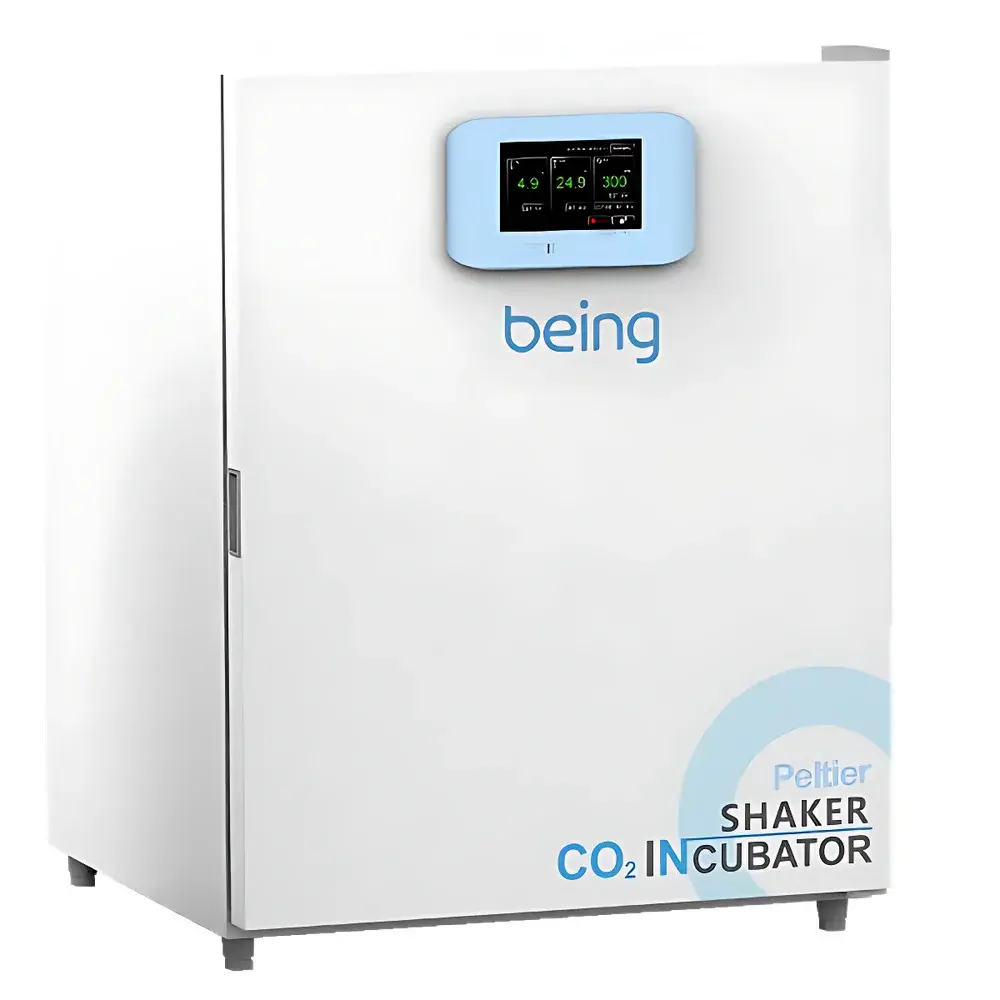
Yiheng BIO-100E Peltier-Cooled CO₂ Incubator
| Brand | Yiheng |
|---|---|
| Origin | Jiangsu, China |
| Manufacturer Type | Direct Manufacturer |
| Country of Origin | China |
| Model | BIO-100E |
| Cooling Method | Thermoelectric (Peltier) |
| Temperature Range | 10–65 °C |
| Temperature Accuracy | ±0.1 °C |
| Temperature Uniformity | ≤ ±0.3 °C (@ 37 °C) |
| Chamber Dimensions (W×D×H) | 420 × 480 × 610 mm |
| External Dimensions (W×D×H) | 725 × 680 × 800 mm |
| CO₂ Sensing | Infrared (IR) Sensor |
| Humidity Control | Integrated Active Humidity Regulation |
| Sterilization | 90 °C High-Humidity Chamber Sterilization |
| Filtration | Internal HEPA Filter (ISO Class 5 equivalent), CO₂ Inlet Microbial Filter (≥0.3 µm, 99.99% efficiency) |
| Compliance | Designed for GLP-compliant cell culture workflows |
Overview
The Yiheng BIO-100E Peltier-Cooled CO₂ Incubator is an engineered platform for precision-controlled, low-temperature mammalian cell culture under regulated CO₂, O₂ (optional), and humidity conditions. Unlike conventional CO₂ incubators limited by ambient temperature dependency, the BIO-100E integrates solid-state thermoelectric (Peltier) cooling with high-stability resistive heating to achieve bidirectional thermal regulation across a broad operational range (10–65 °C). This architecture eliminates reliance on vapor-compression refrigeration—reducing mechanical complexity, acoustic noise, and long-term maintenance overhead—while delivering superior energy efficiency: power consumption during active cooling is reduced by >85% compared to compressor-based equivalents. The chamber employs six-sided heating with preheated air distribution to suppress condensation on the inner glass door, mitigating microbial colonization risk. All thermal, gaseous, and hygric parameters are continuously monitored via calibrated Pt100 temperature sensors, dual-beam infrared CO₂ sensors, and capacitive humidity transducers—ensuring traceable, reproducible environmental control essential for sensitive primary cell lines, stem cells, and co-culture models.
Key Features
- Thermoelectric (Peltier) cooling system enabling stable sub-ambient operation without refrigerants or compressors
- Infrared CO₂ sensor with fast recovery kinetics: returns to setpoint (e.g., 5% CO₂) within ≤3 minutes after 30-second door opening
- Optional zirconia-based O₂ sensor for hypoxic (1–5% O₂), normoxic (21% O₂), or hyperoxic (up to 90% O₂) cultivation protocols
- Integrated 90 °C high-humidity sterilization cycle—validated to eliminate mycoplasma, bacteria, and fungal spores across all internal surfaces, including sensors, fans, and stainless-steel shelves
- Chamber constructed from electropolished 304 stainless steel with radius-corner geometry and electrochemical passivation for corrosion resistance and cleanability
- Multi-layer polyurethane foam insulation with seamless cavity injection for thermal integrity and minimal heat leakage
- Full-color capacitive touchscreen interface with password-protected user tiers (Administrator / Operator / Guest) and configurable access permissions
- Dual independent monitoring: real-time chamber environment + ambient room temperature feedback loop for adaptive thermal compensation
Sample Compatibility & Compliance
The BIO-100E supports diverse biological samples requiring strict environmental fidelity—including human iPSCs, organoids, 3D spheroids, and anaerobic/microaerophilic bacterial cultures (when configured with O₂ control). Its chamber design accommodates standard tissue culture flasks (T25–T225), multi-well plates (6–96-well), Petri dishes, and roller bottles. All materials in direct contact with the culture environment meet USP Class VI biocompatibility requirements. The incubator complies with ISO 13408-1 (aseptic processing), EN 61000-6-3 (EMC emissions), and IEC 61010-1 (safety for laboratory equipment). When equipped with RS485 connectivity and validated firmware, it supports ALCOA+ data integrity principles and fulfills technical prerequisites for FDA 21 CFR Part 11 compliance—including electronic signatures, audit trails, and immutable data export.
Software & Data Management
Local operation is managed through an embedded Linux-based controller with intuitive menu navigation and multilingual UI (English/Chinese). Real-time parameter logging is stored internally and exportable via USB flash drive in CSV format. Optional RS485 serial communication enables integration into centralized lab management systems (LIMS) or SCADA platforms using Modbus RTU protocol. Logged data includes timestamped values for temperature, CO₂, O₂ (if installed), relative humidity, door-open events, alarm triggers, and sterilization cycle status. Audit trail records all configuration changes, user logins, and critical event timestamps—retained for ≥180 days with automatic overwrite protection. Remote monitoring and alerting are available via optional cloud-enabled mobile application, transmitting push notifications for out-of-specification conditions or system faults.
Applications
- Long-term maintenance of temperature-sensitive stem cell lines under defined hypothermic conditions (e.g., 32–34 °C)
- Low-temperature CO₂-dependent bacterial culture (e.g., Campylobacter jejuni, Helicobacter pylori) requiring precise microaerobic control
- Co-culture experiments demanding simultaneous regulation of CO₂, O₂, and humidity gradients
- Pre-clinical biopreservation studies evaluating viability at sub-physiological temperatures
- Quality control testing of cryopreserved cell banks post-thaw expansion under stabilized gas environments
- GLP-regulated toxicology assays where environmental deviation must be documented and justified
FAQ
Does the BIO-100E require external water supply for humidity control?
No—the integrated ultrasonic humidifier operates autonomously using a removable 2.5 L reservoir; no plumbing connection is needed.
Can the incubator maintain CO₂ concentration during sterilization cycles?
CO₂ supply is automatically isolated during the 90 °C sterilization cycle; gas regulation resumes only after chamber cooldown and validation of safe operating conditions.
Is the IR CO₂ sensor factory-calibrated and field-serviceable?
Yes—the dual-beam IR sensor is NIST-traceably calibrated at manufacture and supports user-initiated zero-point verification using ambient air; full recalibration is performed by authorized service technicians.
What safety interlocks prevent thermal or gaseous excursions?
Independent hardware-limiting circuitry disables heating if chamber temperature exceeds user-defined thresholds; CO₂ solenoid valves close upon loss of sensor signal or sustained deviation >±0.5% from setpoint.
How is data integrity ensured during power interruption?
Non-volatile memory preserves all logged parameters and configuration settings; system boots into safe mode with alarms until manual confirmation, preventing unverified parameter resumption.




