
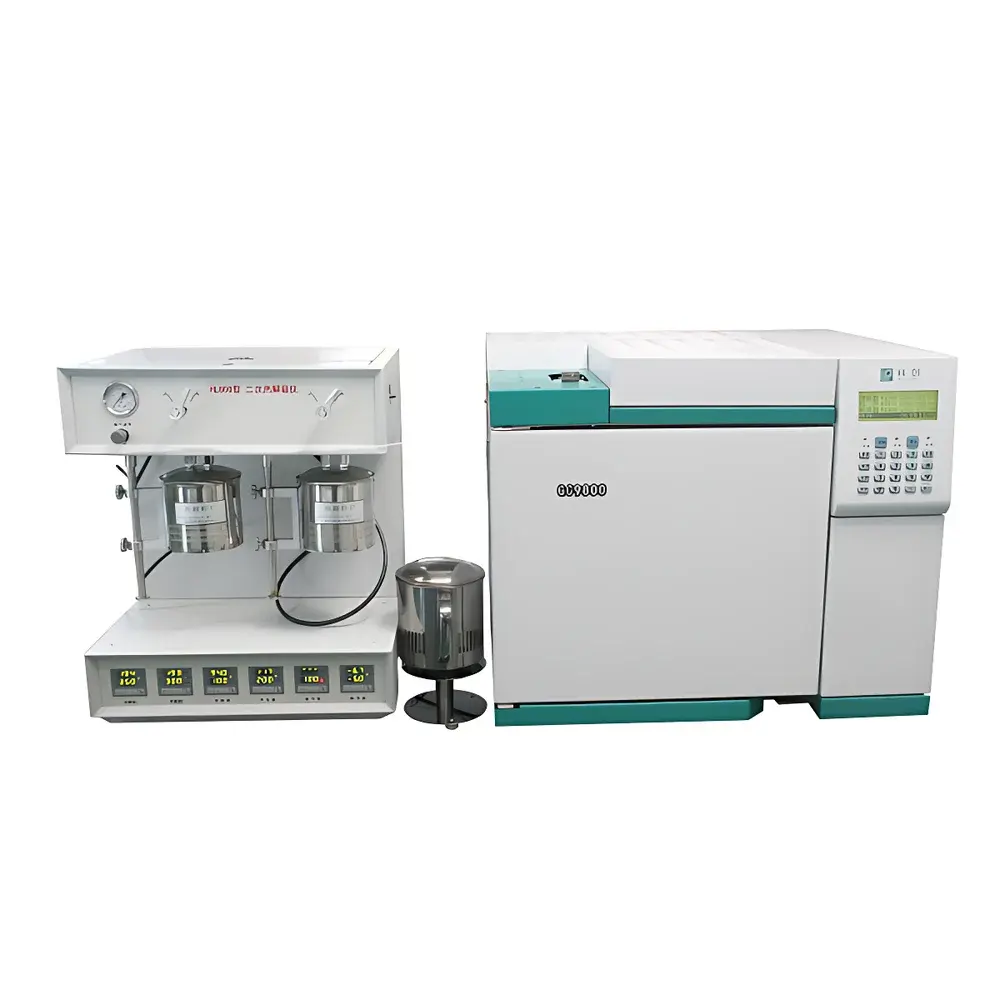
Shanghai Kechuang GC9800 Micro-BTEX & Total Hydrocarbon/Methane Gas Chromatograph
| Brand | Shanghai Kechuang |
|---|---|
| Model | GC9800 |
| Instrument Type | Laboratory Gas Chromatograph |
| Application Domain | High-Purity Gas Analysis (Food-Grade CO₂, Beverage & Brewing Gases) |
| Oven Temperature Range | Ambient + 8 °C to 400 °C |
| Ramp Rate | 0.1–40 °C/min |
| Cool-down Rate | 400 °C → 50 °C in ≤4 min |
| Carrier Gas Flow Control Range | 0–100 mL/min |
| Carrier Gas Pressure Control Range | 0–250 kPa |
| Injector Max Temp | 300 °C |
| Injector Pressure Setpoint Range | 0–250 kPa |
| Injector Total Flow Setpoint Range | 0–1200 mL/min |
| FID Detection Limit (n-Hexadecane) | ≤8.0×10⁻¹² g/s |
| FID Baseline Noise | ≤1×10⁻¹³ A |
| FID Baseline Drift | ≤7×10⁻¹³ A/30 min |
| FID Linear Dynamic Range | 10⁷ |
| Benzene LOD (v/v) | ≤0.010×10⁻⁶ |
| Total Hydrocarbons LOD | ≤0.2×10⁻⁶ |
| Non-Methane Hydrocarbons LOD | ≤0.1×10⁻⁶ |
| Methane LOD | ≤0.1×10⁻⁶ |
Overview
The Shanghai Kechuang GC9800 is a dedicated laboratory gas chromatograph engineered for trace-level hydrocarbon analysis in high-purity industrial and food-grade gases—particularly carbon dioxide used in beverage carbonation, brewing, tobacco processing, and food preservation. It operates on the principle of capillary gas chromatography with flame ionization detection (GC-FID), optimized for quantitative determination of benzene (BTEX), total hydrocarbons (THC), non-methane hydrocarbons (NMHC), and methane (CH₄) at sub-ppb to low-ppm levels. The system meets stringent analytical requirements defined by international food safety standards—including alignment with The Coca-Cola Company’s specification for benzene in food-grade CO₂ (≤0.01 v/v ppm)—and supports compliance with ISO 8573-5 (compressed air purity), ASTM D1945 (gas analysis), and USP (packaging materials). Its modular configuration allows seamless transition between single-analyte validation and multi-parameter regulatory testing within one platform.
Key Features
- Full microprocessor-based control architecture with Ethernet (10/100 MBase-T) connectivity, enabling remote instrument supervision, data acquisition, and centralized fleet management across up to 253 units from a single workstation.
- Advanced thermal management: 8-step programmable column oven with ambient+8 °C near-room-temperature capability, rapid cooling (400 °C → 50 °C in ≤4 min), and independent six-zone temperature control (oven, two injectors, three detectors).
- Dual-inlet configuration options: Thermal desorption inlet for ultra-trace benzene analysis (≤0.001 v/v ppm LOD); 10-port valve with dual fixed-volume loop sampling for parallel THC/NMHC/CH₄ quantification using dual-column separation.
- Integrated digital signal output via embedded chromatography workstation; raw analog signals are digitized onboard and transmitted directly over standard network infrastructure—eliminating external ADC hardware and ensuring timestamped, audit-ready data streams.
- Comprehensive self-diagnostic firmware with real-time fault logging (e.g., heater failure, pressure sensor drift, detector saturation) and cascaded over-temperature protection: automatic power cutoff if any controlled zone exceeds user-defined setpoints.
Sample Compatibility & Compliance
The GC9800 is validated for gaseous matrices with minimal moisture and particulate content, including liquid-phase vaporized CO₂, nitrogen, argon, and synthetic air. Sample introduction conforms to ISO 8573-1 Class 2 purity requirements. For food-grade CO₂ analysis, the system satisfies both Chinese GB 10621–2006 and U.S. FDA 21 CFR Part 11 expectations for electronic records integrity when paired with compliant software configurations. All method parameters—including retention time locking, peak area reproducibility (RSD ≤5% for benzene at 0.01 ppm), and calibration linearity (r² ≥0.9995 over 0.005–1.0 ppm)—are documented per GLP/GMP-aligned validation protocols. Regulatory traceability is supported through configurable audit trails, user-access controls, and electronic signature workflows.
Software & Data Management
Control and data processing are performed using a Windows-based chromatography data system (CDS) compliant with 21 CFR Part 11 Annex 11 principles. The software provides full method development tools—including gradient timing, valve event sequencing, and detector parameter optimization—as well as automated report generation with customizable templates for ISO/IEC 17025-accredited laboratories. Raw data files (.raw or .cdf format) are stored with immutable metadata (instrument ID, operator login, environmental conditions, calibration history). Network deployment enables centralized database archiving, role-based permissions, and integration with LIMS platforms via ODBC or RESTful API endpoints. All chromatograms include embedded calibration curve references and QC flagging for out-of-spec results.
Applications
- Quantitative benzene monitoring in food-grade CO₂ supplies to meet Coca-Cola, PepsiCo, and EFSA specifications (≤10 ppb v/v).
- Regulatory testing of non-methane hydrocarbons in compressed breathing air per ISO 8573-5 and OSHA 29 CFR 1910.134.
- Process gas purity verification in semiconductor manufacturing nitrogen lines (THC <0.1 ppm).
- Environmental emissions screening of landfill and biogas streams for CH₄/NMHC ratios.
- Method transfer and routine QC in contract testing labs serving beverage, pharmaceutical excipient, and cryogenic gas industries.
FAQ
What detection technologies does the GC9800 support for hydrocarbon analysis?
The system exclusively employs flame ionization detection (FID) with factory-calibrated sensitivity and linear response across seven orders of magnitude. Optional TCD or PID modules are not supported in this configuration.
Can the GC9800 analyze benzene and methane simultaneously in a single run?
Yes—via the dual-column, ten-port valve configuration with backflush capability, enabling concurrent resolution of C₁–C₆ aliphatics and aromatic compounds without cross-interference.
Is the instrument compatible with third-party LIMS or ELN systems?
Yes—through standardized data export (CSV, XML, CDF) and optional API integration modules supporting HL7, ASTM E1384, and ANSI/NIST ITL 100-2 compliance.
Does the GC9800 meet FDA 21 CFR Part 11 requirements out-of-the-box?
It supports Part 11 compliance when deployed with the validated CDS version, configured user authentication, electronic signatures, and audit trail activation—all documented in the system validation package.
What maintenance intervals are recommended for sustained performance?
FID jet cleaning every 200 injections; column trimming every 6 months or after 500 injections; carrier gas filter replacement quarterly; annual preventive maintenance including leak testing, pressure calibration, and detector gain verification.
Related Products




