
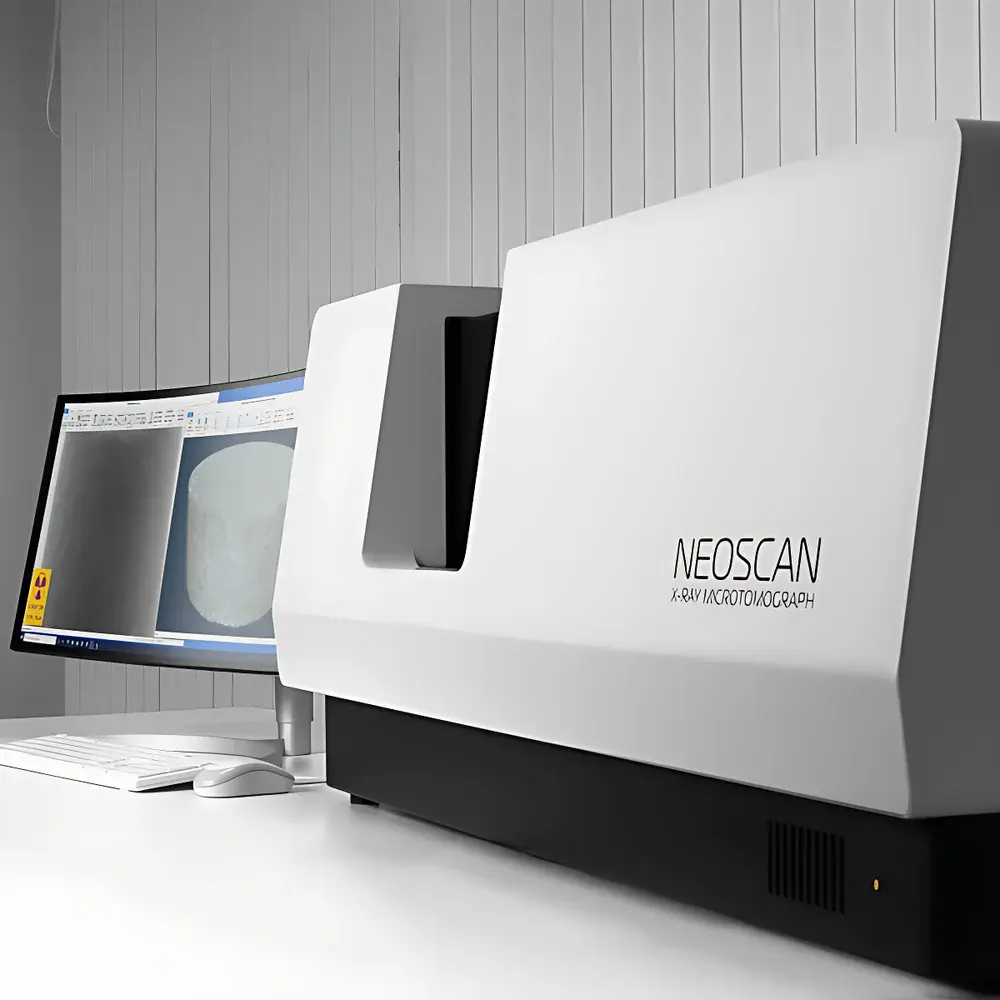
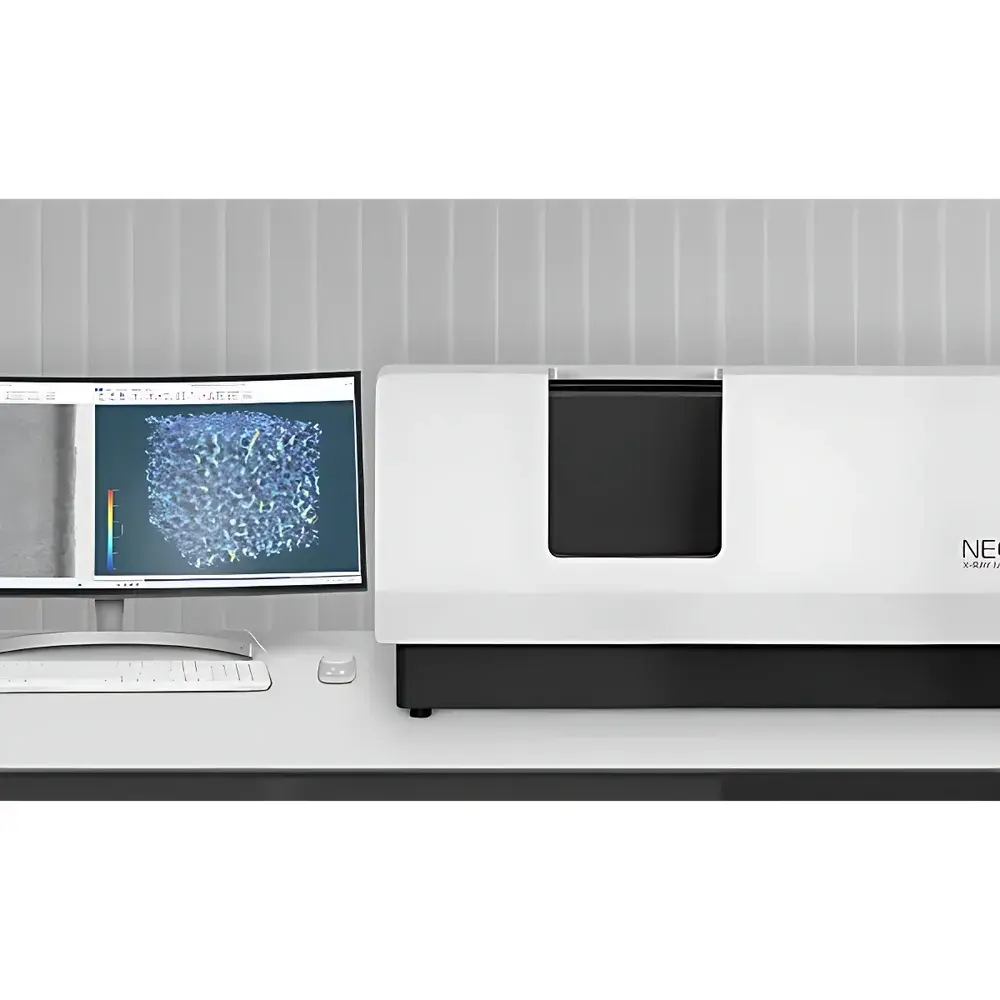
Neoscan N80 High-Resolution Desktop Micro-CT System for Sample Preparation Industries
| Brand | Neoscan |
|---|---|
| Origin | Belgium |
| Detector Type | Flat-Panel Detector |
| Scan Mode | Rotation-Only (RO) |
| Spatial Resolution | 2 µm |
| X-ray Energy | 110 kV |
| Field of View | 100 × 163 mm |
| Maximum Sample Weight | 20 kg |
| System Dimensions | 1200 × 640 × 520 mm |
Overview
The Neoscan N80 High-Resolution Desktop Micro-CT System is an industrial-grade, non-destructive 3D X-ray imaging platform engineered for quantitative structural analysis of solid dosage forms and advanced materials in pharmaceutical R&D, formulation development, and quality control laboratories. Based on cone-beam micro-computed tomography (micro-CT), the system utilizes high-energy X-ray photons (up to 110 kV) to penetrate dense samples while maintaining sub-micron geometric magnification fidelity. Its rotation-only (RO) acquisition geometry ensures mechanical stability and reproducible sample positioning—critical for longitudinal studies and comparative batch analysis. With a native spatial resolution of 2 µm and isotropic voxel reconstruction capability, the N80 delivers true 3D volumetric data that preserves internal morphology, density gradients, and phase boundaries without sectioning or staining. Unlike optical or electron microscopy—which are surface-limited or require vacuum-compatible, conductive, and ultra-thin specimens—the N80 enables full-volume interrogation of intact tablets, capsules, granules, microspheres, herbal pellets, and composite excipient matrices under ambient conditions.
Key Features
- Sub-2 µm spatial resolution achieved via high-brightness microfocus X-ray source and low-noise flat-panel detector with >16-bit dynamic range
- Rotation-only (RO) scanning architecture minimizes mechanical drift and eliminates complex translation stages—enhancing scan repeatability and long-term calibration stability
- 110 kV sealed-tube X-ray source optimized for high-density pharmaceutical formulations, including coated tablets, enteric layers, and metal-containing excipients
- Large field-of-view (100 × 163 mm) accommodates oversized samples such as blister packs, multi-tablet arrays, or whole vials—without compromising resolution through binning or cropping
- 20 kg maximum sample load capacity supports heavy instrumentation fixtures, custom holders, and in situ environmental stages (e.g., humidity-controlled enclosures)
- Compact desktop footprint (1200 × 640 × 520 mm) integrates into ISO Class 7 cleanrooms or QC labs without requiring dedicated shielding rooms—compliant with IEC 61000-6-3 EMC standards
Sample Compatibility & Compliance
The N80 is validated for use across solid oral dosage forms—including immediate-release and modified-release tablets, soft/hard gelatin capsules, lyophilized powders, herbal micro-pellets, and biphasic transdermal patches. Its non-invasive workflow satisfies GLP and GMP-aligned documentation requirements: raw projection data, reconstructed volumes, and segmentation logs are timestamped and stored with full audit trail metadata. The system supports ASTM E1441-22 (Standard Guide for Computed Tomography Imaging) and ISO/IEC 17025:2017 traceable calibration protocols. All image reconstructions comply with FDA 21 CFR Part 11 electronic record and signature requirements when deployed with Neoscan’s optional secure software package, including role-based access control, electronic signatures, and immutable log archiving.
Software & Data Management
Neoscan’s proprietary CT Studio software provides end-to-end processing—from acquisition parameter optimization and beam-hardening correction to GPU-accelerated Feldkamp-Davis-Kress (FDK) reconstruction and AI-assisted segmentation. Quantitative outputs include porosity distribution maps (per ASTM D2854), particle size distribution (PSD) histograms derived from 3D watershed analysis, local thickness mapping of coating layers, and interfacial surface area quantification between API and excipients. Export formats include DICOM-CT, NIfTI, STL (for CFD/FEA simulation), and CSV reports compatible with JMP, MATLAB, and Python-based statistical analysis pipelines. All datasets support FAIR principles (Findable, Accessible, Interoperable, Reusable) through embedded EXIF-like metadata tags describing acquisition parameters, calibration history, and user-defined annotations.
Applications
- Pharmaceutical Consistency Evaluation: Quantitative comparison of pore network architecture, coating uniformity, and core integrity between reference listed drugs (RLDs) and generic products—supporting ANDA submissions per FDA guidance on product-specific bioequivalence
- Structural Pharmaceutics Research: Correlation of 3D microstructure (e.g., tortuosity, connectivity index, specific surface area) with dissolution kinetics, mechanical strength, and stability profiles
- Traditional Chinese Medicine (TCM) Formulation Analysis: Non-destructive assessment of herb–excipient integration in pill matrices, honey-coated丸 (wan), and controlled-release microsphere composites
- API Polymorph Discrimination: Density-based differentiation of crystalline phases within heterogeneous powder blends using dual-energy or multi-threshold segmentation—validated against SR-μCT benchmarks
- Process Development Support: In-line validation of roller compaction, hot-melt extrusion, and spray-drying outcomes via rapid 3D structural fingerprinting of intermediate granules and final compressed tablets
FAQ
What regulatory standards does the N80 comply with for pharmaceutical use?
The system adheres to ASTM E1441-22, ISO/IEC 17025:2017 calibration traceability, and supports 21 CFR Part 11 compliance when configured with secure audit logging and electronic signature modules.
Can the N80 resolve individual API crystals inside a tablet matrix?
Yes—when pixel size is set to ≤2 µm and sample density contrast permits, crystalline domains ≥3–5 µm in diameter can be segmented and classified based on Hounsfield unit (HU) distributions and morphological descriptors.
Is environmental control (e.g., temperature or humidity) supported during scanning?
The standard chamber accommodates third-party environmental stages; Neoscan offers OEM-integrated humidity-controlled sample holders (20–90% RH, ±2% accuracy) and thermal plates (−10°C to +60°C) with real-time sensor feedback.
How is data integrity ensured during long-duration scans?
Hardware-level watchdog timers monitor detector readout stability, while software enforces automatic reacquisition of corrupted projections and generates checksum-verified DICOM archives with SHA-256 hashes.
Does Neoscan provide application-specific SOPs for USP/Ph. Eur. methods?
Yes—custom method development services include validation packages aligned with USP , Ph. Eur. 2.9.38, and ICH Q5C guidelines for structural characterization of biologics delivery systems and complex generics.



