
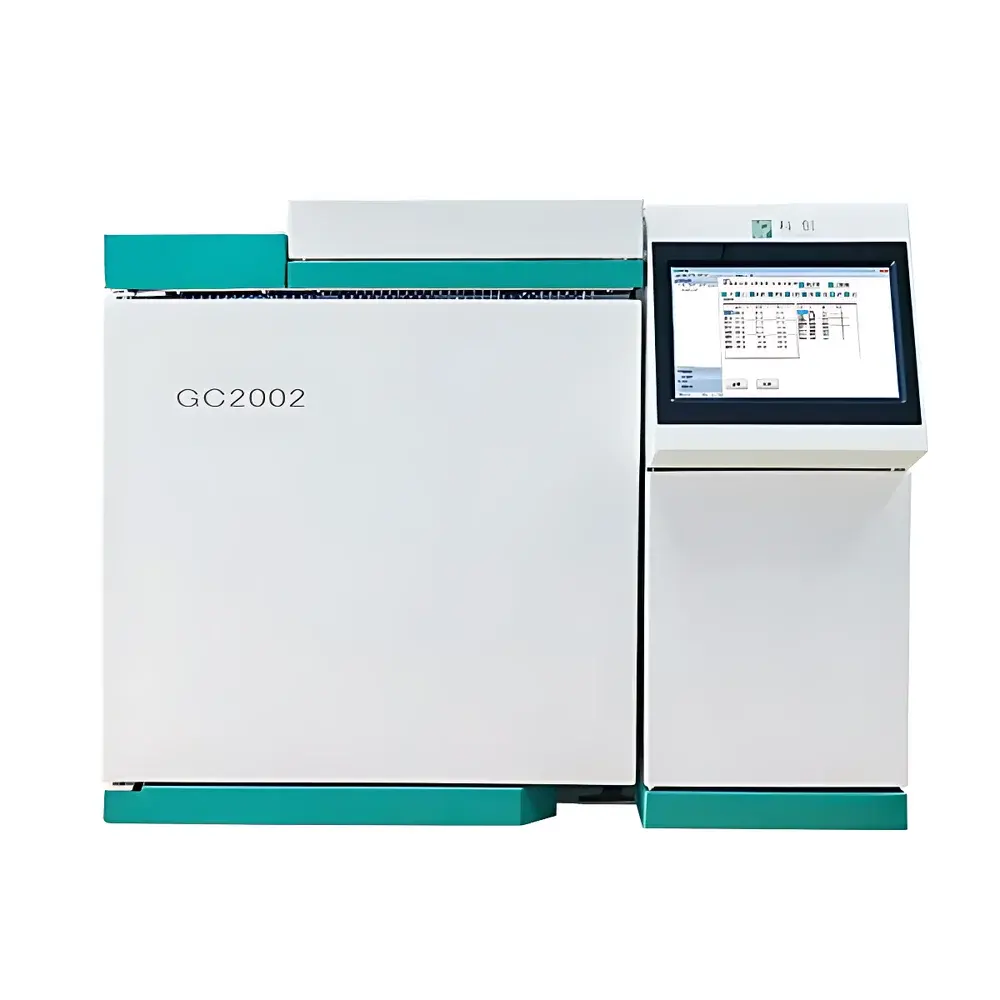
Thermo-Desorption Gas Chromatograph GC9800N
| Brand | Kechuang |
|---|---|
| Origin | Shanghai, China |
| Manufacturer Type | Direct Manufacturer |
| Region Classification | Domestic (China) |
| Model | GC9800N |
| Instrument Category | Laboratory Gas Chromatograph |
| Application Field | Petrochemical Industry Dedicated |
| Oven Temperature Range | Ambient + 8 °C to 400 °C |
| Ramp Rate | 0.1–40 °C/min |
| Cooling Rate | 450 °C → 50 °C in ≤4 min |
| Carrier Gas Flow Range & Control | 0–100 mL/min |
| Carrier Gas Pressure Range & Control | 0–970 kPa |
| Injector Maximum Operating Temperature | 800 °C |
| Injector Pressure Setpoint Range | 0–970 kPa |
| Injector Total Flow Setpoint Range | 0–1200 mL/min |
| Column Oven Temp Accuracy | ±0.1 °C |
| Programmed Ramp Rate (Standard) | 0.1–35 °C/min |
| Vaporizer & Detector Temp Range | Ambient + 6 °C to 350 °C |
| Pyrolyzer Temp Range | 100–800 °C |
| Transfer Line Outlet Temp Range | Ambient + 6 °C to 300 °C |
| FID Detection Limit | ≤1 × 10⁻¹¹ g/s (n-C₁₆) |
| Baseline Drift | ≤30 µV/15 min |
| Noise | ≤10 µV |
| Solid Sample Mass Range | 0.01–1.0 mg |
Overview
The Kechuang GC9800N Thermo-Desorption Gas Chromatograph is a dedicated laboratory-scale analytical system engineered for the controlled thermal decomposition and subsequent separation of thermally labile or non-volatile organic compounds. It integrates a high-temperature programmable pyrolyzer (100–800 °C) with a precision gas chromatograph featuring dual independent temperature zones—column oven and transfer line—and a flame ionization detector (FID). The instrument operates on the principle of flash pyrolysis followed by on-line capillary GC analysis: solid or polymeric samples are rapidly heated under inert atmosphere to induce bond cleavage, generating volatile fragments that are swept directly into the GC column for separation and quantification. This architecture enables structural characterization of polymers, resins, rubbers, coal, biomass, and petrochemical feedstocks without solvent extraction or derivatization—supporting ASTM D7203, ISO 11348, and method development aligned with USP chromatographic system suitability requirements.
Key Features
- High-temperature pyrolysis furnace with precise ramp control (0.1 °C/min resolution) and isothermal stability (±0.5 °C over 30 min at 750 °C), enabling reproducible thermal degradation profiles.
- Column oven with extended operating range (ambient + 8 °C to 400 °C) and rapid cooling capability (450 °C → 50 °C in ≤4 min), facilitating high-throughput analysis of complex mixtures with wide boiling point distributions.
- Independent temperature control for vaporizer (up to 350 °C), detector (up to 350 °C), and transfer line (up to 300 °C), minimizing condensation and ensuring quantitative transfer of pyrolyzates.
- Dual-pressure and dual-flow electronic pneumatic control (EPC) modules for carrier gas (0–100 mL/min, 0–970 kPa) and injector total flow (0–1200 mL/min), supporting split/splitless injection and consistent retention time reproducibility (RSD < 0.15% n=10).
- FID with detection limit ≤1 × 10⁻¹¹ g/s (n-C₁₆), baseline drift ≤30 µV/15 min, and noise ≤10 µV—meeting ICH Q2(R2) sensitivity and precision criteria for impurity profiling.
Sample Compatibility & Compliance
The GC9800N accommodates solid samples in the 0.01–1.0 mg mass range—including thermosets, elastomers, carbon black composites, and geological solids—without pre-treatment. Its pyrolyzer design conforms to ASTM E2154 (Standard Practice for Pyrolysis-GC Analysis of Polymers) and supports GLP-compliant workflows through hardware-level audit trail logging (via optional firmware upgrade) and configurable user access levels. All temperature and flow parameters are traceable to NIST-certified references, and system suitability tests (SST) can be executed per USP and EP 2.2.46 protocols. The instrument meets CE marking requirements for electromagnetic compatibility (EN 61326-1) and safety (EN 61010-1), and its gas handling architecture complies with ISO 8573-1 Class 2 compressed air purity standards when used with certified zero-air generators.
Software & Data Management
Bundled ChromaLab GC software provides full instrument control, real-time chromatogram visualization, peak integration with customizable baselines, and automated calibration curve generation (linear, quadratic, or weighted). Raw data files (.cdf) adhere to ASTM E1947-19 format for long-term archival and third-party spectral library interoperability (e.g., NIST MS Search, Wiley Registry). Audit trail functionality records all parameter changes, method executions, and user logins with timestamps and operator IDs—enabling compliance with FDA 21 CFR Part 11 when paired with electronic signature validation modules. Data export supports CSV, PDF, and XML formats for LIMS integration (e.g., LabWare, STARLIMS) and automated report generation per ISO/IEC 17025 clause 7.8.2.
Applications
- Identification and quantification of polymer microstructures (e.g., butadiene/styrene ratios in SBR, vinyl acetate content in EVA) via evolved gas analysis (EGA) and fingerprint pyrogram interpretation.
- Quality control of catalyst-coated substrates in FCC units through thermal desorption-GC profiling of coke precursors and sulfur-containing fragments.
- Forensic analysis of adhesives, paints, and composite materials using comparative pyrolysis-GC patterns matched against reference libraries.
- Characterization of biochar and lignocellulosic feedstocks by monitoring levoglucosan, furans, and phenolic monomers released during staged pyrolysis.
- Residual solvent and extractable impurity screening in pharmaceutical excipients per ICH Q3C guidelines, leveraging the system’s low detection limits and robust baseline stability.
FAQ
What sample forms are compatible with the GC9800N pyrolyzer?
Solid samples only—powders, films, granules, or cured elastomers—with mass between 0.01 mg and 1.0 mg. Liquid or gaseous samples require prior derivatization or trapping and are not supported in standard configuration.
Can the system be validated for GMP environments?
Yes—when equipped with optional 21 CFR Part 11-compliant software modules, IQ/OQ documentation packages, and NIST-traceable calibration certificates, the GC9800N supports full GMP validation per Annex 15 and EU GMP Chapter 4 requirements.
Is the pyrolyzer compatible with quadrupole mass spectrometry detection?
The transfer line interface is mechanically and thermally compatible with standard GC-MS interfaces (e.g., Agilent 5977, Thermo ISQ); however, direct coupling requires custom adapter installation and vacuum system coordination—consult technical support for integration protocols.
What maintenance intervals are recommended for routine operation?
FID jet cleaning every 200 injections; pyrolyzer quartz tube replacement every 1,000 runs or upon visible carbon deposition; EPC module recalibration every 6 months or after major ambient pressure changes.






