
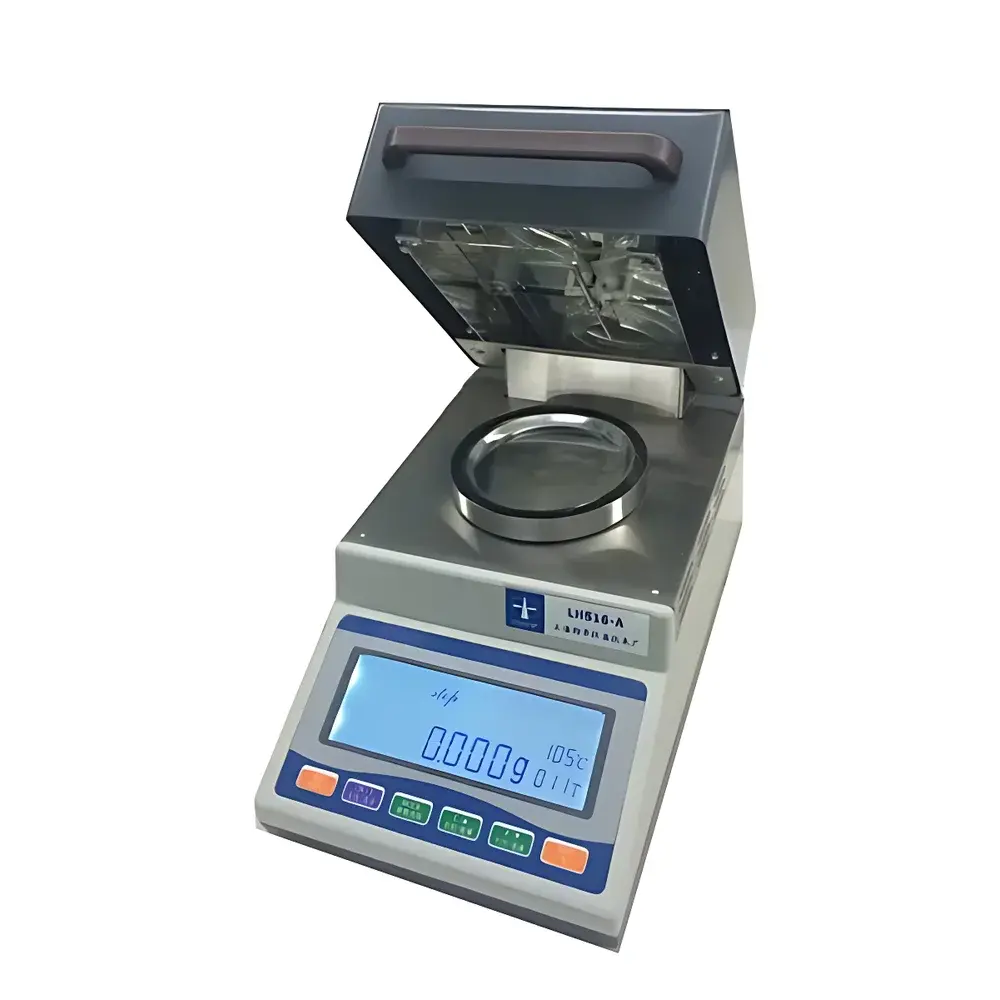
Hengping LHS16-A Halogen Moisture Analyzer
| Brand | Hengping |
|---|---|
| Origin | Shanghai, China |
| Model | LHS16-A |
| Readability | 0.001 g |
| Weighing Range | 0–100 g |
| Temperature Range | Ambient to 160 °C |
| Temperature Control Accuracy | ±1 °C |
| Moisture Content Readability | 0.01 % |
| Repeatability (≥2 g sample) | 0.2 % |
| Timer Range | 0–120 min |
| Sample Pan Diameter | Φ90 mm |
| Dimensions (W×D×H) | 235 × 195 × 195 mm |
| Power Supply | 220 V, 50 Hz or 110 V ±11 V, 60 Hz |
| Net Weight | 11.5 kg |
| Interface | RS232 |
| Display Parameters | 8 configurable parameters |
| Heating Modes | Manual / Automatic / Programmable |
| Compliance | Designed for GLP-compliant workflows |
Overview
The Hengping LHS16-A Halogen Moisture Analyzer is a precision thermogravimetric instrument engineered for rapid, reliable moisture content determination in solid and semi-solid samples. It operates on the principle of loss-on-drying (LOD), where a halogen lamp provides uniform, controllable infrared radiation to heat the sample at defined temperature profiles. Simultaneously, a high-resolution electromagnetic balance continuously monitors mass loss with 0.001 g readability. The integrated microprocessor synchronizes thermal input, real-time mass tracking, and endpoint detection—enabling accurate quantification of volatile content as moisture percentage (w/w %). Designed for routine quality control and R&D environments, the LHS16-A delivers consistent results within minutes, eliminating the need for time-consuming oven-drying methods while maintaining traceability and procedural integrity.
Key Features
- Halogen heating system with programmable temperature range from ambient to 160 °C, offering faster thermal response and improved energy efficiency compared to traditional infrared or quartz tube heaters.
- Electromagnetic force compensation balance with 0.001 g readability and 100 g maximum capacity, calibrated internally with automatic zero-tracking and linearization algorithms.
- Microprocessor-controlled operation supporting three heating modes: manual (user-defined hold time), automatic (pre-set endpoint criteria), and programmable (multi-step temperature ramps).
- Configurable display interface showing up to eight real-time parameters—including initial mass, current mass, moisture %, dry mass %, residual mass, elapsed time, temperature, and heating status.
- RS232 serial interface enabling direct data export to external printers or laboratory information management systems (LIMS) using four selectable output formats (e.g., tab-delimited, CSV-compatible).
- Robust mechanical architecture with stainless-steel sample pan (Φ90 mm), compact footprint (235 × 195 × 195 mm), and stable base design minimizing vibration-induced drift during measurement.
Sample Compatibility & Compliance
The LHS16-A accommodates a broad spectrum of non-volatile and low-volatility matrices, including pharmaceutical excipients, powdered foodstuffs (e.g., milk powder, starch), tobacco leaf, grain kernels, polymer granules, and inorganic salts. Sample mass requirements (≥2 g) ensure statistical representativeness and minimize surface-area-to-volume ratio effects. While not certified to ISO 12099 or AOAC Official Method 952.12 out-of-the-box, the instrument supports method validation per internal SOPs aligned with USP <921>, ASTM D4457, and ISO 5351. Its programmable heating profiles and audit-ready data logging facilitate compliance with GLP and GMP documentation standards when paired with appropriate electronic record controls.
Software & Data Management
Data acquisition and reporting are managed through embedded firmware—not proprietary PC software—ensuring deterministic timing and minimal configuration dependencies. All measurements include timestamped metadata (date, time, operator ID if entered, method name, temperature setpoint, duration). RS232 output supports ASCII-based transmission compatible with common spreadsheet and database import tools. For regulated environments, integration with third-party LIMS or ELN platforms can be achieved via custom serial protocol mapping. Optional external printers generate hard-copy reports with full parameter traceability, satisfying basic 21 CFR Part 11 requirements when combined with procedural controls (e.g., user login logs, change history documentation).
Applications
- Pharmaceutical manufacturing: Moisture verification of active pharmaceutical ingredients (APIs), tablet granules, and lyophilized powders prior to packaging.
- Food quality assurance: Rapid assessment of moisture in flour, sugar, coffee beans, and snack products to prevent microbial growth and ensure shelf-life stability.
- Tobacco processing: In-line monitoring of leaf moisture during curing and re-drying stages to optimize blending consistency.
- Chemical production: Batch release testing of catalyst carriers, silica gels, and desiccants where water content directly impacts reactivity and storage safety.
- Agricultural commodity trading: On-site verification of grain moisture levels against contractual specifications (e.g., ISO 712 for cereals).
FAQ
What is the recommended minimum sample mass for reliable results?
A minimum of 2 g is specified to ensure adequate signal-to-noise ratio and statistical repeatability (±0.2 % RSD under standard conditions).
Can the LHS16-A be used for volatile organic compound (VOC) analysis?
No—it measures total volatile loss under defined thermal conditions, not compound-specific volatiles; GC or KF titration is required for selective VOC quantification.
Is calibration traceable to national standards?
Internal calibration uses factory-traceable weights; external verification requires NIST-traceable mass standards and temperature probes per ISO/IEC 17025 guidelines.
Does the instrument support multi-stage heating programs?
Yes—up to three sequential temperature segments with independent time and ramp rate settings can be stored in memory.
How is endpoint detection determined in automatic mode?
Endpoint is triggered when mass change falls below 0.005 g over a 30-second interval, or after user-defined time elapses—whichever occurs first.




