
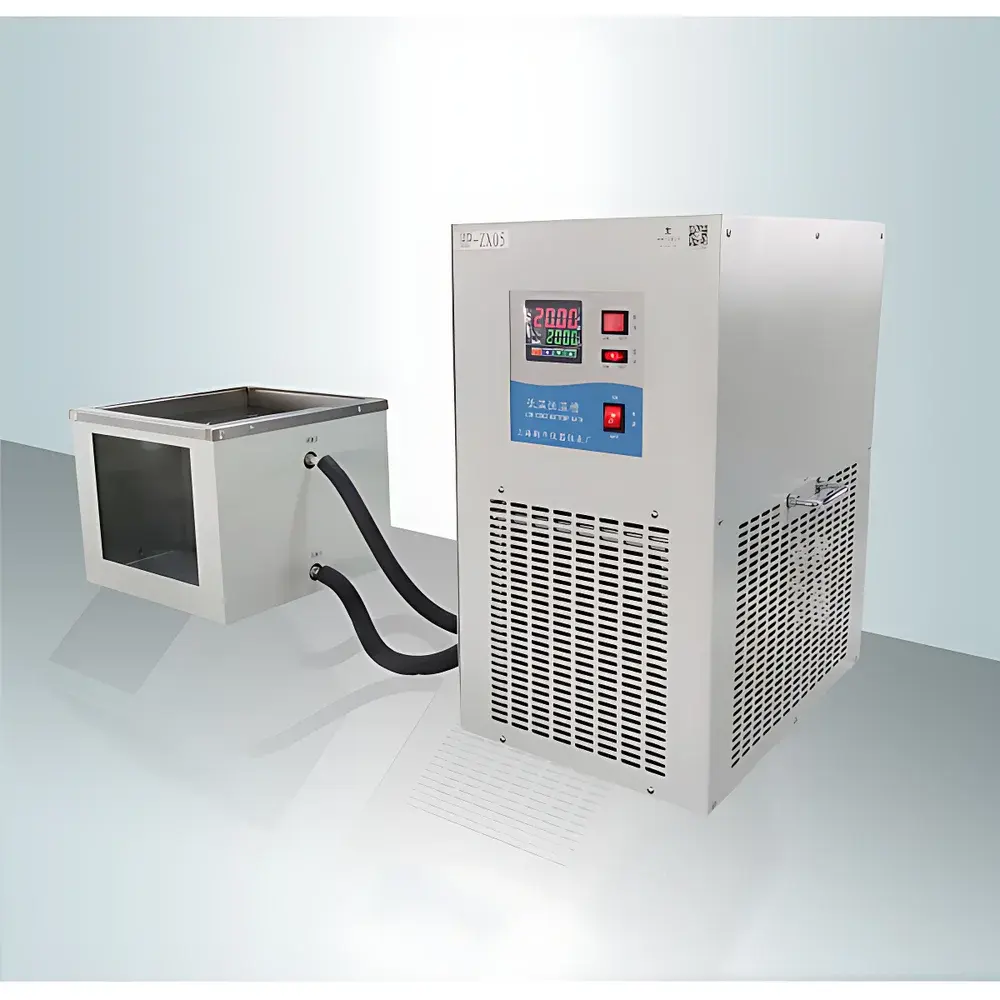
Shanghai Hengping HP-ZX05 Self-Priming Circulating Constant Temperature Bath
| Brand | Hengping |
|---|---|
| Origin | Shanghai, China |
| Model | HP-ZX05 |
| Type | Circulating Constant-Temperature Bath |
| Circulation Mode | Internal & External |
| Temperature Control | Refrigeration & Heating |
| Bath Volume | 36 L |
| Temperature Range | 5–90 °C |
| Temperature Stability | ±0.1 °C (at 25 °C ambient) |
| Refrigerant | CFC-free |
| Cooling Method | Forced-air condenser |
| Pump Type | Integrated self-priming circulation pump |
| Control System | Microprocessor-based PID temperature controller with auto-deaeration logic |
Overview
The Shanghai Hengping HP-ZX05 Self-Priming Circulating Constant Temperature Bath is an engineered thermal management system designed for precise, stable, and reliable temperature control in laboratory-scale applications requiring external heat exchange. Operating on a closed-loop refrigeration-heating principle, the unit integrates a hermetic compressor, forced-air condenser, high-efficiency evaporator, and a microprocessor-controlled PID temperature regulation system. Its defining feature is the integrated self-priming circulation architecture—eliminating manual air purging and enabling automatic startup of external recirculation to open or semi-open vessels. The 36 L stainless steel bath reservoir supports both water and low-viscosity heat-transfer fluids (e.g., silicone oil, ethylene glycol/water mixtures), with operational compatibility across a continuous range from 5 °C to 90 °C. Temperature stability is maintained at ±0.1 °C under standard ambient conditions (≤25 °C, ≤60% RH), meeting baseline requirements for calibration traceability and method reproducibility in QC/QA workflows.
Key Features
- Self-priming circulation system with automatic air evacuation logic—no manual bleeding required prior to external loop activation
- Dual-mode temperature control: simultaneous refrigeration and heating via compressor-based cooling and resistive heating elements
- Forced-air condenser design ensures consistent thermal rejection without need for chilled water supply or external ventilation ducting
- Microprocessor PID controller with real-time setpoint tracking, ramp-soak programming, and over-temperature/low-fluid-level safety cutoffs
- Stainless steel bath tank (36 L capacity) with integrated submersible circulation pump and dual-port fluid interface (inlet/outlet)
- CFC-free refrigerant compliant with Montreal Protocol Annex A Group I requirements; RoHS-conformant electrical components
Sample Compatibility & Compliance
The HP-ZX05 is compatible with a broad spectrum of heat-transfer media—including deionized water, aqueous glycol solutions, and silicone oils—provided they remain non-corrosive and exhibit viscosity <500 cSt across the full operating range (−10 °C to 100 °C). It supports external circulation to jacketed reactors, viscometers, spectrophotometer cells, and other analytical instrumentation requiring stable thermal conditioning. While not certified to ISO/IEC 17025 or ASTM E2877 for metrological validation, the unit’s temperature stability and repeatability align with general-purpose laboratory requirements per ISO 17025 Clause 6.4.2 (equipment suitability) and USP guidance for analytical instrument qualification (AIQ) at the Operational Qualification (OQ) level. No built-in 21 CFR Part 11 audit trail, but analog/digital output signals (0–5 V / 4–20 mA) support integration into validated SCADA or LIMS environments with external logging.
Software & Data Management
The HP-ZX05 operates via an embedded front-panel interface with LED display, tactile membrane keys, and non-volatile parameter storage. It does not include onboard data logging or PC connectivity as standard; however, optional analog outputs (0–5 V for temperature, 4–20 mA for pump speed) enable integration with third-party DAQ systems (e.g., National Instruments CompactDAQ, Keysight DAQ970A) for time-stamped thermal profiling. Firmware supports user-defined setpoint ramps and hold steps, with password-protected configuration access to prevent unauthorized parameter changes. For GLP/GMP-aligned labs, external validation documentation—including IQ/OQ protocols, sensor calibration certificates (NIST-traceable Pt100 probe), and preventive maintenance logs—must be generated and retained per internal SOPs.
Applications
- Thermal conditioning of UV-Vis cuvettes, fluorescence sample holders, and DSC pans during temperature-dependent optical or calorimetric measurements
- External temperature control of rotary evaporation systems, especially for low-boiling-point solvents requiring sub-ambient bath temperatures
- Stabilization of refractometers, density meters, and capillary viscometers where ambient drift compromises measurement fidelity
- Pre-conditioning of reference standards (e.g., NIST SRM thermistor probes) prior to calibration against primary standards
- Supporting ASTM D2857 (FTIR spectroscopy), ISO 2555 (viscosity of polymer solutions), and USP environmental monitoring equipment qualification
FAQ
What types of heat-transfer fluids are compatible with the HP-ZX05?
Deionized water, 30–50% ethylene glycol/water mixtures, and low-viscosity silicone oils (e.g., Dow Corning 200 Fluid, 50 cSt) are recommended. Avoid halogenated solvents, strong acids/bases, or fluids with flash points below 60 °C.
Does the unit support external communication protocols (e.g., RS232, Modbus)?
No native serial or industrial protocol interface is included; only analog voltage/current outputs are provided for external monitoring and control integration.
Is the HP-ZX05 suitable for use with open-top vessels?
Yes—the self-priming design enables stable external circulation to open or vented containers, provided the return line is submerged and system head loss remains within the pump’s 3.5 m maximum lift specification.
What is the recommended ambient operating environment?
Ambient temperature ≤25 °C and relative humidity ≤60% (non-condensing); operation above 25 °C may reduce maximum achievable cooling capacity and long-term compressor reliability.
How often should the refrigerant circuit be serviced?
Under normal laboratory use, the sealed refrigeration system requires no scheduled refrigerant servicing; annual inspection of condenser coil cleanliness and electrical connections is advised per manufacturer’s PM schedule.



