
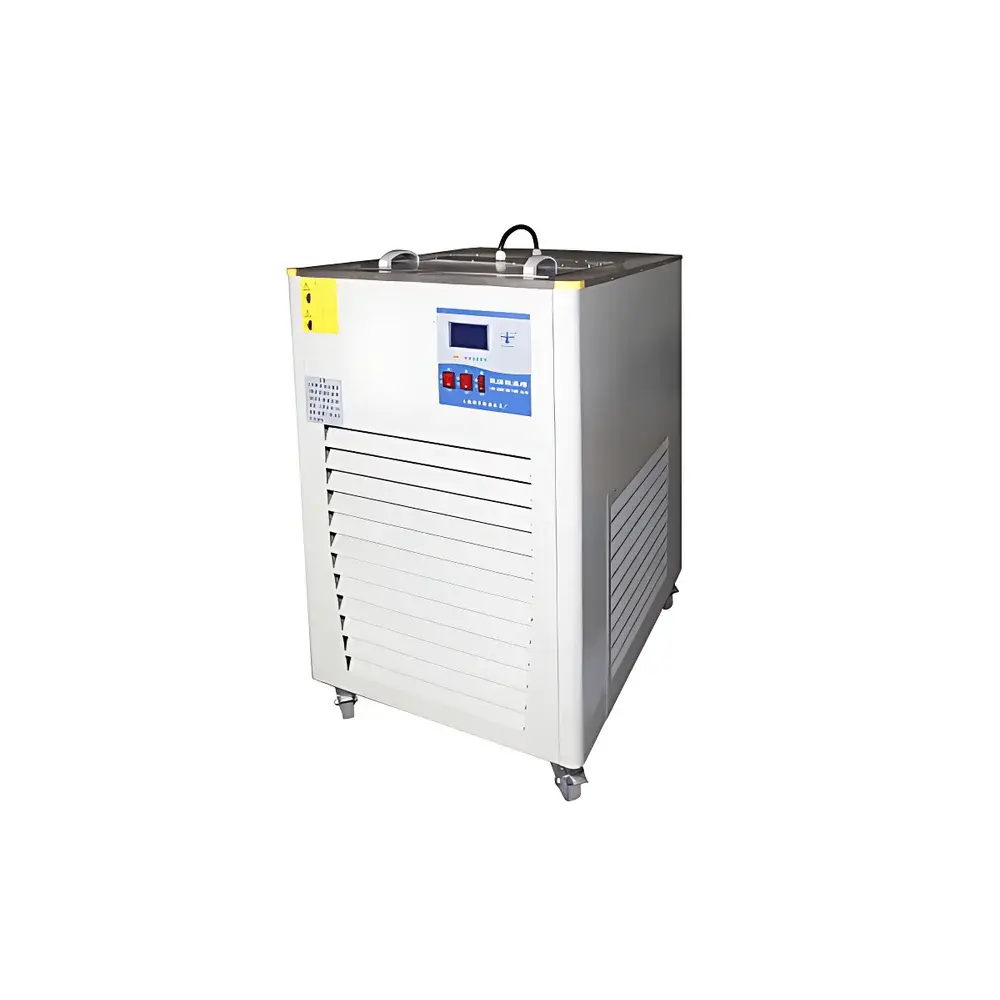
Hengping DC5-3000G Cryogenic Circulating Thermostat
| Brand | Hengping |
|---|---|
| Model | DC5-3000G |
| Temperature Range | –5 to 99 °C (refrigeration disabled above 55 °C) |
| Refrigeration Capacity | 3000 W @ 20 °C |
| Heating Power | 7 kW |
| Refrigeration Power | 1.6 kW |
| Temperature Uniformity | ±0.2 °C |
| Display Resolution | 0.1 °C |
| Pump Flow Rate | 10–1000 L/h (adjustable) |
| Reservoir Volume | 50 L |
| Bath Tank Material | Brushed 304 Stainless Steel |
| Compressor | Tecumseh (France) |
| Circulation Pump | Nanfang Pump (China) |
| Power Supply | AC 380 V, 50 Hz (±10%), 5-wire (3-phase + N + PE) |
| Ambient Operating Conditions | ≤25 °C, RH <85%, ≥500 mm clearance around unit |
| Compliance | Designed for GLP-aligned lab environments |
Overview
The Hengping DC5-3000G Cryogenic Circulating Thermostat is a precision-engineered laboratory temperature control system designed to deliver stable, uniform thermal environments across a broad operational range of –5 °C to 99 °C. It employs a single-stage air-cooled compression refrigeration cycle—integrated with an independent nickel-chromium heating system—to enable bidirectional thermal regulation without cross-interference. The unit utilizes a Tecumseh (France) hermetic compressor and a high-efficiency Nanfang circulation pump, ensuring reliable long-term operation under continuous load. Its 50 L brushed 304 stainless steel reservoir provides corrosion resistance and thermal inertia suitable for extended stability testing. Temperature control is executed via a PID + SSR microprocessor-based controller with 0.1 °C digital resolution and ±0.2 °C uniformity across the bath volume—critical for applications requiring reproducible thermal boundary conditions in physical property measurement, reaction calorimetry, or sensor calibration.
Key Features
- Robust dual-mode thermal architecture: Independent refrigeration (1.6 kW input, 3000 W output at 20 °C) and heating (7 kW) systems prevent thermal crosstalk and ensure rapid setpoint acquisition.
- PID auto-tuning controller with real-time output visualization (heating % bar graph), SV/PV dual-line LCD display, and intuitive keypad navigation (▲/▼/◀/▶/FUNC).
- Adjustable flow delivery: Circulation rate continuously tunable from 10 to 1000 L/h, enabling compatibility with external jackets, reactors, or viscometers requiring variable coolant throughput.
- Full stainless steel construction (304 brushed finish): Chemically inert tank, reinforced insulation, and sealed electrical compartment meet IP20-rated lab safety requirements.
- Comprehensive safety interlocks: Dry-run protection, overtemperature cutoff (>105 °C), ground-fault detection, compressor restart delay (>180 s), and airflow obstruction monitoring via mandatory 500 mm clearance zones.
- Configurable fluid compatibility: Supports water, ethanol, glycol-water mixtures (15% v/v), and silicone oil—selected per operational temperature window to maintain adequate vapor pressure, viscosity, and freezing point margins.
Sample Compatibility & Compliance
The DC5-3000G is engineered for integration into analytical and process validation workflows where thermal traceability is essential. Its design adheres to fundamental principles outlined in ISO 17025:2017 (clause 6.4.3 on environmental monitoring) and supports audit-ready operation when paired with external calibration records. While not inherently 21 CFR Part 11 compliant (lacking electronic signature and audit trail firmware), its analog/digital hybrid controller permits manual logging of setpoints, actual temperatures, and runtime—fully compatible with paper-based GLP/GMP documentation protocols. The unit operates safely with non-corrosive heat transfer media only; introduction of particulates, chlorinated solvents, or pH-unstable solutions voids warranty and risks pump seal degradation or evaporator fouling. Fluid selection must satisfy two criteria: freezing point at least 5 °C below minimum operating temperature, and boiling point at least 10 °C above maximum setpoint.
Software & Data Management
The DC5-3000G operates via embedded firmware without proprietary software dependency. All configuration—including PID parameters (P/I/D values), ramp/soak profiles, and alarm thresholds—is accessible through the front-panel interface. While no USB/RS-485 communication port is standard, optional analog 4–20 mA or 0–10 V output modules (available upon request) permit connection to SCADA systems or data loggers for time-stamped temperature trending. Users performing IQ/OQ validation may record calibration points using NIST-traceable RTD probes placed at three axial positions (center, corner, mid-depth); deviation from setpoint must remain within ±0.2 °C over 30 minutes to satisfy acceptance criteria. Maintenance logs—compressor runtime, filter replacement dates, and fluid change intervals—are recommended for internal quality records.
Applications
This thermostat serves as a primary temperature source in diverse scientific and industrial settings: calibration of thermocouples and RTDs per ASTM E230; viscosity measurements using rotational or capillary viscometers requiring constant bath temperature; stability testing of pharmaceutical formulations per ICH Q1A(R2); thermal cycling of polymer samples during DSC sample preparation; conditioning of optical components prior to interferometric measurement; and jacketed reactor temperature control in pilot-scale chemical synthesis. Its wide span and high power density make it especially suitable for laboratories lacking centralized HVAC-chilled water infrastructure—enabling localized cold/hot sourcing without facility retrofitting.
FAQ
What is the minimum safe fluid level required to operate the DC5-3000G?
The liquid medium must cover the heating element by at least 20 mm above the lower recess of the lid plate. Operation below this level risks dry-heating failure and irreversible element damage.
Can the unit be used above 55 °C while engaging refrigeration?
No. Refrigeration is electronically disabled above 55 °C to prevent condenser overload and compressor oil breakdown. Attempting forced cooling beyond this threshold triggers automatic lockout.
Is remote monitoring or control possible out-of-the-box?
No native Ethernet, Wi-Fi, or Modbus interface is included. Optional analog output modules (4–20 mA) can be factory-installed for third-party DAQ integration.
What maintenance intervals are recommended for optimal longevity?
Replace circulating fluid every 6 months under continuous use; inspect and clean pump inlet strainer quarterly; verify compressor oil level and refrigerant charge annually via certified technician.
Does the device comply with CE or UL safety standards?
It meets GB/T 22989–2008 (Chinese national standard for laboratory thermostats) and carries CCC certification. CE/UL listing requires additional conformity assessment and is not pre-certified.
Related Products



