
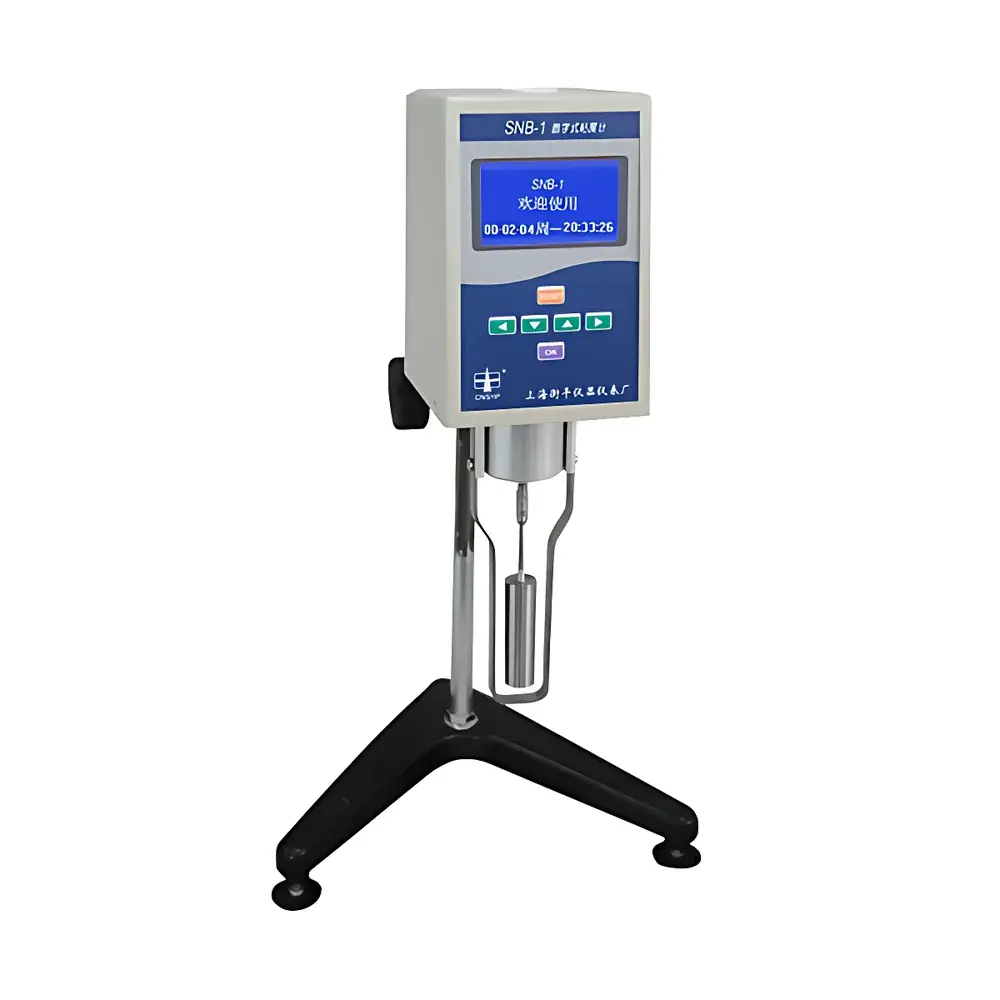
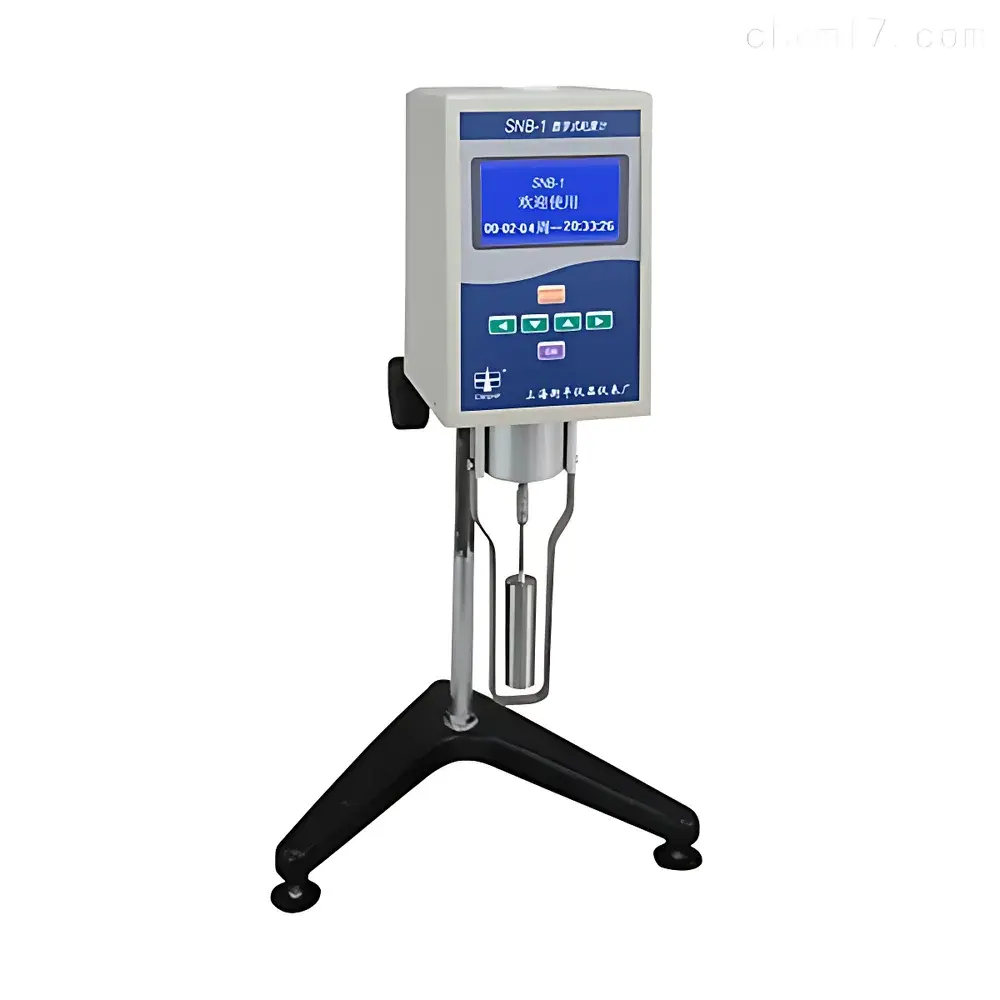
Shanghai Hengping SNB-1 Advanced Rotational Viscometer
| Brand | Hengping |
|---|---|
| Origin | Shanghai, China |
| Manufacturer Type | Authorized Distributor |
| Product Category | Domestic |
| Model | SNB-1 |
| Instrument Type | Rotational Viscometer |
| Viscosity Range | 1–1×10⁵ mPa·s |
| Standard Spindles | #1–#4 (optional #0 for 0.1–10 mPa·s) |
| Rotational Speeds | 6, 12, 30, 60 rpm |
| Display | Backlit High-Brightness LCD |
| Interface | RS-232 Serial Port |
| Temperature Sensor Interface | Yes |
| Printer Interface | Yes |
| Auto-Ranging | Automatic spindle/speed selection |
| Measurement Stability Detection | Auto-hold & auto-stop upon reading stabilization |
| Accuracy | ±2% (for Newtonian fluids) |
| Power Supply | AC 220 V ±10%, 50 Hz ±10% |
| Operating Environment | 5–35 °C, ≤80% RH |
| Dimensions (W×D×H) | 280×320×390 mm |
| Net Weight | 4.5 kg |
| Compliance | Designed per GB/T 27893–2011 (Chinese national standard for rotational viscometers), compatible with ISO 2555 and ASTM D2196 test protocols |
Overview
The Shanghai Hengping SNB-1 Advanced Rotational Viscometer is a microprocessor-controlled, torque-based instrument engineered for precision measurement of dynamic viscosity in both Newtonian and non-Newtonian fluids. It operates on the principle of rotational viscometry—applying controlled shear stress via a rotating spindle immersed in the sample, while measuring the resulting viscous resistance (torque) to determine apparent or absolute viscosity. The SNB-1 employs a calibrated spring-and-damping mechanical system coupled with high-resolution angular displacement sensing, ensuring repeatable torque transduction across its full 1–1×10⁵ mPa·s range. Designed for routine QC laboratories and R&D environments, it delivers stable, operator-independent measurements under standardized shear conditions defined by spindle geometry, rotational speed, and immersion depth—critical parameters governed by ISO 3219 and ASTM D1084.
Key Features
- Backlit high-brightness LCD display with intuitive Chinese-language interface (software-localized for regional operation)
- Four standard spindles (#1–#4) covering broad viscosity coverage; optional #0 spindle extends low-end capability to 0.1 mPa·s for dilute polymer solutions or solvents
- Four fixed-speed settings (6, 12, 30, 60 rpm) optimized for consistent shear rate application—enabling direct comparison against reference standards
- Automatic spindle and speed selection logic minimizes user error during multi-range testing
- Real-time measurement stabilization detection: instrument halts rotation automatically once torque variance falls below ±0.5% over 3 seconds
- RS-232 serial interface supports bidirectional communication with Windows-based PCs for data logging, report generation, and remote control
- Dedicated hardware ports for optional PT100 temperature sensor (±0.5 °C accuracy) and thermal-line printer—enabling simultaneous temperature-correlated viscosity reporting per ISO 7305
- All-aluminum housing with EMI-shielded head assembly ensures electromagnetic compatibility in shared lab environments
Sample Compatibility & Compliance
The SNB-1 is validated for use with transparent and opaque liquids exhibiting laminar flow behavior under tested shear rates—including mineral oils, edible fats, latex dispersions, pharmaceutical suspensions, and water-based coatings. Its spindle geometry conforms to DIN 53019-1 dimensional tolerances, supporting compliance with ISO 2555 (aqueous polymer solutions), ASTM D2196 (non-Newtonian paints), and USP (viscosity of semisolid dosage forms). While not certified for GMP-regulated production release testing, the instrument’s audit-ready data export (CSV/Excel), timestamped measurement logs, and parameter-locking capability support GLP-aligned documentation practices. Temperature compensation functionality aligns with ASTM D445 Annex A1 for kinematic viscosity correlation where density data are available.
Software & Data Management
The included PC software (Windows 7–11 compatible) provides real-time graphing of viscosity vs. time, shear rate sweeps (via manual speed sequencing), and batch-wise statistical analysis (mean, SD, CV%). All exported datasets contain embedded metadata: date/time stamp, spindle ID, rotational speed, ambient temperature (if sensor connected), and user-defined sample ID. Raw torque and angular velocity values are stored at 10 Hz sampling resolution, enabling post-hoc reprocessing. Software-generated reports comply with internal QA templates and may be exported as PDF or printed directly—supporting traceability requirements in contract testing labs. No cloud connectivity or subscription model is implemented; all data remain locally stored and fully owned by the end user.
Applications
- Quality control of edible oils and margarines per AOAC 962.03
- Batch consistency verification of solvent-based industrial coatings (e.g., alkyd resins)
- Rheological screening of topical gels and ointments during formulation development
- Monitoring viscosity drift in fermentation broths or enzyme solutions
- Educational demonstration of shear-thinning behavior in polymer melts and colloidal suspensions
- Pre-screening of cleaning agent formulations prior to capillary viscometry validation
FAQ
Is the SNB-1 compliant with FDA 21 CFR Part 11?
No—the instrument lacks electronic signature capability, audit trail encryption, and role-based access control required for Part 11 compliance. It is suitable for non-GMP research and QC support roles only.
Can I use ASTM D1200 Ford Cups with this viscometer?
No—SNB-1 is a rotational viscometer and does not support efflux cup methods. Ford Cup data cannot be directly correlated without empirical calibration against rotational measurements.
What is the minimum sample volume required for #1 spindle?
600 mL in a standard 600-mL low-form beaker, with spindle immersed to the marked fill line (20 mm below surface). Smaller volumes introduce wall-effect errors exceeding ±5%.
Does the instrument support continuous shear-rate ramping?
No—it operates at discrete fixed speeds only. For rheological profiling (flow curves), users must manually sequence speeds and compile data externally.
How often should calibration verification be performed?
Daily verification using NIST-traceable silicone oil standards (e.g., Cannon N4, N10) is recommended before critical measurements; annual recalibration by an accredited metrology lab is advised for ISO/IEC 17025 alignment.



