
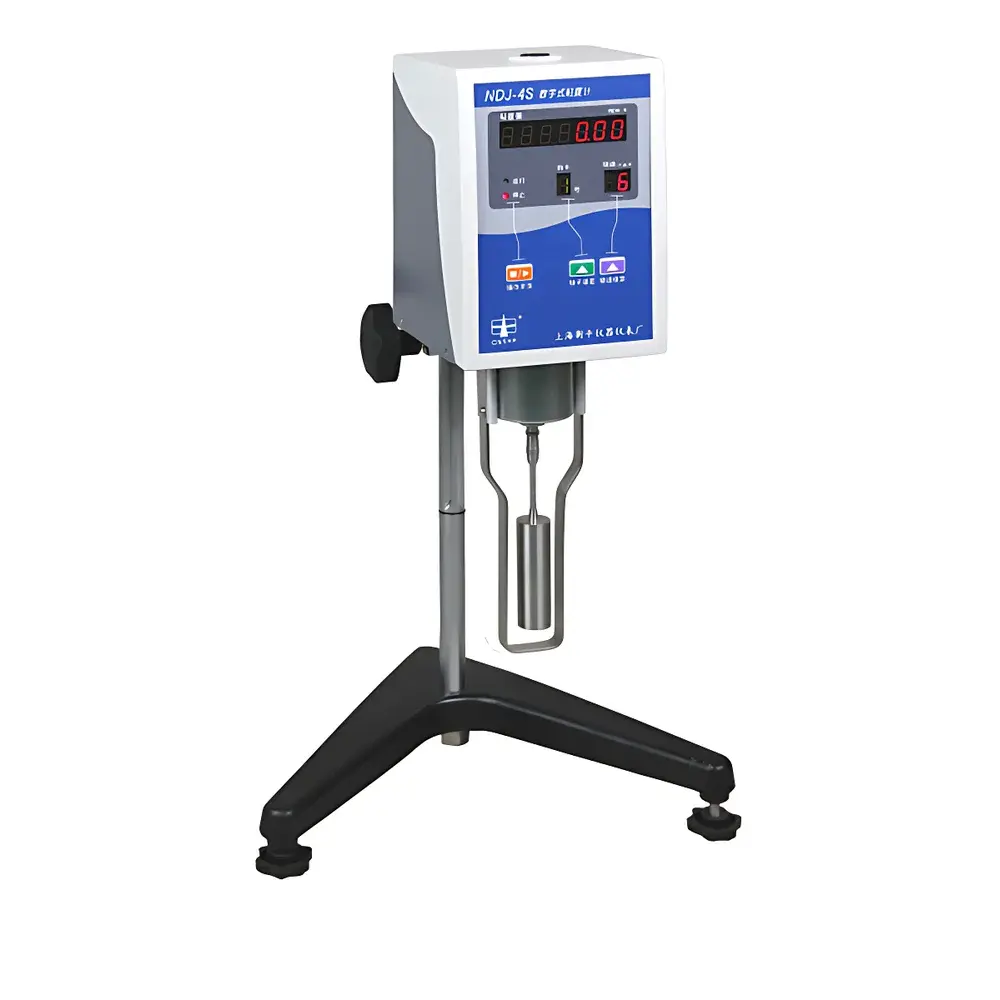
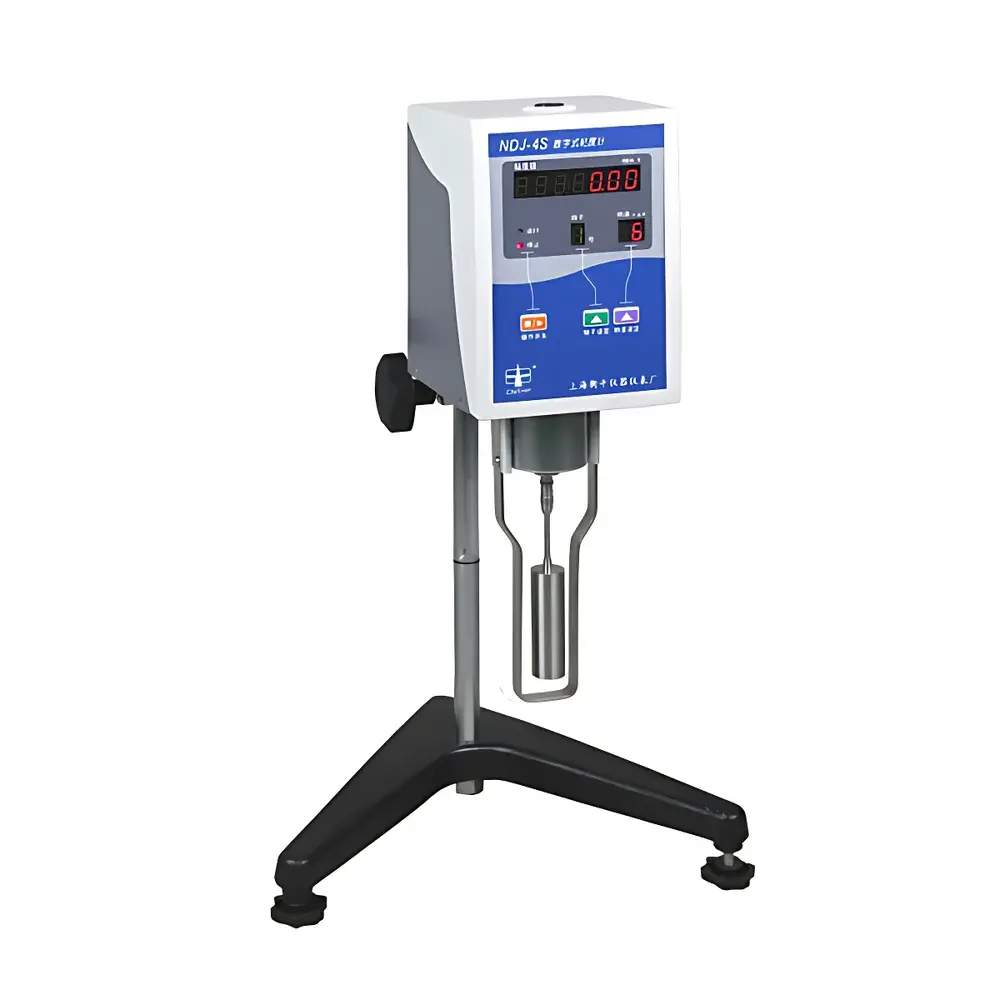
Shanghai Hengping NDJ-4S Digital Display Rotational Viscometer
| Brand | Hengping |
|---|---|
| Origin | Shanghai, China |
| Model | NDJ-4S |
| Instrument Type | Rotational Viscometer |
| Viscosity Range | 1–2×10⁶ mPa·s |
| Rotors | Standard #1–#4 (Optional #0 for 0.1–10 mPa·s) |
| Speed Settings | 0.3, 0.6, 1.5, 3, 6, 12, 30, 60 rpm |
| Accuracy | ±2% (for Newtonian fluids) |
| Power Supply | AC 220 V ±10%, 50 Hz ±10% |
| Operating Temperature | 5–35 °C, RH ≤80% |
| Dimensions (W×D×H) | 380×320×390 mm |
| Net Weight | 4.5 kg |
Overview
The Shanghai Hengping NDJ-4S Digital Display Rotational Viscometer is a microprocessor-controlled, coaxial cylinder-type viscometer engineered for precision measurement of dynamic viscosity in both Newtonian and non-Newtonian fluids. Based on the principle of rotational drag torque measurement—where viscous resistance exerted on a rotating spindle immersed in a sample generates a measurable torsional force—the NDJ-4S employs a calibrated spring-sensor system coupled with digital signal processing to deliver stable, repeatable readings. Unlike analog pointer-based instruments, this model eliminates parallax error and mechanical hysteresis through solid-state sensing and LED numeric display. Its design conforms to fundamental rheological standards governing steady-shear viscosity determination (e.g., ASTM D2196, ISO 2555), making it suitable for routine quality control and R&D screening where reproducibility and operational simplicity are prioritized over advanced rheological profiling.
Key Features
- Digital LED display with high-brightness 4-digit readout for instantaneous viscosity values in mPa·s (cP)
- Three-button intuitive interface: dedicated keys for rotor selection, speed adjustment, and measurement initiation
- Eight preset rotational speeds (0.3–60 rpm) enabling shear rate variation across low- to medium-viscosity regimes
- Standard set of four spindles (#1–#4) covering the full specified range of 1–2×10⁶ mPa·s; optional #0 spindle extends low-end capability to 0.1–10 mPa·s
- Auto-hold function: instrument detects torque stabilization and halts rotation automatically upon reading convergence
- Robust aluminum housing with compact benchtop footprint (380×320×390 mm) and 4.5 kg net weight for lab stability and portability
- Compliant power input (AC 220 V ±10%, 50 Hz ±10%) with thermal management optimized for continuous operation within 5–35 °C ambient conditions
Sample Compatibility & Compliance
The NDJ-4S accommodates a broad spectrum of homogeneous liquid and semi-liquid samples—including oils, resins, polymer melts, food emulsions, pharmaceutical suspensions, coatings, and surfactant solutions—provided they exhibit sufficient fluidity to permit spindle immersion and rotation without cavitation or wall slip artifacts. While not designed for yield stress or time-dependent measurements (e.g., thixotropy, creep), it satisfies standard test protocols requiring single-point apparent viscosity reporting under defined shear conditions. The instrument meets general laboratory safety and electromagnetic compatibility requirements per GB/T 14710 (Chinese national standard for environmental adaptability of medical and analytical equipment) and supports documentation traceability in GLP-aligned workflows when used with manual logbooks or external data capture systems.
Software & Data Management
The NDJ-4S operates as a standalone hardware unit with no embedded software or USB/RS-232 connectivity. All data acquisition and display are handled internally via real-time microcontroller firmware. Readings are not stored onboard and must be manually recorded or transcribed into LIMS or Excel-based tracking systems. For regulated environments requiring audit trails (e.g., FDA 21 CFR Part 11), users are advised to implement procedural controls—including operator identification, calibration log maintenance, and timestamped entry of raw values—to ensure data integrity. Optional external printers or analog-to-digital converters may be integrated at the system level for semi-automated reporting.
Applications
- Quality assurance of lubricating oils and greases in mechanical manufacturing
- Batch consistency verification of paint and ink formulations during production
- Routine viscosity screening of edible oils, syrups, and dairy-based products in food laboratories
- Preliminary characterization of polymer solutions prior to advanced rheometry
- Stability assessment of topical pharmaceutical gels and ointments per USP
- Educational use in undergraduate physical chemistry and materials science laboratories
FAQ
What types of fluids can be measured with the NDJ-4S?
It is validated for Newtonian liquids (e.g., mineral oil, glycerol) and provides apparent viscosity for non-Newtonian fluids (e.g., ketchup, latex paint) at each selected shear rate.
Is calibration traceable to national standards?
The instrument requires periodic verification using certified silicone oil standards (e.g., Cannon, Brookfield NIST-traceable reference fluids); factory calibration certificates are not supplied by default.
Can the NDJ-4S measure yield stress?
No—it lacks controlled-stress capability and ramped-speed programming; yield point determination requires a dedicated controlled-stress rheometer.
What is the recommended maintenance schedule?
Rotor cleaning after each use with appropriate solvents; annual mechanical inspection of bearing play and spring tension is advised for long-term accuracy retention.
Does the NDJ-4S support temperature control?
No built-in Peltier or water-jacketing; external thermostatic baths must be used for temperature-dependent measurements.
Related Products



