
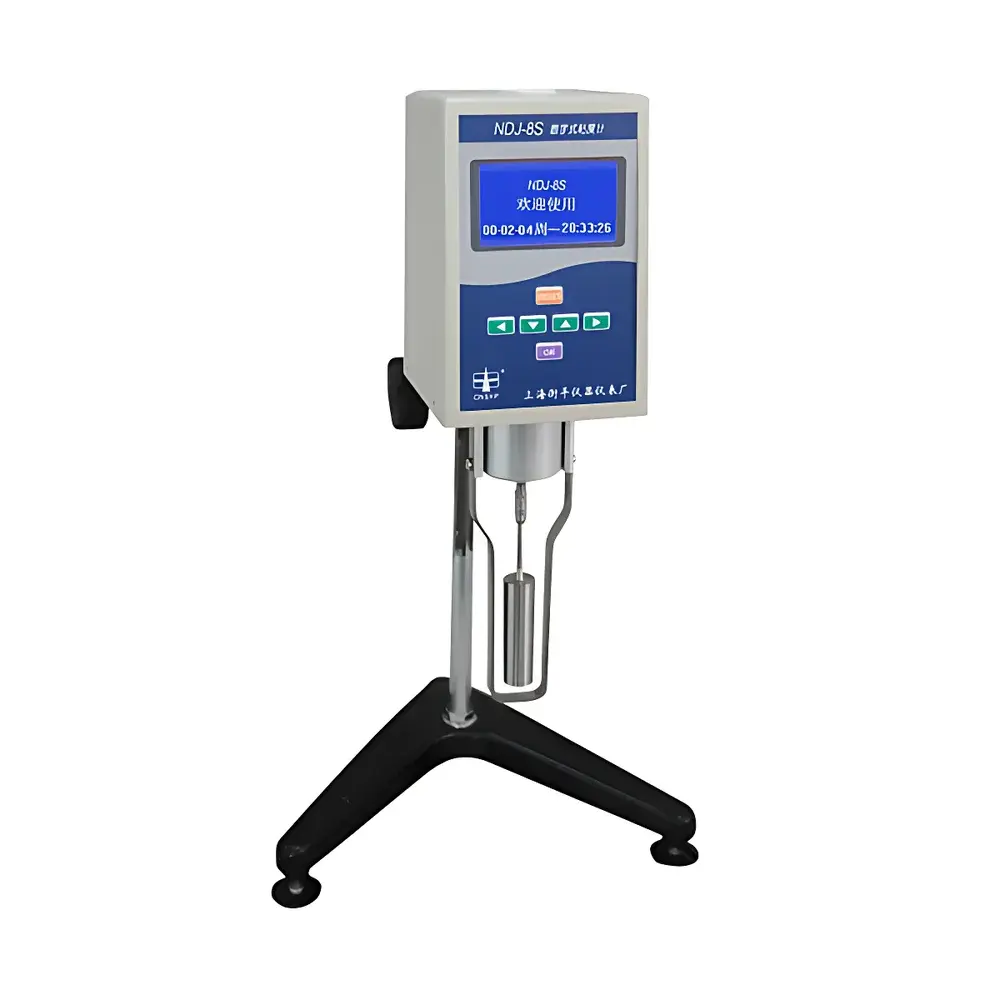
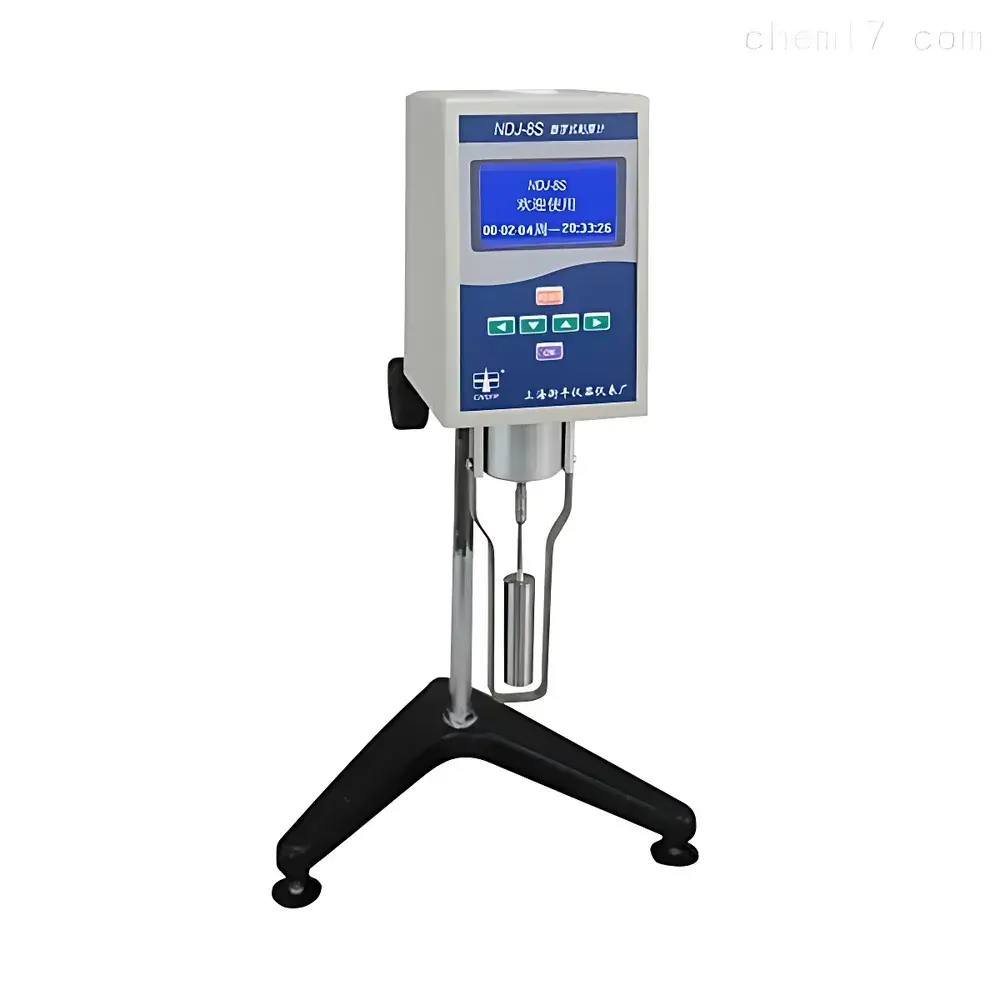
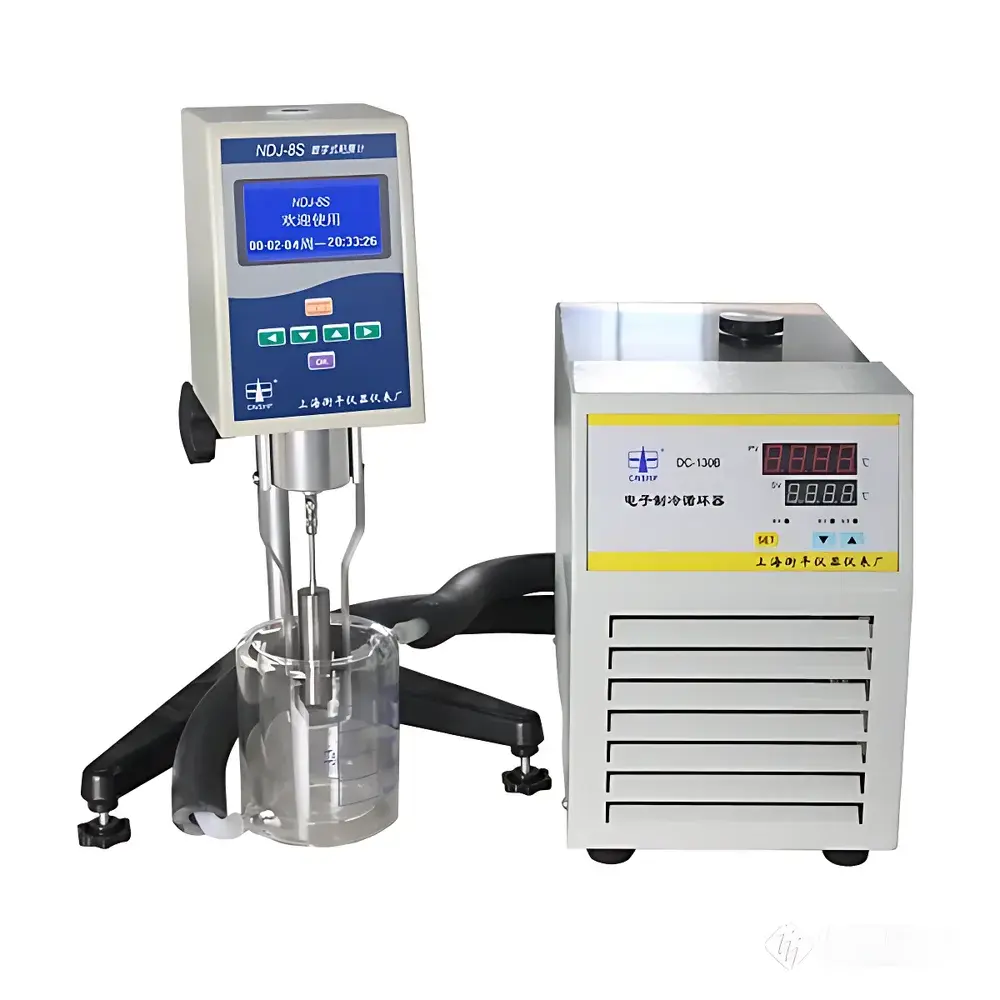
Shanghai Hengping NDJ-8S Digital Display Rotational Viscometer
| Brand | Hengping |
|---|---|
| Origin | Shanghai, China |
| Model | NDJ-8S |
| Instrument Type | Rotational Viscometer |
| Viscosity Range | 1–2×10⁶ mPa·s |
| Rotors | Standard #1–#4, Optional #0 |
| Speed Settings | 0.3, 0.6, 1.5, 3, 6, 12, 30, 60 rpm |
| Accuracy | ±2% (for Newtonian fluids) |
| Power Supply | AC 220 V ±10%, 50 Hz ±10% |
| Operating Environment | 5–35 °C, ≤80% RH |
| Dimensions | 380 × 320 × 390 mm |
| Net Weight | 6.8 kg |
| Display | Backlit LCD with bilingual (Chinese/English) UI |
| Auto-Ranging | Yes (auto-selects optimal rotor/speed combination) |
| Stability Indicator | Bar-graph stabilization prompt |
Overview
The Shanghai Hengping NDJ-8S Digital Display Rotational Viscometer is a precision-engineered instrument designed for laboratory and quality control applications requiring reliable, repeatable viscosity measurements of Newtonian and mildly non-Newtonian liquids. Based on the classical Couette principle, the NDJ-8S employs a motor-driven spindle system that rotates a calibrated cylindrical or bob-type rotor at precisely controlled speeds within the sample. The viscous drag torque exerted by the fluid on the rotor is detected via a high-sensitivity torsion sensor, converted to an analog signal, digitized, and processed by an embedded microcontroller. The resulting dynamic viscosity value—expressed in millipascal-seconds (mPa·s)—is displayed in real time alongside operational parameters including selected rotor number, rotational speed (rpm), % full-scale reading, and stability status. Its design conforms to fundamental rheological measurement standards under steady-state shear conditions, making it suitable for routine QC testing where traceability, operator independence, and procedural consistency are prioritized.
Key Features
- Eight discrete rotational speeds (0.3–60 rpm) enabling flexible shear rate selection across a broad viscosity spectrum
- Four standard precision-machined spindles (#1–#4), each geometrically optimized for specific viscosity ranges; optional #0 spindle extends low-end capability down to 0.1 mPa·s
- Intelligent auto-ranging function that recommends and applies the optimal rotor–speed combination based on preliminary readings, minimizing manual setup errors
- High-contrast backlit LCD display with dual-language interface (English/Chinese), supporting international lab environments and multilingual operators
- Digital signal processing architecture ensures stable data acquisition, noise rejection, and consistent repeatability (±2% accuracy for Newtonian reference oils per ASTM D2196 and ISO 2555)
- Robust mechanical construction with vibration-damped base and precision-machined bearing assembly for long-term calibration stability
- Compliance-ready design: supports manual documentation of test conditions (rotor ID, speed, ambient temperature) required under GLP and internal QA protocols
Sample Compatibility & Compliance
The NDJ-8S accommodates samples ranging from low-viscosity solvents (e.g., ethanol, acetone) to highly viscous pastes and polymer solutions (up to 2×10⁶ mPa·s). Sample volume requirements are minimal—typically 20–30 mL depending on rotor geometry—making it ideal for limited-sample scenarios. While not equipped with Peltier temperature control or automated sample loading, its operating envelope (5–35 °C, ≤80% RH) aligns with standard laboratory environmental controls. The instrument meets basic electrical safety requirements per IEC 61010-1 and is routinely deployed in settings governed by ISO/IEC 17025, USP , and internal SOPs for viscosity verification. For regulated industries (pharmaceuticals, cosmetics, coatings), users must validate method performance—including calibration against NIST-traceable standard oils—and maintain records of rotor cleaning, alignment checks, and periodic verification runs.
Software & Data Management
The NDJ-8S operates as a standalone instrument without proprietary PC software or USB connectivity. All measurement data—including viscosity (mPa·s), % full-scale, rotor identifier, and rpm—is retained only on-screen during active measurement and is not stored internally or exportable. Users are expected to manually record results in lab notebooks or LIMS-compatible spreadsheets. This architecture intentionally avoids complex software validation burdens while preserving audit readiness through transparent, human-readable output. For laboratories requiring electronic data capture, third-party serial-to-USB adapters (RS-232 TTL interface) may be used with custom scripts or generic terminal emulators—though such configurations fall outside factory support scope and require independent validation per FDA 21 CFR Part 11 if used in GxP environments.
Applications
- Quality assurance of industrial lubricants, transformer oils, and hydraulic fluids per ASTM D445
- Routine viscosity checks of adhesives, inks, paints, and architectural coatings during formulation and batch release
- Stability monitoring of food emulsions (e.g., salad dressings, sauces) and dairy-based suspensions
- Educational demonstrations of Newtonian behavior, shear-thinning trends, and viscometric calibration principles
- Raw material screening for polymers, resins, and synthetic latexes prior to reactor charging
- Verification of cleaning agent viscosity in semiconductor and medical device manufacturing support processes
FAQ
What viscosity standards are recommended for calibration verification?
NIST-traceable silicone oil standards (e.g., Cannon N4, N10, N100) or equivalent certified reference materials meeting ISO 8217 or ASTM D2196 specifications are advised for annual verification.
Can the NDJ-8S measure non-Newtonian fluids accurately?
It provides single-point apparent viscosity values under defined shear rates; for full flow curve characterization (e.g., yield stress, power-law index), a controlled-stress rheometer is required.
Is rotor #0 included in the standard configuration?
No—rotor #0 is an optional accessory intended for low-viscosity liquids (0.1–10 mPa·s) and must be ordered separately.
Does the instrument support temperature-controlled measurements?
No—the NDJ-8S lacks integrated temperature regulation; external water baths or Peltier stages must be used with appropriate fixtures and documented separately.
How often should calibration verification be performed?
At minimum: before first use, after any mechanical impact or maintenance, and at least once per quarter—or per internal SOP—using certified reference oils.



