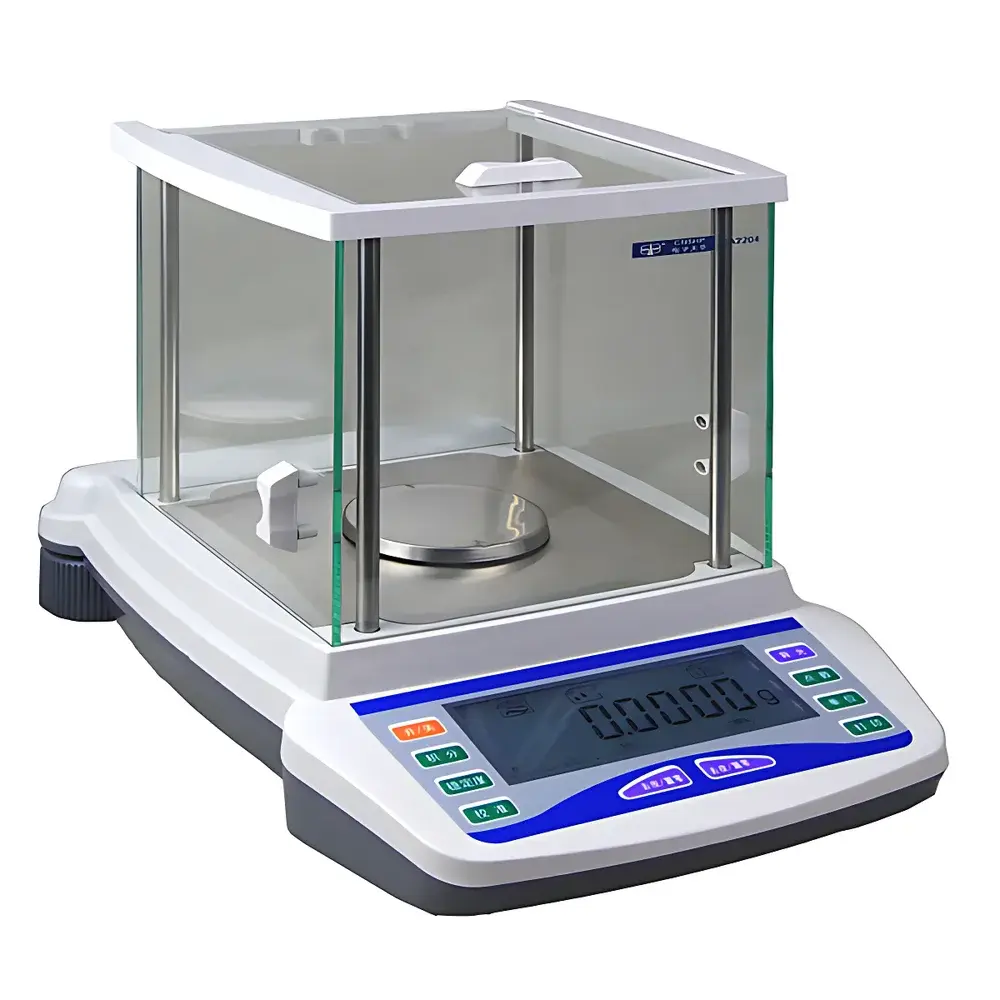
Hengping FA2104 Advanced Analytical Balance
| Brand | Hengping |
|---|---|
| Origin | Shanghai, China |
| Model | FA2104 |
| Maximum Capacity | 220 g |
| Readability | 0.1 mg (100 µg) |
| Repeatability | ≤ ±0.1 mg |
| Calibration | External (with 200 g weight) |
| Weighing Pan Diameter | Φ80 mm |
| Dimensions (L×W×H) | 366 × 230 × 340 mm |
| Net Weight | 8 kg |
| Power Supply | DC 6 V / 2 A (via AC adapter, 220 V input) |
| Stabilization Time | ≤ 8 s |
| Integration Time Options | 2.5 / 5 / 10 s |
| Leveling | Built-in bubble level + adjustable leveling feet |
| Interface | RS232 serial port |
| Compliance | GB/T 26497–2011, EMC Class B (5-test suite passed) |
| Protection | Overload protection, auto-fault detection, full-range tare, linear 4-point calibration |
Overview
The Hengping FA2104 Advanced Analytical Balance is a Class I precision instrument engineered for high-accuracy mass measurement in regulated and research-intensive laboratory environments. It operates on the electromagnetic force compensation principle — a proven method wherein the downward gravitational force exerted by a sample is precisely counterbalanced by an electromagnetic current-generated upward force. This closed-loop feedback system ensures exceptional linearity, long-term stability, and minimal drift over time. Designed to meet stringent metrological requirements for analytical weighing, the FA2104 delivers 0.1 mg readability across its 220 g maximum capacity, with repeatability ≤ ±0.1 mg under controlled ambient conditions (20 ±2 °C, <60% RH, vibration-isolated bench). Its robust mechanical architecture includes a high-stiffness weighing sensor, thermally stable internal components, and a rigid aluminum alloy housing that minimizes thermal expansion effects. The balance conforms to national standard GB/T 26497–2011 for non-automatic weighing instruments and has been independently verified against all five essential electromagnetic compatibility (EMC) tests per GB/T 18268.31–2017, ensuring reliable operation in electromagnetically noisy settings such as QC labs adjacent to centrifuges or RF equipment.
Key Features
- Five-sided fully transparent glass draft shield — optimized for unobstructed sample visibility and rapid airflow equilibration, reducing settling time without compromising accuracy.
- LCD backlit display with intuitive open-menu interface — all functions accessible directly from front panel; no hidden submenus or configuration layers.
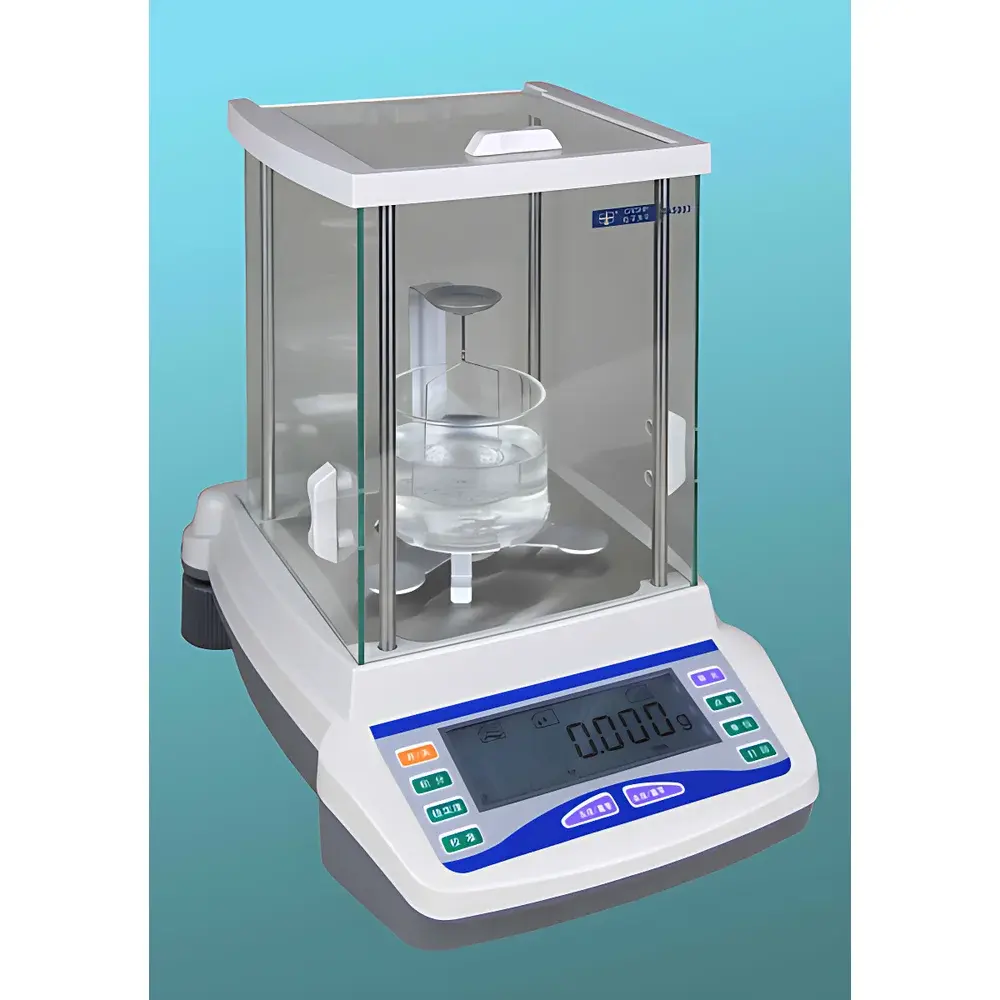
- Integrated below-balance weighing hook — enables density determination of irregular solids (when used with optional density kit), magnetic materials, or large-volume samples exceeding pan dimensions.
- Four-point linear calibration routine — performed externally using certified 200 g weights; supports traceable verification at multiple load points across the range.
- Comprehensive protection suite — includes full-range tare, overload cutoff, automatic fault diagnostics, and real-time error flagging (e.g., draft disturbance, temperature instability, or leveling misalignment).
- Adjustable leveling system — dual coarse/fine leveling feet paired with a precision bubble level indicator ensure optimal horizontal alignment prior to measurement — a prerequisite for achieving specified repeatability and linearity.
Sample Compatibility & Compliance
The FA2104 accommodates solid, liquid, and granular samples typical in pharmaceutical formulation, polymer characterization, catalyst loading, and geochemical analysis. Its Φ80 mm stainless-steel weighing pan and draft shield geometry support volumetric containers (e.g., beakers up to 100 mL), crucibles, filter papers, and small electronic components. For density applications, optional accessories include a density stand, sinker, and thermometer interface — enabling calculation per Archimedes’ principle with uncertainty propagation aligned with ISO 16269 and ASTM D792. Regulatory compliance extends to GLP-aligned workflows: RS232 output supports audit-trail-capable data logging systems compliant with FDA 21 CFR Part 11 when integrated with validated software. While not intrinsically 21 CFR Part 11–certified, the balance’s deterministic behavior, non-volatile memory retention of calibration logs, and timestamp-free raw output enable integration into validated electronic lab notebooks (ELNs) and LIMS platforms.
Software & Data Management
Equipped with a standard RS232 serial interface (9600 baud, N-8-1), the FA2104 transmits stabilized weight values, tare status, unit selection, and error codes in ASCII format. Output formatting is configurable via DIP-switch settings to match legacy lab printers or modern data acquisition systems. No proprietary drivers are required — native COM port communication allows seamless integration with Excel-based macros, LabVIEW VIs, Python scripts (via pySerial), or commercial QC software (e.g., Minitab Workspace, JMP Connect). All transmitted data include carriage return/line feed termination for parser compatibility. Internal memory retains last calibration date, integration time setting, and unit preference across power cycles — supporting continuity in multi-shift operations without reconfiguration.
Applications
This balance serves critical roles in quality control laboratories performing USP repeatability testing, ISO/IEC 17025–accredited reference material certification, and GMP-compliant batch release testing. Typical use cases include: gravimetric preparation of standard solutions (e.g., 100 ppm stock dilutions), loss-on-drying (LOD) assays per USP , active pharmaceutical ingredient (API) potency verification, catalyst mass dosing in heterogeneous catalysis R&D, ash content determination in coal and biomass samples (ASTM D3174), and microgram-level additive blending in semiconductor packaging formulations. Its environmental resilience and low susceptibility to electrostatic interference also make it suitable for cleanroom environments (ISO Class 7 and above) where static discharge mitigation is mandatory.
FAQ
What is the recommended warm-up time before first use?
For Class I accuracy per GB/T 26497–2011, a minimum 120-minute preheating period is required after initial power-on. Subsequent daily use requires ≥30 minutes of stabilization following idle periods exceeding 60 minutes.
Does the FA2104 support internal calibration?
No — it is externally calibrated only. A certified 200 g weight (Class E2 or better) is required for full-range verification and adjustment.
Can this balance be used for density measurement?
Yes — when fitted with the optional density measurement kit (including sinker, support rod, and temperature probe), it calculates solid density per ISO 1183-1 with resolution down to 0.001 g/cm³.
Is the RS232 interface opto-isolated?
No — the interface uses standard TTL-level signaling. For electrically noisy industrial environments, a galvanically isolated USB-to-RS232 converter is recommended.
What maintenance intervals are advised for long-term accuracy?
Daily: visual inspection of draft shield integrity and leveling bubble position. Weekly: cleaning of pan and shield with lint-free ethanol wipe. Annually: full metrological verification by an accredited calibration laboratory (ISO/IEC 17025).