
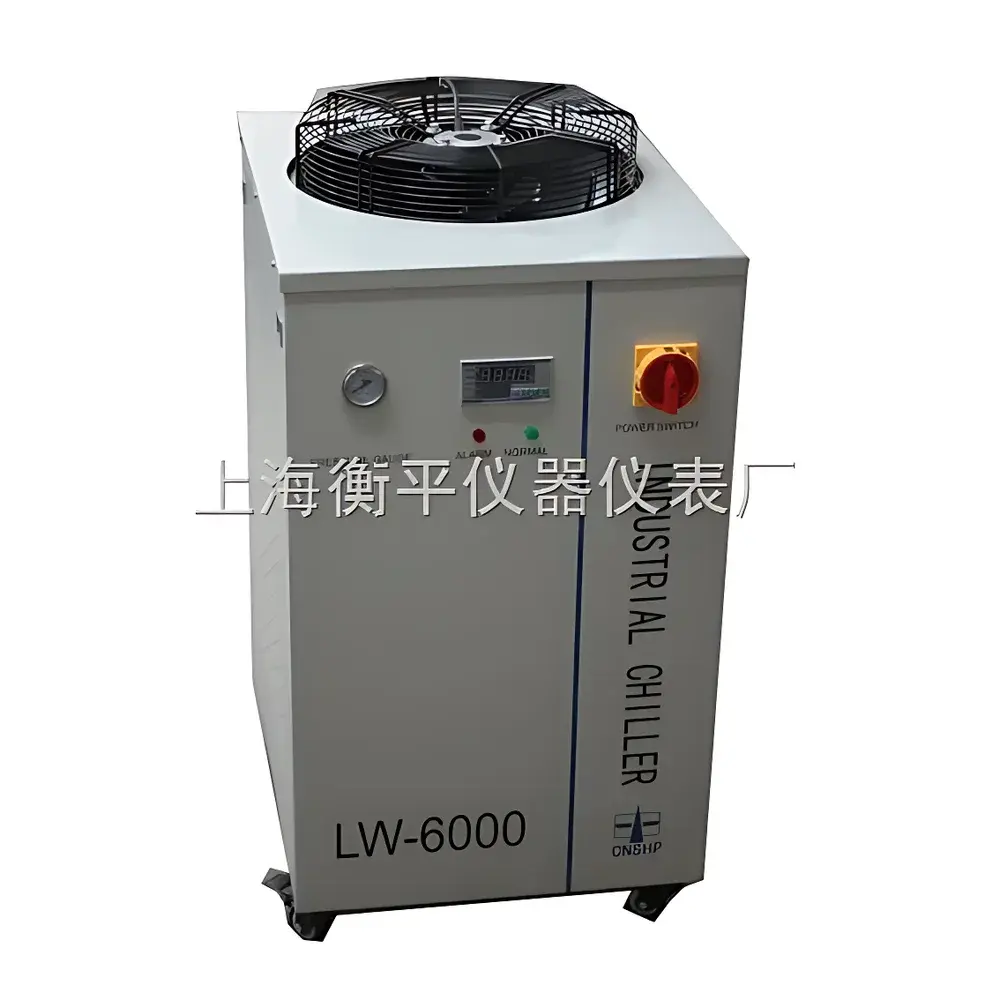
Shanghai Hengping LW-6000 Series Industrial Circulating Chiller
| Brand | Hengping |
|---|---|
| Origin | Shanghai, China |
| Model | LW-6000 |
| Type | Integrated Air-Cooled Circulating Chiller |
| Temperature Control Range | 5–40 °C |
| Temperature Stability | ±0.1 °C |
| Refrigeration Capacity | 2700–3000 W (9210–10,230 Btu/h) |
| Pump Flow Rate | 13 / 16 / 58 L/min |
| Pump Pressure | 2.0 bar (max. head: 12 / 25 / 28 m) |
| Reservoir Volume | 15 L |
| Power Supply | 220 V, 50 Hz |
| Compressor Power | 0.965–1.28 kW |
| Refrigerants | R-22 / R-134a / R-410a |
| Water Inlet/Outlet | Rp½″ |
| Net Weight | 60–72 kg |
| Dimensions (W×D×H) | 600 × 470 × 870 mm |
| Compliance | CE-marked design principles, GLP-aligned operational safeguards |
Overview
The Shanghai Hengping LW-6000 Series Industrial Circulating Chiller is an integrated, air-cooled precision temperature control system engineered for continuous-duty thermal management of high-heat-load laboratory and industrial equipment. Based on vapor-compression refrigeration cycle architecture, it delivers stable, controllable coolant circulation across a wide operating range (5–40 °C) with high thermal reproducibility (±0.1 °C stability). Designed to meet the demanding cooling requirements of laser sources, CNC spindles, and high-power optical systems, the LW-6000 integrates a hermetic scroll or rotary compressor, high-efficiency finned-tube condenser, expansion valve, and brazed plate evaporator—configured for optimal heat transfer in compact footprint (600 × 470 × 870 mm). Its modular internal layout supports field-serviceable maintenance and long-term reliability under 24/7 operation.
Key Features
- Triple-model configuration (LW-6000H2, LW-6000I2, LW-6000N2) optimized for distinct thermal loads: CO₂ glass tube lasers (≤300 W total), RF metal tube lasers (≤100 W), and solid-state/fiber lasers or CNC spindles (up to 22 kW).
- High-capacity centrifugal pump with adjustable flow (13–58 L/min) and pressure up to 2.0 bar, supporting multi-loop distribution and elevated discharge heads (up to 28 m).
- Dual-mode temperature control: setpoint regulation and delta-T (inlet–outlet) differential control, enabling adaptive response to dynamic thermal loads.
- Comprehensive protection suite: compressor overcurrent cutoff, delayed startup (3-min anti-short-cycling), real-time water flow monitoring with alarm output, and dual-stage temperature alarms (high/low limit thresholds).
- Corrosion-resistant 15 L stainless steel reservoir with level sensor, integrated air venting, and quick-connect Rp½″ NPT-compatible ports.
- Refrigerant flexibility: factory-configurable for R-22, R-134a, or R-410a—ensuring compliance with regional environmental regulations and service infrastructure availability.
Sample Compatibility & Compliance
The LW-6000 series is validated for direct integration with laser machining platforms (e.g., CO₂, fiber, and solid-state laser sources), high-speed electric spindles (≥10,000 rpm), coordinate boring machines, surface grinders, and multi-axis CNC machining centers. Its closed-loop architecture prevents contamination of sensitive optics and bearings while maintaining ISO 8573-1 Class 4 compressed-air-equivalent cleanliness in coolant pathways. While not certified to UL/CSA standards, its electrical design adheres to IEC 61000-6-2 (immunity) and IEC 61000-6-4 (emission) limits. The control logic supports audit-ready event logging—including temperature excursions, pump faults, and compressor cycles—for laboratories operating under GLP or ISO/IEC 17025 frameworks.
Software & Data Management
The chiller operates via a front-panel LCD interface with tactile membrane keys and real-time parameter display (setpoint, actual temp, flow rate, compressor status). Optional RS-485 Modbus RTU communication enables integration into SCADA or MES environments for remote monitoring, scheduled setpoint changes, and fault reporting. All operational events—including alarm triggers, runtime hours, and compressor start-stop cycles—are timestamped and stored in non-volatile memory for ≥30 days. Data export requires external serial-to-USB adapter; no proprietary software or cloud dependency is required. Firmware updates are performed via microSD card slot (not included), ensuring offline maintainability in regulated facilities where network isolation is mandated (e.g., FDA 21 CFR Part 11 environments with local validation protocols).
Applications
- Cooling of CO₂ laser tubes (glass or metal RF), including multi-tube configurations requiring balanced flow distribution.
- Thermal stabilization of fiber laser diode stacks and Yb-doped gain modules operating at 1064 nm or 1080 nm wavelengths.
- Continuous-duty heat extraction from high-RPM CNC spindles, preventing thermal drift in precision milling and turning operations.
- Supporting spectroscopic instrumentation (e.g., FTIR detectors, CCD coolers) requiring low-noise, vibration-isolated coolant delivery.
- Integration into automated laser marking, engraving, welding, and cutting workcells where consistent coolant temperature directly impacts beam quality and process repeatability.
FAQ
What refrigerants are supported, and can the unit be retrofitted for newer alternatives?
The LW-6000 accepts R-22, R-134a, or R-410a depending on factory configuration. Retrofitting requires full refrigerant circuit revalidation—including oil compatibility assessment, expansion device recalibration, and pressure switch adjustment—and must be performed by authorized service personnel.
Is the chiller suitable for cleanroom environments?
Yes—its sealed refrigeration loop, stainless steel reservoir, and absence of volatile organic lubricants make it compatible with ISO Class 5–7 cleanrooms when installed with HEPA-filtered ambient intake and proper condensate management.
Does the unit support external temperature feedback control?
No native PID input for external sensor feedback is provided; however, the delta-T control mode allows indirect regulation using inlet/outlet thermistors installed in the user’s process loop.
What is the expected service interval for compressor oil and filter replacement?
Under continuous operation at ≤80% load, compressor oil and dryer filter replacement is recommended every 12,000 operating hours or 24 months—whichever occurs first—as per ASHRAE Guideline 3-2023 for industrial chillers.
Can multiple LW-6000 units be synchronized for redundant cooling?
Yes—via dry-contact alarm relays and shared setpoint reference signals, enabling master-slave cascading or N+1 redundancy architectures without additional controllers.



