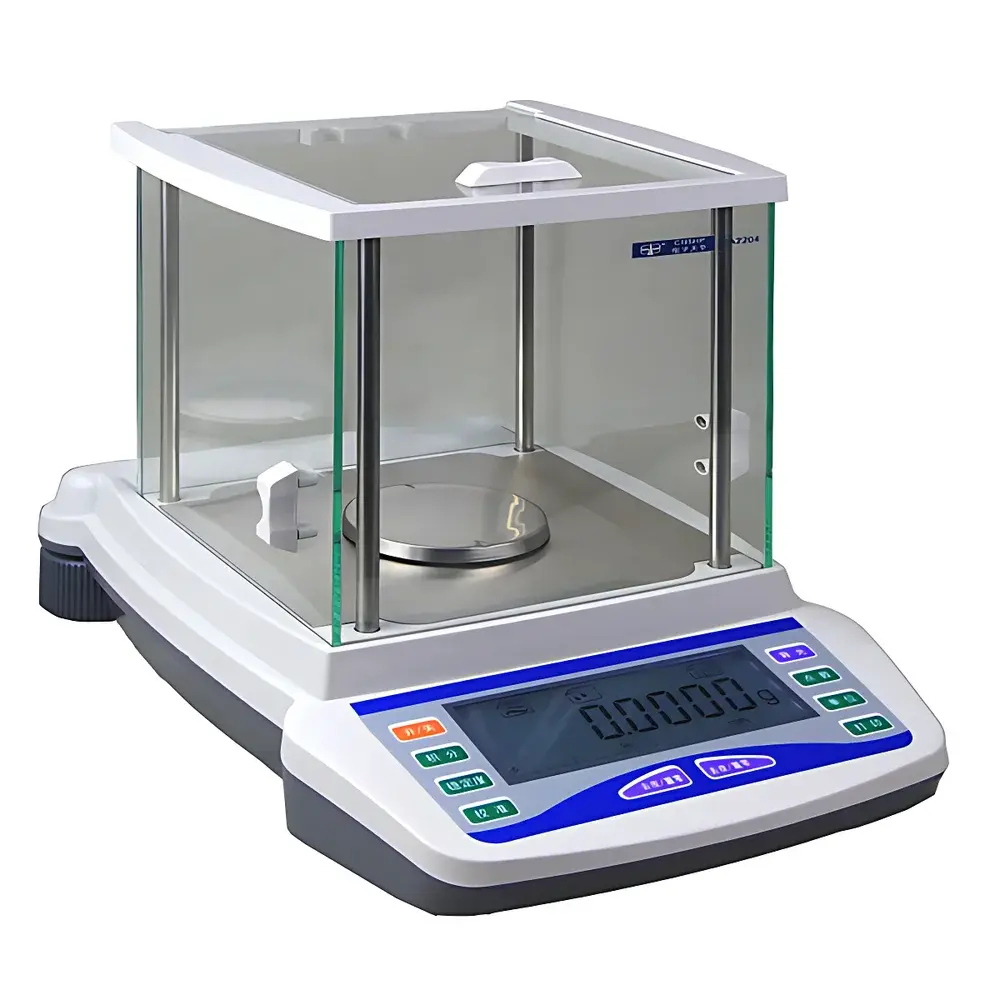
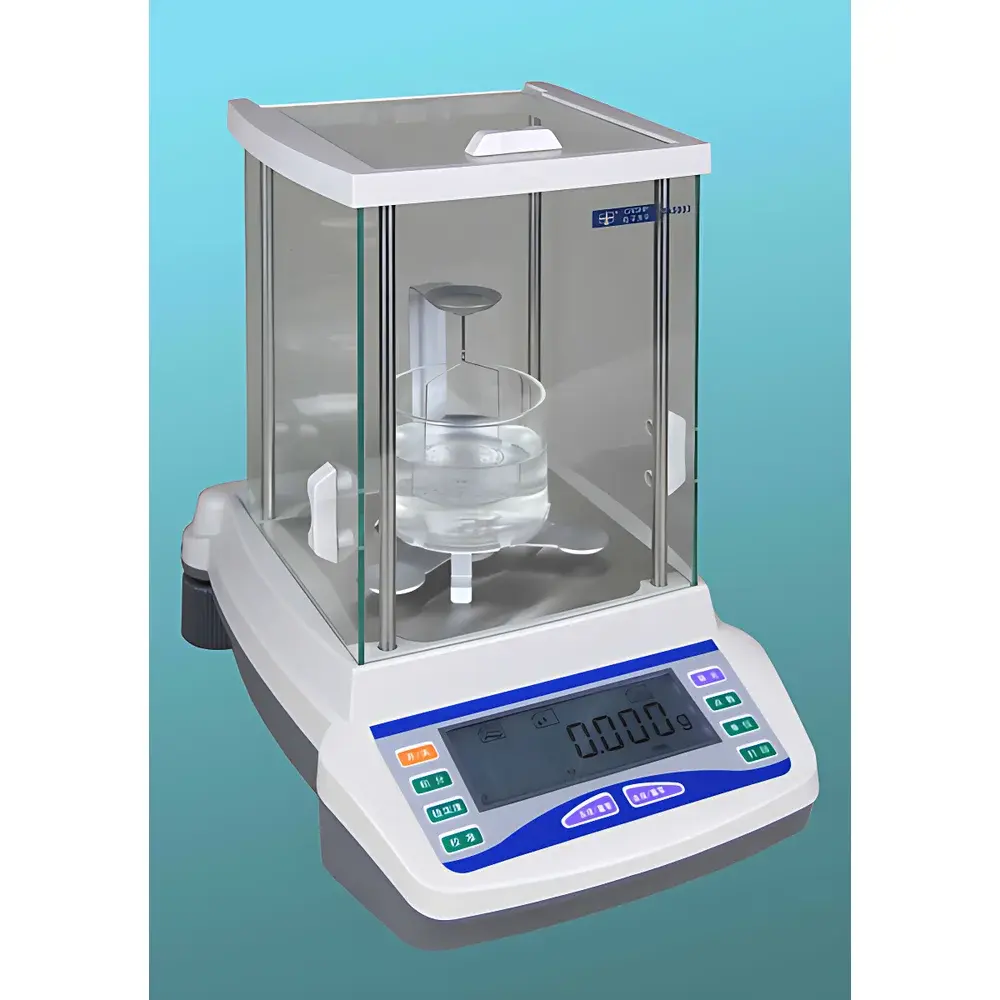
Hengping FA2204 Advanced Analytical Balance
| Brand | Hengping |
|---|---|
| Origin | Shanghai, China |
| Model | FA2204 |
| Maximum Capacity | 220 g |
| Readability | 0.1 mg |
| Repeatability | ≤ ±0.1 mg |
| Calibration Method | External manual calibration (100 g weight included) |
| Pan Diameter | Φ80 mm |
| Dimensions (L×W×H) | 366 × 230 × 340 mm |
| Net Weight | 8 kg |
| Power Supply | DC 6 V / 2 A adapter (AC 220 V input) |
| Warm-up Time | ≥120 min for optimal Class I accuracy |
| Compliance | GB/T 26497–2011, EMC Directive (5 test items passed) |
| Interface | RS232 serial port |
Overview
The Hengping FA2204 Advanced Analytical Balance is a precision electromagnetic force compensation balance engineered for high-reproducibility mass measurement in regulated laboratory environments. Operating on the principle of electromagnetic force restoration—where an internal coil generates a counteracting magnetic field to balance the gravitational load—the instrument delivers stable, drift-compensated readings with inherent linearity and minimal hysteresis. Designed to meet Class I accuracy requirements per GB/T 26497–2011 (equivalent to OIML R76-1 metrological classification), it supports critical workflows in quality control, pharmaceutical formulation, materials research, and academic analytical chemistry. Its robust mechanical architecture includes a draft shield with four-sided transparent glass enclosure, integrated leveling bubble, and adjustable leveling feet to ensure mechanical stability under variable floor conditions. The balance achieves thermal equilibrium after a minimum 120-minute warm-up period—a prerequisite for achieving its specified repeatability and readability performance across ambient temperature fluctuations typical in non-climate-controlled labs.
Key Features
- Electromagnetic force compensation sensor with optimized thermal drift suppression and long-term zero stability
- LCD backlit display with intuitive menu navigation and real-time status indicators (e.g., calibration status, overload warning, stabilization prompt)
- External calibration capability using certified 100 g weights; calibration sequence guided by on-screen prompts
- RS232 interface compliant with standard asynchronous serial protocols (9600 baud, 8N1), enabling direct connection to PCs, label printers, or LIMS systems
- Multiple built-in functions: piece counting (with user-defined sample weight), unit conversion (g, mg, oz, ct, etc.), below-balance weighing via hook assembly, and auto-zero tracking
- Integrated environmental protection: IP42-rated enclosure, ESD-safe housing, and five-point EMC certification per IEC/EN 61326-1 (surge, EFT, radiated RF, conducted RF, and electrostatic discharge)
- Configurable integration time (2.5 / 5 / 10 s) and stabilization threshold to adapt to vibration-prone lab benches or low-mass samples
Sample Compatibility & Compliance
The FA2204 accommodates a broad range of sample types—including powders, granules, small metallic components, filter papers, and pre-weighed vials—within its 220 g capacity and 80 mm diameter stainless-steel pan. Its design conforms to fundamental metrological requirements for analytical balances used in GLP and GMP-aligned laboratories. While not inherently 21 CFR Part 11 compliant (as it lacks audit-trail-capable firmware), its RS232 output enables traceable data capture when paired with validated third-party software. The balance satisfies national metrological verification standards in China (GB/T 26497–2011) and demonstrates full compliance with electromagnetic compatibility directives applicable to laboratory instrumentation in EU and North American markets. Optional density determination kits (FA/JA-M series) extend functionality to solid and liquid density measurement per Archimedean principle, supporting applications in polymer characterization, precious metal assay, and geological sample analysis.
Software & Data Management
Data export is facilitated through ASCII-based RS232 transmission, supporting seamless integration with spreadsheet applications, statistical process control (SPC) tools, and electronic lab notebooks (ELNs). Output format is configurable (e.g., “g” or tab-delimited), ensuring compatibility with legacy and modern data acquisition systems. Though the FA2204 does not feature onboard data logging or password-protected user levels, its deterministic communication protocol allows for repeatable, timestamped data capture when interfaced with external controllers. For regulated environments requiring audit trails, integration with validated middleware (e.g., LabWare LIMS or Thermo Fisher SampleManager) is recommended to fulfill ALCOA+ data integrity principles.
Applications
- Pharmaceutical QC: Active pharmaceutical ingredient (API) weighing, excipient blending verification, and tablet content uniformity testing
- Materials science: Density determination of composites, ceramics, and alloys using optional density kit
- Food safety labs: Moisture content analysis via gravimetric loss-on-drying protocols
- Environmental testing: Filter mass gain measurement for particulate matter (PM₂.₅/PM₁₀) analysis
- University teaching labs: Fundamental metrology instruction, stoichiometric reaction setup, and calibration standard preparation
- Metallurgical QA: Small-part mass verification prior to tensile or hardness testing
FAQ
What is the required warm-up time before achieving Class I accuracy?
A minimum of 120 minutes is required after power-on to stabilize internal thermal gradients and achieve the specified 0.1 mg readability and ≤±0.1 mg repeatability.
Does the FA2204 support internal calibration?
No—it requires external calibration using a certified 100 g weight; no motorized internal mass or automatic calibration mechanism is included.
Can this balance be used for density measurement out of the box?
Density functionality is optional and requires the separately ordered FA/JA-M density kit, which includes sinker, thermometer, and liquid support stand.
Is the RS232 interface compatible with modern Windows/macOS systems?
Yes—when used with a USB-to-RS232 adapter and standard terminal emulation software (e.g., Tera Term, PuTTY), the interface reliably transmits stable ASCII-formatted weight data.
What environmental conditions are recommended for optimal performance?
Operate within 15–30 °C ambient temperature, <70% RH non-condensing, and away from air currents, direct sunlight, or vibrating surfaces; leveling must be verified before each measurement session.