
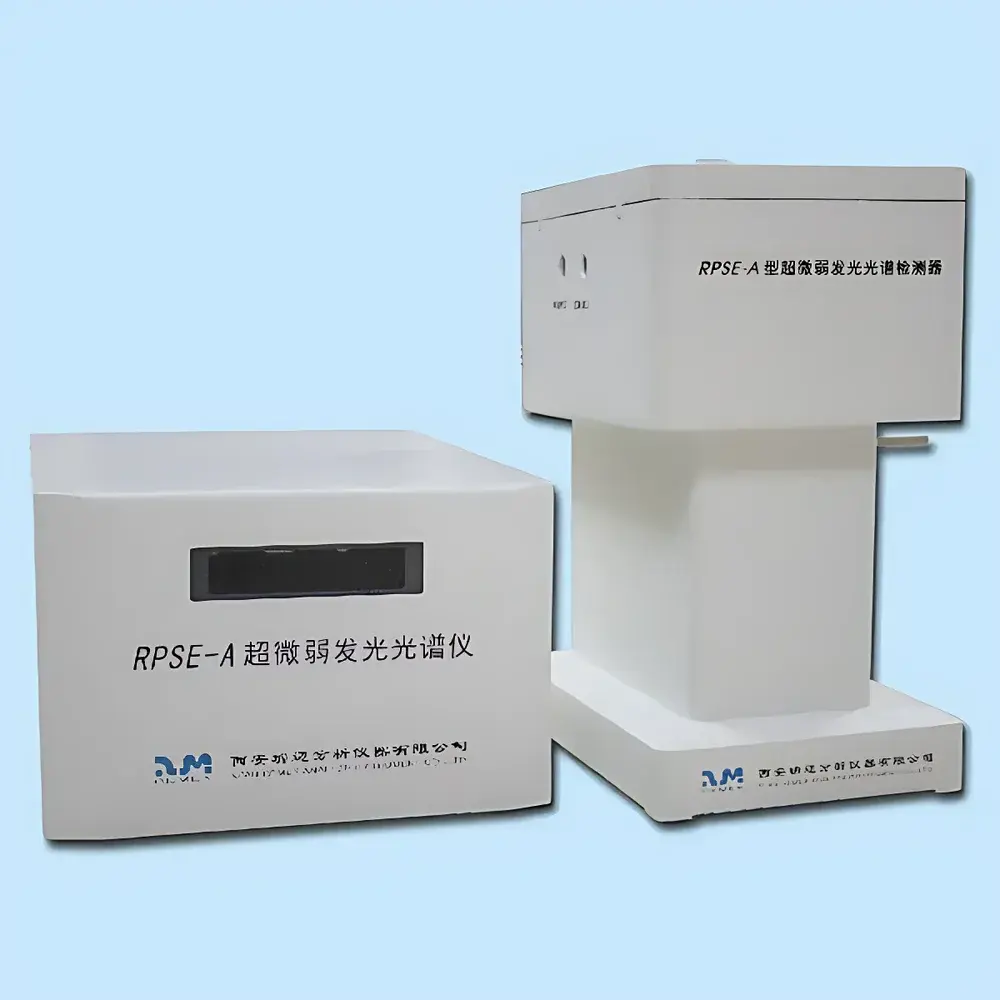
REMEX RPSE-A Ultra-Weak Luminescence Spectrometer
| Brand | REMEX (Xi’an Remex Analytical Instrument Co., Ltd.) |
|---|---|
| Origin | Shaanxi, China |
| Manufacturer Type | Authorized Distributor |
| Country of Origin | China |
| Model | RPSE-A |
| Pricing | Upon Request |
| Electrochemical Potential Range | −10 V to +10 V |
| Current Range | ±250 mA |
| Reference Electrode Input Impedance | ≥10 MΩ |
| Current Sensitivity | 1 × 10⁻⁹ A to 1 × 10⁻² A (8 decades) |
| Input Bias Current | <50 pA |
| Potential Increment | 1 mV |
| Scan Rate | 0.001–65 V/s |
| Wavelength Range (Monochromator) | 300–800 nm (standard), optional 200–800 nm |
| Spectral Resolution | 4.32 nm (adjustable via slit pairs: 0.4–7.2 nm, slit widths 0.05–1.0 mm) |
| Wavelength Accuracy | ±0.2% |
| Wavelength Repeatability | ±0.15% |
| Monochromator Scan Speed | 50 nm/s (standard), 100 nm/s (high-speed) |
| Exit Slit Width | 600 µm |
| Scan Modes | Time-based, fixed-point, range-scan, cyclic scan |
| Photodetector Wavelength Range | 230–700 nm |
| Peak Sensitivity Wavelength | 420 nm |
| Detection Method | Single-Photon Counting |
| Integration Times | 1 ms to 3600 s (12 selectable steps) |
Overview
The REMEX RPSE-A Ultra-Weak Luminescence Spectrometer is a fully integrated, PC-controlled analytical platform engineered for high-fidelity detection and spectral characterization of ultra-low-intensity luminescent emissions—spanning chemiluminescence (CL), electrochemiluminescence (ECL), bioluminescence (BL), and photoluminescence in the sub-picomolar regime. At its core, the system employs a high-resolution, motorized scanning monochromator coupled with a single-photon counting photomultiplier tube (PMT) detector, enabling quantitative spectral acquisition across the UV-Vis-NIR range (230–700 nm detection; 300–800 nm monochromator standard). Unlike conventional spectrophotometers or intensified CCD-based systems, the RPSE-A utilizes time-resolved photon counting methodology, delivering superior signal-to-noise ratio (SNR) and linear dynamic range (>10⁸) essential for kinetic studies of transient luminescent events. Its embedded electrochemical workstation supports potentiostatic, galvanostatic, cyclic voltammetry (CV), linear sweep voltammetry (LSV), and amperometric detection—allowing real-time synchronization between electrochemical stimulus and spectral emission response. This architecture makes the RPSE-A particularly suited for mechanistic investigations where temporal resolution, spectral fidelity, and electro-optical correlation are critical.
Key Features
- Integrated dual-function platform: Simultaneous electrochemical control and time-resolved luminescence spectroscopy in a single instrument.
- High-stability monochromator with programmable slit selection (0.05–1.0 mm), enabling adjustable spectral resolution from 0.4 nm to 7.2 nm without hardware recalibration.
- Single-photon counting PMT detector with peak quantum efficiency at 420 nm and dark count rate <10 cps (typ.), optimized for sub-attowatt optical power detection.
- Electrochemical module compliant with standard potentiostat specifications: ±10 V potential window, ±250 mA current output, input impedance ≥10 MΩ, bias current <50 pA.
- Multi-mode scanning: Supports time-triggered, wavelength-fixed, user-defined spectral range, and repetitive cycling scans—enabling kinetic profiling, emission mapping, and spectral stability assessment.
- USB 2.0 interface with deterministic latency (<10 ms), supporting synchronized data acquisition across electrochemical waveforms and photon arrival timestamps.
- Real-time 2D/3D visualization: Intensity vs. wavelength vs. time plots generated directly in software, with export-ready formats (CSV, ASCII, HDF5).
Sample Compatibility & Compliance
The RPSE-A accommodates diverse sample configurations including static cuvettes, flow-injection cells, microfluidic chips, and electrode-integrated ECL reactors. Its electromagnetic shielding design meets IEC 61326-1 Class B requirements for laboratory electromagnetic compatibility (EMC), minimizing interference from adjacent instrumentation such as centrifuges, stirrers, or RF sources. While not certified for GMP production environments, the system supports GLP-aligned workflows through full audit trail logging (user actions, parameter changes, calibration timestamps) and exportable raw-data archives. Software-generated reports include metadata per ASTM E2917-21 (Standard Practice for Validation of Analytical Methods Using Chemiluminescence) and align with principles outlined in ISO/IEC 17025:2017 for measurement traceability. All electrochemical methods conform to IUPAC-recommended definitions for CV parameters and comply with USP guidelines for analytical instrument qualification (AIQ) when deployed in regulated research settings.
Software & Data Management
The RPSE-A operates under Windows-based REMEX SpectraControl v3.x software, which provides unified control of both electrochemical and optical subsystems. The application implements a modular driver architecture compliant with NI-VISA and IVI-C standards, facilitating third-party integration via LabVIEW, Python (PyVISA), or MATLAB. Data acquisition supports event-triggered sampling synchronized to electrochemical pulse edges (e.g., ECL onset during square-wave excitation), with timestamp resolution ≤1 µs. All raw photon counts and electrochemical currents are stored in binary format with embedded metadata (wavelength calibration coefficients, slit position, HV setting, integration time). Post-acquisition processing includes background subtraction (rolling median filter), spectral deconvolution (Gaussian/Lorentzian fitting), kinetic decay modeling (mono-/bi-exponential fits), and comparative spectral library matching. Export options include CSV (tabular), PNG/SVG (publication-grade figures), and HDF5 (for machine learning pipelines). Audit logs record operator ID, session start/end, method name, and checksums for all exported files—supporting 21 CFR Part 11 readiness when paired with institutional identity management.
Applications
- Mechanistic studies of CL/ECL reaction pathways, including radical intermediates, excited-state lifetimes, and electron-transfer kinetics.
- Development and validation of ECL biosensors for clinical biomarkers (e.g., cardiac troponin, PSA) using Ru(bpy)₃²⁺- or luminol-based labels.
- Time-resolved spectral fingerprinting of bioluminescent proteins (e.g., NanoLuc, Gaussia luciferase) under varying pH, temperature, or cofactor conditions.
- Characterization of photocatalytic materials (e.g., TiO₂, g-C₃N₄) via in situ monitoring of reactive oxygen species (ROS)-induced CL bursts.
- Quality control of ultra-pure reagents where trace metal impurities catalyze background CL signals.
- Microfluidic ECL chip optimization—correlating electrode geometry, flow rate, and spectral output to maximize signal intensity and reproducibility.
FAQ
What is the minimum detectable photon flux under standard operating conditions?
At 420 nm and 1 s integration time, the system achieves a detection limit of ≤0.5 photons per second (signal above 3σ background), corresponding to ~10⁻¹⁸ W optical power.
Can the RPSE-A be used with non-aqueous electrochemical solvents?
Yes—the electrochemical cell compartment supports sealed, argon-purged configurations and is compatible with common organic electrolytes (e.g., acetonitrile/LiClO₄, DMF/TBAP) provided appropriate reference electrodes and solvent windows are selected.
Is wavelength calibration traceable to NIST standards?
Factory calibration uses Hg/Ar emission lines (253.65 nm, 365.01 nm, 404.66 nm, 435.83 nm, 546.07 nm, 696.54 nm); users may perform verification or recalibration using optional NIST-traceable holmium oxide or didymium filters.
Does the software support automated method sequencing for unattended operation?
Yes—batch mode allows up to 99 pre-programmed methods (electrochemical waveform + spectral acquisition parameters) with conditional logic (e.g., “if peak intensity > X, trigger next scan”).
What maintenance is required for long-term stability of the PMT detector?
The PMT operates at −800 V nominal; annual gain verification using a stable LED source is recommended. No routine vacuum maintenance is needed—the detector is sealed and permanently evacuated at manufacture.
Related Products



