
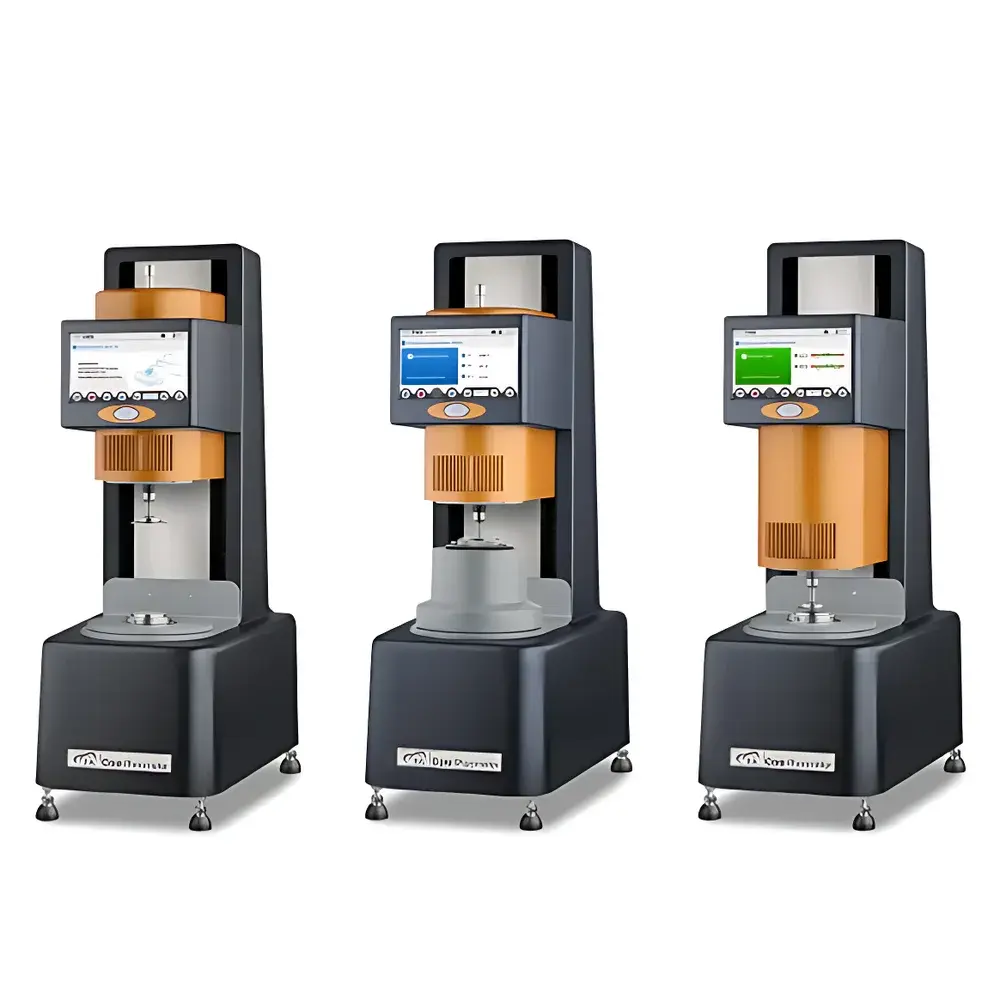
TA Instruments DISCOVERY CORE Rotational Rheometer
| Brand | TA Instruments |
|---|---|
| Origin | USA |
| Instrument Type | Rotational Rheometer |
| Motor Bearing | Precision Air Bearing |
| Temperature Range | -10 to 200 °C |
| Frequency Range | 10⁻⁴ to 628 rad/s |
| Minimum Angular Velocity | 10⁻⁴ rad/s |
| Maximum Angular Velocity | 300 rad/s |
| Maximum Torque | 125 mN·m |
| Torque Resolution | 10 nN·m |
Overview
The TA Instruments DISCOVERY CORE Rotational Rheometer is an engineered platform for precise, reproducible rheological characterization of complex fluids and soft solids under controlled thermal and mechanical conditions. Based on the Couette and cone-plate geometries and utilizing a high-stiffness air-bearing motor system, the DISCOVERY CORE applies controlled shear stress or strain to samples while measuring the resulting deformation response. This enables quantification of fundamental viscoelastic properties—including storage modulus (G′), loss modulus (G″), complex viscosity (η*), yield stress, and time-dependent behaviors such as thixotropy and creep recovery—across a broad dynamic range. Designed for laboratories requiring regulatory-compliant, operator-independent measurements, the system bridges the gap between R&D-grade instrumentation and routine QC testing without compromising metrological integrity.
Key Features
- Intuitive RheoGuide™ touchscreen interface enabling fully standalone operation—no PC required for standard tests.
- Step-by-step guided workflows with real-time visual prompts, contextual instructions, and built-in validation checkpoints at each procedural stage (e.g., fixture mounting verification, sample loading confirmation, temperature stabilization monitoring).
- Safety-integrated thermal management: automatic alerting when surface temperatures exceed safe touch thresholds (per ASTM C1055), with mandatory PPE reminders and motion-sensing interlock to disable touch input during head movement.
- Automated post-test analysis delivering immediate pass/fail evaluation against user-defined specification limits—optimized for high-throughput QA/QC environments.
- Method synchronization capability: seamless transfer of TRIOS™-developed measurement protocols from DISCOVERY Hybrid or other TA Instruments rheometers to ensure method equivalence across R&D, pilot-scale, and production labs.
- High-fidelity torque sensing with 10 nN·m resolution and ±0.1% torque accuracy, supported by a low-inertia air-bearing drive delivering exceptional signal-to-noise ratio across the full frequency spectrum (10⁻⁴–628 rad/s).
Sample Compatibility & Compliance
The DISCOVERY CORE accommodates standard rheological fixtures—including parallel plate, cone-and-plate, concentric cylinder, and vane geometries—enabling characterization of diverse material classes: polymer melts and solutions, pharmaceutical suspensions, food emulsions, cosmetic gels, battery slurries, and cementitious pastes. All hardware and firmware comply with ISO 17025:2017 requirements for testing laboratories, and data acquisition supports audit-trail functionality aligned with FDA 21 CFR Part 11 and EU Annex 11 for electronic records and signatures. Calibration traceability is maintained to NIST standards via TA Instruments’ certified calibration kits and documented procedures.
Software & Data Management
While the RheoGuide™ interface provides rapid execution of preconfigured methods, full analytical flexibility is retained through integration with TA Instruments’ TRIOS™ software suite. TRIOS™ enables advanced modeling (e.g., Cox-Merz, Williams-Landel-Ferry, Maxwell/Kelvin-Voigt fitting), custom report generation, batch processing, and export to industry-standard formats (CSV, XML, HDF5). Raw time-series data—including torque, angular displacement, temperature, and normal force—is stored in native .trd format with embedded metadata (operator ID, timestamp, instrument serial number, environmental logs) to support GLP/GMP documentation workflows.
Applications
- Formulation development: mapping structure–property relationships in surfactant systems, hydrogels, and thermoplastic elastomers.
- Process optimization: correlating melt rheology (e.g., zero-shear viscosity, extensional behavior) with extrusion or injection molding performance.
- Quality assurance: release testing of ophthalmic gels per USP , topical creams per EP 2.9.37, and adhesives per ASTM D1002.
- Stability assessment: time-sweep and oscillatory temperature ramp tests to evaluate shelf-life indicators such as phase separation or gelation onset.
- Regulatory submission support: generating GMP-compliant datasets for IND/NDA filings, including raw data archives, method validation reports, and equipment qualification records (IQ/OQ/PQ).
FAQ
Is the DISCOVERY CORE compliant with 21 CFR Part 11 for electronic records?
Yes—the system supports electronic signatures, audit trails, and secure user access controls when operated with TRIOS™ in validated configuration mode.
Can I use existing DISCOVERY Hybrid methods on the CORE platform?
Yes—TRIOS™-generated methods are directly importable and executable on the DISCOVERY CORE, ensuring measurement continuity across instrument platforms.
What temperature control options are available?
The system integrates with Peltier-based temperature control units (TAC) for rapid cooling/heating within –10 to 200 °C, with optional liquid-circulated accessories for extended low-temperature or high-precision applications.
Does the instrument support normal force measurement?
Yes—it includes a high-resolution axial force transducer for accurate normal stress determination during steady shear and oscillatory tests.
How is calibration verified during daily operation?
RheoGuide™ performs automated geometry recognition and executes built-in calibration checks prior to test initiation, logging all verification events to the audit trail.



