
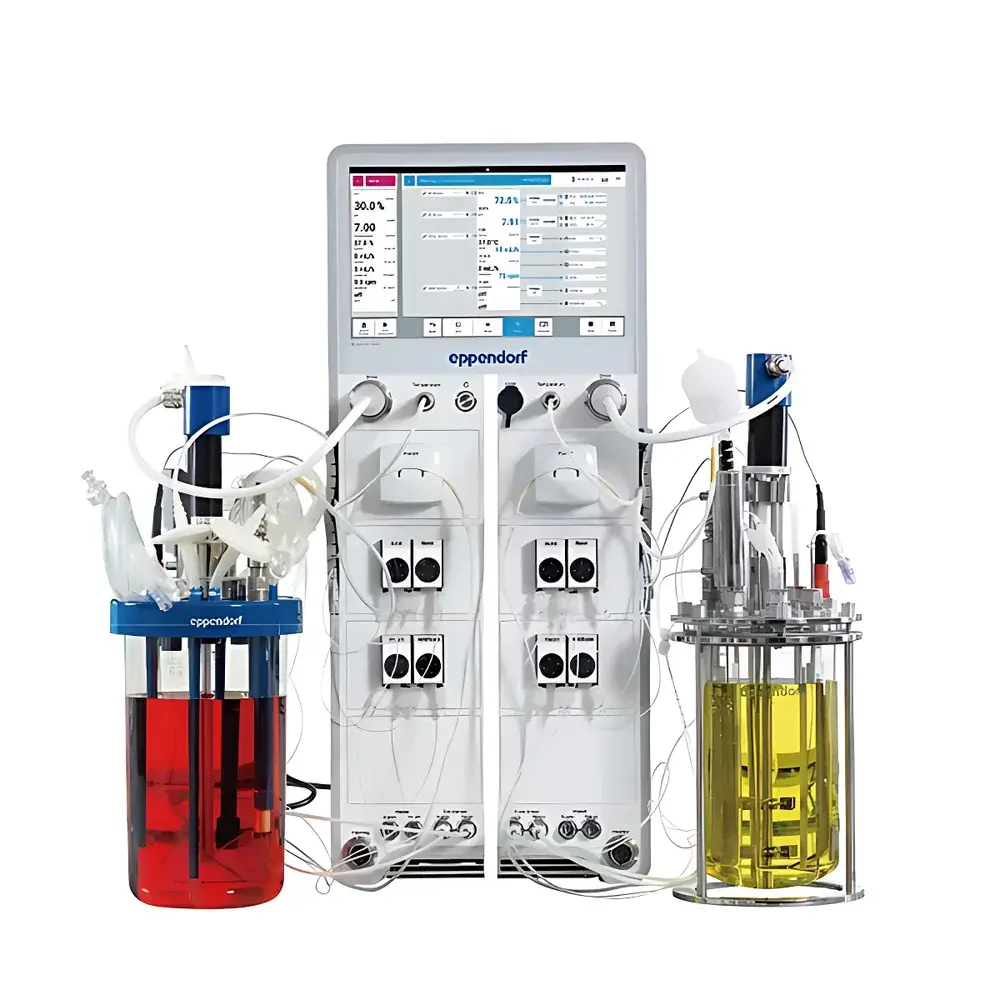
Eppendorf SciVario Twin Dual-Station Bioreactor System
| Brand | Eppendorf |
|---|---|
| Origin | Germany |
| Manufacturer Type | Original Equipment Manufacturer (OEM) |
| Import Status | Imported |
| Model | SciVario Twin |
| Working Volume Range | 0.7 L – 4.3 L |
| Construction Material | Stainless Steel (316L) |
| Operating Pressure | Up to 2 bar(g) |
| Vacuum Capability | Not Supported |
| Control Architecture | Dual independent stations, modular controller platform |
| Gas Flow Control | Mass Flow Controller (MFC)-based, scalable from 100 mL/min to 20 L/min |
| Electrode Compatibility | Auto-sensing pH, DO, conductivity, and redox electrodes |
| Remote Access | iOS/Android mobile app with real-time monitoring and push alerts |
| Compliance | Designed for GLP-compliant process development |
Overview
The Eppendorf SciVario Twin is a dual-station, benchtop bioreactor control system engineered for precision, scalability, and operational flexibility in early-stage bioprocess development. Based on a modular, microprocessor-controlled architecture, it implements closed-loop regulation of critical bioreaction parameters—including temperature, dissolved oxygen (DO), pH, agitation speed, gas flow (air/O₂/N₂/CO₂), and antifoam addition—across two independent vessels simultaneously. Its design adheres to the fundamental principles of microbial and mammalian cell culture kinetics, enabling reproducible scale-down modeling for upstream process development. Unlike monolithic reactor systems, the SciVario Twin decouples hardware control from vessel geometry, supporting interchangeable use of glass vessels (e.g., DASGIP-style) and single-use BioBLU bioreactors (0.7–4.3 L working volume), thereby bridging the gap between lab-scale experimentation and pilot-scale feasibility assessment.
Key Features
- Dual independent control stations with fully synchronized or asynchronous operation modes, allowing comparative studies (e.g., media screening, strain evaluation) under identical environmental conditions.
- Integrated mass flow controller (MFC) system delivering high-accuracy gas blending and dynamic flow modulation—from sub-100 mL/min for low-volume seed cultures to >15 L/min for high-density fed-batch runs—enabling faithful down-scaled simulation of large-scale sparging profiles.
- Auto-detect electrode interface supporting analog and digital (ISFET, optical DO) sensors from multiple vendors; automatic calibration recognition and drift compensation algorithms ensure long-term measurement stability.
- Drawer-based modular hardware design: users can add or replace modules—including peristaltic pumps, gas mixing units, or additional sensor inputs—without system downtime or firmware reconfiguration.
- Touchscreen HMI with guided workflow templates (e.g., “Yeast Batch Mode”, “CHO Fed-Batch Protocol”) reduces operator dependency and minimizes setup errors; all parameter changes are timestamped and logged with user ID attribution.
- Secure remote access via encrypted HTTPS API and native iOS/Android application, featuring live trend visualization, configurable alarm thresholds, and automated push notifications for critical deviations (e.g., DO drop >15% below setpoint for >90 s).
Sample Compatibility & Compliance
The SciVario Twin accommodates a broad spectrum of biological systems: aerobic and anaerobic bacterial fermentations (E. coli, Pseudomonas), yeast (S. cerevisiae, P. pastoris), filamentous fungi (Aspergillus, Trichoderma), insect cells (Sf9, High Five), and suspension-adapted mammalian lines (CHO, HEK293). Vessel compatibility includes standard jacketed glass reactors (DIN 15129, ISO 8573-1 clean air compliant) and Eppendorf BioBLU single-use bags (gamma-irradiated, USP Class VI certified). The system meets mechanical safety requirements per EN 61000-6-2/6-4 (EMC) and pressure equipment directives (PED 2014/68/EU) for vessels rated up to 2 bar(g). When configured with optional Eppendorf BioProcess Suite software, it supports ALCOA+ data integrity principles and provides full 21 CFR Part 11 compliance—including electronic signatures, audit trails, and role-based access control—for GMP-aligned process characterization studies.
Software & Data Management
Control logic and data acquisition are managed by Eppendorf’s BioProcess Suite (v4.2+), a Windows-based SCADA platform built on Microsoft .NET Framework and SQL Server Express. All sensor inputs are sampled at 1 Hz minimum, stored in structured binary archives (.bpr files), and exported to CSV, Excel, or OPC UA-compatible historians. The software enables real-time multivariate analysis (e.g., OTR-CER correlation, respiratory quotient calculation), customizable report generation (PDF/HTML), and integration with third-party analytics tools (MATLAB, Python via REST API). Raw data files include embedded metadata (vessel ID, operator, protocol version, firmware build), ensuring traceability across experiments. Optional cloud synchronization allows secure offsite backup and cross-site collaboration without compromising data sovereignty.
Applications
- Strain selection and media optimization for recombinant protein expression in microbial hosts.
- Process window definition for monoclonal antibody production in CHO cells under varying pH and feed strategies.
- Scale-down model validation for commercial bioreactor platforms (e.g., Sartorius BIOSTAT® STR, Thermo Fisher HyPerforma).
- Metabolic flux analysis requiring tightly controlled DO and CO₂ partial pressure gradients.
- Regulatory filing support: generation of robust, auditable datasets for IND/IMPD submissions per ICH Q5D and Q8(R2) guidelines.
- Education and training: standardized protocols for teaching bioreactor fundamentals in academic bioprocessing laboratories.
FAQ
Can the SciVario Twin control non-Eppendorf single-use bioreactors?
Yes—it supports third-party single-use vessels via analog 4–20 mA or digital Modbus RTU interfaces, provided they integrate compatible pH/DO probes and level sensors.
Is sterilization-in-place (SIP) functionality included?
No. SIP must be performed externally using autoclaves or steam generators; the system supports temperature ramping and hold profiles during post-sterilization cooldown and pre-inoculation equilibration.
What is the maximum allowable working pressure for connected vessels?
The controller itself does not impose pressure limits; vessel pressure rating depends on the selected reactor—glass vessels are typically rated to 1.5 bar(g), while BioBLU bags support up to 2 bar(g) per manufacturer specifications.
Does the system support feeding based on online glucose or viable cell density measurements?
Yes—via analog input channels or digital integration (e.g., Hamilton Arc Plus, Cedex Bio HT), enabling feedback-controlled nutrient addition triggered by user-defined thresholds.
How is cybersecurity addressed in remote access mode?
All mobile and web connections use TLS 1.2+ encryption; device authentication requires OAuth 2.0 tokens, and session timeouts are enforced after 15 minutes of inactivity.



