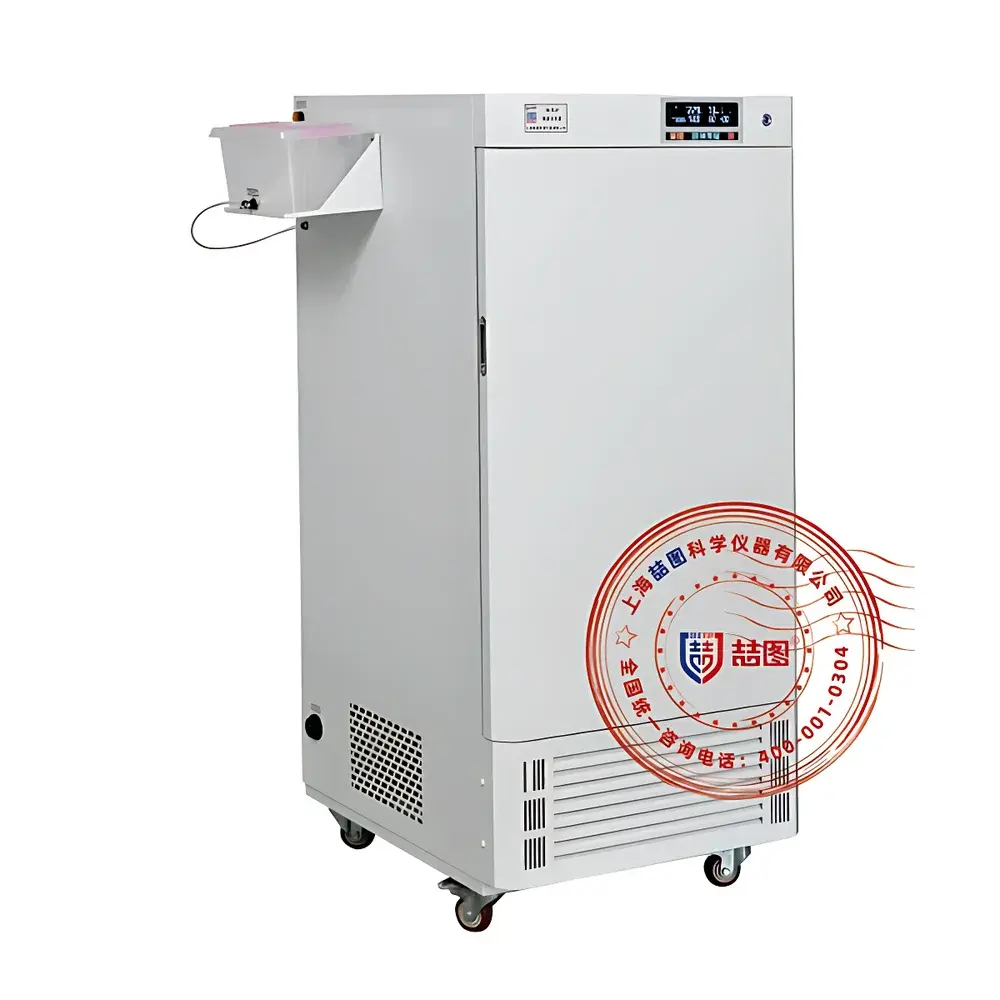
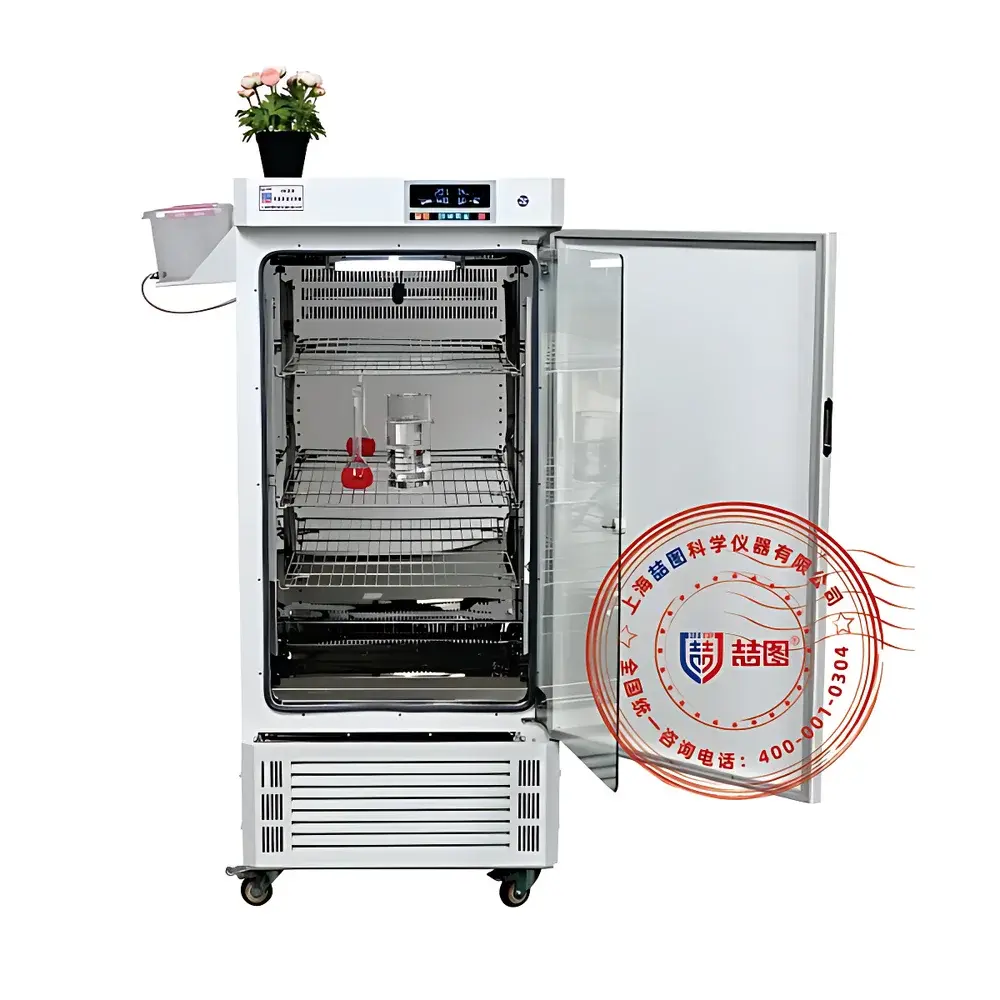
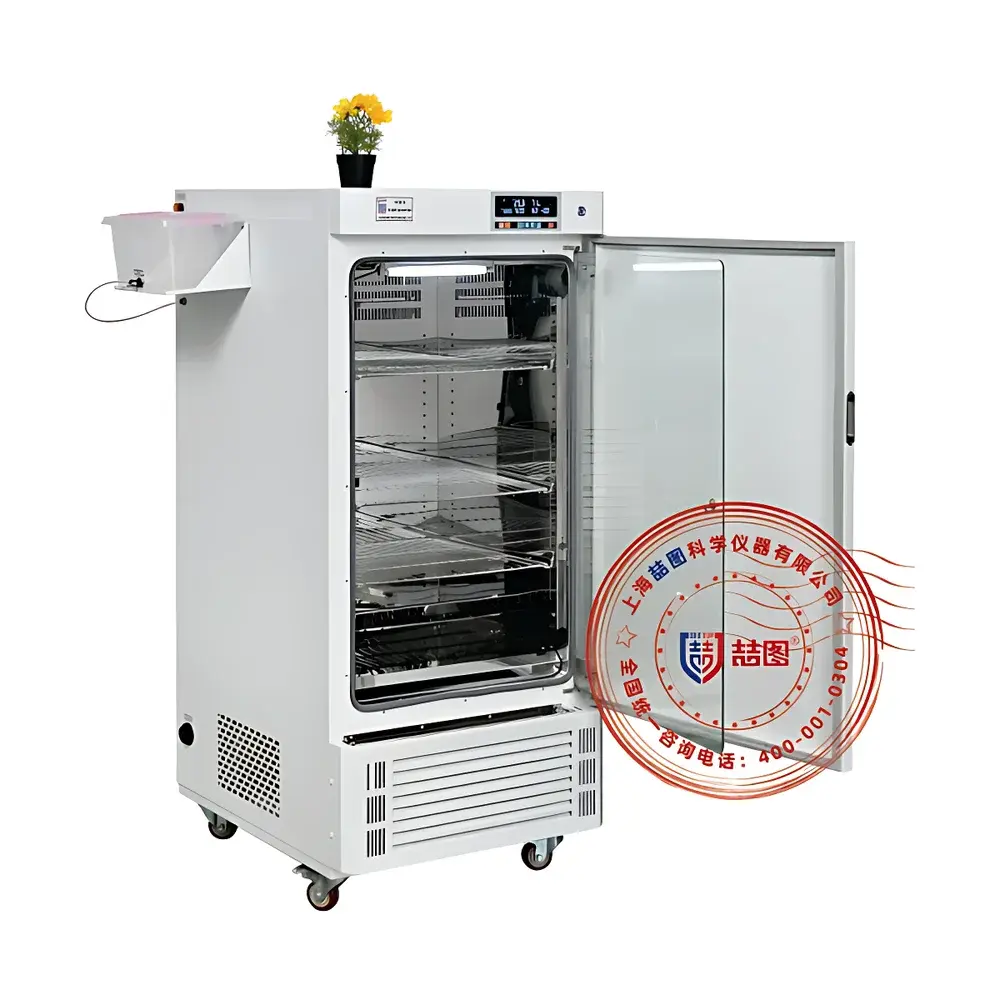
DRETOP ZHS-150HC Temperature and Humidity Controlled Incubator
| Brand | DRETOP |
|---|---|
| Origin | Shanghai, China |
| Model | ZHS-150HC |
| Heating Method | Air-jacketed |
| Cooling Method | Compressor-based |
| Humidification Reservoir | Integrated water tank |
| Temperature Range (with humidity) | 15–45 °C |
| Temperature Range (dry operation) | 0–65 °C |
| Temperature Fluctuation | ±0.5 °C at high temp / ±1 °C at low temp |
| Temperature Uniformity | ±0.1 °C |
| Humidity Range | 40–95 % RH |
| Humidity Resolution | 0.1 % RH |
| Chamber Capacity | 150 L |
| External Dimensions (W×D×H) | 630×700×1365 mm |
Overview
The DRETOP ZHS-150HC Temperature and Humidity Controlled Incubator is engineered for precise, long-term environmental simulation in life science laboratories, pharmaceutical stability testing, and materials performance evaluation. It operates on a dual-control principle—combining air-jacketed heating with compressor-driven refrigeration and integrated ultrasonic or evaporative humidification—to maintain stable, programmable temperature and relative humidity conditions across its 150 L stainless-steel chamber. Unlike basic incubators, the ZHS-150HC supports both active cooling and high-fidelity humidity regulation down to 40 % RH, enabling compliance with ICH Q1A(R2) guidelines for accelerated stability studies and USP environmental conditioning protocols. Its microprocessor-based PID control architecture ensures traceable, repeatable setpoint adherence—critical for GLP-compliant microbiological assays, seed germination trials, and polymer aging tests where thermal and hygric drift directly impact data validity.
Key Features
- Microcomputer PID temperature/humidity controller with 30-segment programmable cycle capability, supporting time-dependent ramp-and-soak profiles for multi-phase experiments.
- Large backlit LCD interface with touch-sensitive keys; real-time display of chamber setpoints, actual values, elapsed time, and alarm status.
- Air-jacketed heating system with NiCr alloy heaters and independent overtemperature cutoff (adjustable limit up to 85 °C), minimizing thermal overshoot and improving recovery after door opening.
- Compressor-based cooling circuit using R134a or R600a refrigerant (CFC-free), equipped with start-delay protection and compressor duty-cycle management to extend service life under continuous operation.
- Integrated humidification reservoir with automatic water-level detection and dry-run prevention; humidity output regulated via feedback-controlled evaporation surface area and fan-assisted vapor distribution.
- Chamber constructed from brushed 304 stainless steel interior with removable, height-adjustable shelves; rounded internal corners and seamless welds eliminate microbial harborage zones and simplify autoclave-compatible cleaning.
- Dual-pane observation window with tempered inner glass and magnetic door seal—optimized for thermal insulation and condensation resistance during high-humidity operation.
- Four-directional casters with locking mechanism and adjustable leveling feet for stable placement on uneven laboratory flooring.
Sample Compatibility & Compliance
The ZHS-150HC accommodates standard Petri dishes, multi-well plates, culture flasks (up to T225), and sealed stability chambers without airflow obstruction. Its uniform airflow pattern—generated by a low-noise axial fan and optimized internal duct geometry—ensures ≤±0.1 °C spatial temperature variation (measured per ISO 15270:2019 Annex B) and ≤±3 % RH humidity deviation (per ASTM E2041-21). The unit meets CE marking requirements for electrical safety (EN 61010-1) and electromagnetic compatibility (EN 61326-1). Optional RS485 serial interface enables integration into centralized lab monitoring systems compliant with FDA 21 CFR Part 11 when paired with validated third-party software for electronic audit trails and user-access logging.
Software & Data Management
While the ZHS-150HC operates autonomously via its onboard controller, optional communication modules support bidirectional data exchange. The RS485 port permits connection to SCADA platforms or custom LabVIEW applications for remote parameter adjustment, real-time trend logging, and alarm forwarding via email/SNMP. All operational events—including power interruptions, door openings, sensor faults, and setpoint changes—are timestamped and stored in non-volatile memory. Upon power restoration, the incubator resumes the last active program sequence with full parameter retention—a feature essential for unattended overnight or weekend stability runs. Firmware updates are performed via USB flash drive, ensuring regulatory traceability of control logic revisions.
Applications
- Pharmaceutical stability testing per ICH Q5C and Q1E protocols (e.g., 40 °C/75 % RH for accelerated conditions).
- Biological sample conditioning prior to rheological or spectroscopic analysis.
- Textile and packaging material hygrothermal aging per ISO 2231 and ASTM D4332.
- Fungal and bacterial culture maintenance under controlled moisture stress (e.g., Aspergillus spp. sporulation at 30 °C/85 % RH).
- Seed viability assessment and germination kinetics under variable humidity gradients.
- Electronics component moisture sensitivity level (MSL) preconditioning per JEDEC J-STD-020.
FAQ
What is the minimum humidity setpoint achievable with this incubator?
The ZHS-150HC maintains stable humidity down to 40 % RH across its full operating temperature range.
Does the unit support validation documentation (IQ/OQ/PQ)?
Yes—DRETOP provides factory calibration certificates traceable to NIST standards; users may perform on-site OQ using calibrated thermohygrometers and documented test protocols.
Can the incubator operate continuously at 45 °C and 95 % RH?
Yes—the integrated cooling and humidification systems are rated for uninterrupted operation under maximum combined load conditions.
Is the stainless-steel chamber electropolished?
No—the interior uses mechanically polished 304 stainless steel, sufficient for routine disinfection with 70 % ethanol or hydrogen peroxide vapor; electropolishing is available as a custom option.
What safety protections prevent condensation damage during rapid dehumidification?
The controller modulates compressor cycling and heater duty cycle to avoid cold-surface dew formation; no active anti-condensation heater is installed, but internal airflow design minimizes localized saturation.