
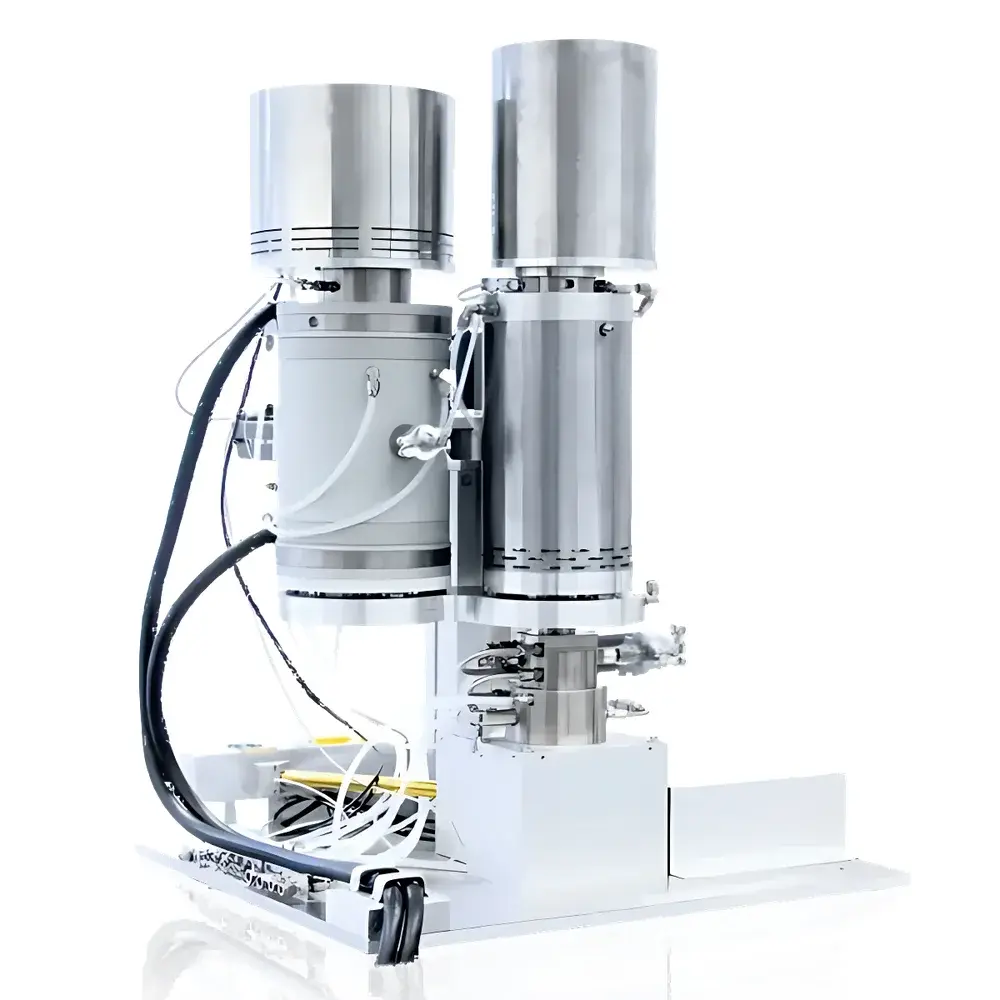
LINSEIS LFA L52 Nuclear Laser Flash Analyzer
| Brand | LINSEIS |
|---|---|
| Origin | Germany |
| Model | LFA L52 Nuclear |
| Measurement Principle | Laser Flash Analysis (LFA) |
| Thermal Conductivity Range | 0.1 – 4000 W/(m·K) |
| Thermal Diffusivity Range | 0.01 – 2000 mm²/s |
| Temperature Range | −125 °C to 2800 °C (configurable furnace options) |
| Laser Source | Nd:YAG, 25 J/pulse |
| Detector Type | Non-contact IR (InSb or MCT) |
| Atmosphere | Inert or reducing (recommended) |
| Sample Geometry | Circular (Ø 6, 10, 12.7, 25.4 mm) or square (10 × 10 mm, 20 × 20 mm) |
| Sample Thickness | 0.1 – 6 mm |
| Auto-sampler Options | 3-, 6-, or 18-position |
| Furnace Liner Materials | Metal / SiC / Graphite |
| Data Acquisition Rate | 2 MHz |
| Interface | USB |
| Heating Rate | 0.01 – 100 °C/min (furnace-dependent) |
Overview
The LINSEIS LFA L52 Nuclear is a purpose-engineered laser flash analyzer designed explicitly for thermal property characterization of nuclear-grade materials under stringent regulatory, safety, and operational constraints. Operating on the standardized laser flash method (ASTM E1461, ISO 13826, DIN EN 821-2), the instrument quantifies thermal diffusivity (α) by measuring the transient temperature rise on the rear surface of a thin, uniformly irradiated sample following a short, high-energy laser pulse. Thermal conductivity (λ) is then derived via λ = α · ρ · Cp, where ρ is density and Cp is specific heat—both determined independently or imported from validated reference databases. Unlike general-purpose LFA systems, the LFA L52 Nuclear integrates radiation-hardened electronics, hermetically sealed sample chambers, and furnace architectures compatible with glove-box integration or hot-cell remote operation. Its design accommodates the full spectrum of nuclear fuel forms—including UO₂, MOX, TRISO particles, molten salt compositions (e.g., FLiNaK), refractory carbides, nitrides, and advanced cladding alloys—across cryogenic to ultra-high-temperature regimes.
Key Features
- Multi-furnace architecture supporting three distinct thermal ranges: low-temperature cryo module (−125 °C), standard high-temperature furnace (RT–1600 °C), and ultra-high-temperature graphite/SiC furnace (RT–2800 °C)
- Nd:YAG laser source delivering 25 J/pulse with user-replaceable optics and integrated beam homogenization for uniform energy distribution
- Dual IR detector options: InSb (optimized for <500 °C) and MCT (extended range up to 2800 °C), both operating at 2 MHz sampling frequency for sub-millisecond thermal transient capture
- Modular sample chamber construction using radiation-stable materials—stainless steel, silicon carbide, and high-purity graphite—to maintain dimensional stability and minimize parasitic heat loss during prolonged exposure
- Configurable auto-samplers (3/6/18 positions) with pneumatic sample transfer and real-time position verification, enabling unattended batch analysis in shielded environments
- Compliance-ready firmware with audit trail logging, electronic signature support, and configurable user access levels aligned with 21 CFR Part 11 and GLP/GMP documentation requirements
Sample Compatibility & Compliance
The LFA L52 Nuclear accepts solid, sintered, or pelletized samples conforming to ASTM E1461 geometry guidelines: circular discs (Ø 6–25.4 mm) or square specimens (10 × 10 mm or 20 × 20 mm), thickness 0.1–6 mm. It supports highly reactive, radioactive, or air-sensitive nuclear materials—including actinide oxides, fluoride salts, and liquid metal simulants—when operated under inert (He, Ar) or reducing (Ar/H₂) atmospheres. All internal surfaces contacting samples are electropolished stainless steel or coated graphite to prevent catalytic decomposition or cross-contamination. The system meets IAEA TS-G-1.1 recommendations for thermal property instrumentation in nuclear fuel development laboratories and is routinely deployed in facilities accredited to ISO/IEC 17025 for nuclear material testing. Optional integration with secondary calorimetry modules enables concurrent Cp measurement per ISO 11357-4, eliminating reliance on literature values for conductivity derivation.
Software & Data Management
ThermoSoft™ Nuclear Edition provides full control, acquisition, and post-processing capabilities through an intuitive Windows-based interface. Raw thermogram data are stored in HDF5 format with embedded metadata (operator ID, furnace configuration, atmosphere, pulse energy, detector gain). Built-in algorithms apply pulse shape correction, radiative loss compensation (Dusza model), and multi-layer diffusion modeling for coated or composite nuclear fuels. Uncertainty propagation follows GUM (JCGM 100:2019) methodology, reporting expanded uncertainty (k=2) for both α and λ. Export options include CSV, XML, and PDF reports compliant with NRC Regulatory Guide 1.183 and EPRI technical report formatting standards. Data backups synchronize automatically to network-attached storage with SHA-256 checksum validation and time-stamped version control.
Applications
- Thermal diffusivity mapping of uranium dioxide (UO₂) and mixed oxide (MOX) pellets across burnup-relevant temperature gradients (300–2000 °C)
- High-temperature thermal conductivity validation of SiC fiber-reinforced composites for accident-tolerant fuel cladding
- Molten salt heat transfer characterization (e.g., FLiBe, FLiNaK) between 773 K and 973 K under helium purge, including degassing protocol implementation and bubble artifact suppression
- Transient thermal response analysis of TRISO fuel particle coatings (pyrolytic carbon, SiC) during rapid heating cycles simulating LOCA scenarios
- Thermal aging studies of nuclear graphite moderators, correlating irradiation dose with microstructural evolution and thermal transport degradation
FAQ
Does the LFA L52 Nuclear comply with nuclear facility cybersecurity requirements?
Yes—the instrument’s embedded controller runs a locked-down Linux RTOS with disabled USB mass storage, configurable firewall rules, and TLS 1.2 encrypted communication for remote monitoring.
Can it measure molten salts without sample container interference?
Yes—proprietary crucible-free sample holders with laser-transparent quartz windows and active background subtraction eliminate container contribution to the thermal signal.
Is calibration traceable to national metrology institutes?
All factory calibrations use NIST-traceable reference materials (e.g., NIST SRM 735a, SRM 1978) and are documented per ISO/IEC 17025 Annex A.2.
What safety interlocks are implemented for remote operation in hot cells?
Dual-channel radiation-hardened door interlocks, laser shutter fail-safes, overtemperature cutouts, and emergency purge gas activation are hardwired into the safety PLC per IEC 61508 SIL2.
How is data integrity ensured during long-duration high-temperature tests?
Real-time CRC-32 checksumming of every acquired thermogram frame, combined with redundant SSD + network RAID-1 storage, prevents silent corruption during multi-hour runs at 2500 °C.



