
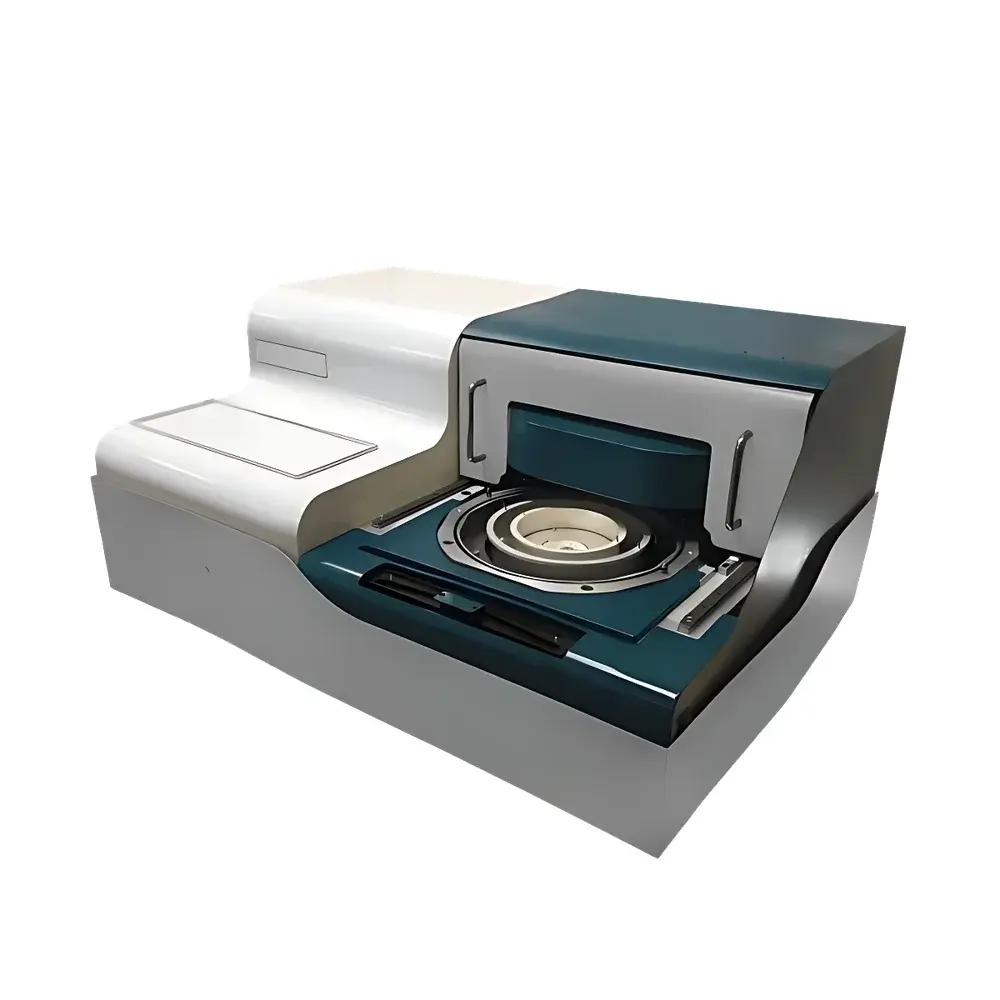
LINSEIS Calneos DSC L64 Differential Scanning Calorimeter
| Brand | LINSEIS |
|---|---|
| Origin | Germany |
| Model | DSC L64 |
| Instrument Type | Differential Scanning Calorimeter (DSC) |
| Temperature Range | −50 to 160 °C (standard) |
| Heating/Cooling Rate | 0.001–10 K/min (standard) |
| Temperature Accuracy | ±100 µ°C |
| Sensitivity | 550 µV/mW (25 °C) |
| Sample Volume | 5–100 µL (standard) |
| Sensor Technology | Patented high-sensitivity thermopile-based sensor with direct sample temperature measurement and Joule-effect calibration |
| Sample Holder | Removable, hermetically sealed crucible |
| Dimensions (W×D×H) | 900 × 700 × 500 mm (standard) |
Overview
The LINSEIS Calneos DSC L64 is a high-precision differential scanning calorimeter engineered for demanding thermal characterization in life sciences and advanced materials research. It operates on the principle of heat-flux DSC, where the differential heat flow between a sample and an inert reference is measured as both are subjected to identical, precisely controlled temperature programs. Unlike conventional DSC systems relying on indirect thermal coupling, the DSC L64 integrates a patented thermopile-based sensor architecture that enables direct, real-time measurement of sample temperature—eliminating thermal lag and significantly improving baseline stability and signal-to-noise ratio. This design delivers exceptional sensitivity (550 µV/mW at 25 °C), making it uniquely suited for detecting subtle thermal transitions in low-mass biological samples such as protein unfolding, lipid phase transitions, polymer crystallization, and small-molecule polymorph screening. Its modular configuration supports two operational variants: the standard DSC L64 (−50 to 160 °C) and the cryogenic DSC L64-LT (−170 to 50 °C), the latter incorporating a closed-cycle mechanical cooler capable of sub-liquid-nitrogen temperatures without consumables.
Key Features
- Patented high-sensitivity thermopile sensor with direct sample temperature sensing and integrated Joule-effect calibration for traceable thermal response
- Ultra-low sample consumption: 5–100 µL for liquid, gel, or solid specimens—ideal for precious biopharmaceuticals and limited-availability biomaterials
- Removable, hermetically sealed sample crucibles eliminate cross-contamination and reduce cleaning downtime; no solvent rinsing or ultrasonic treatment required
- Precise thermal control with programmable heating/cooling rates from 0.001 to 10 K/min (standard) or 0.001 to 3 K/min (LT), enabling both slow equilibrium scans and rapid kinetic profiling
- Temperature accuracy of ±100 µ°C across the full operating range, verified via NIST-traceable calibration protocols
- Modular platform architecture supporting optional automation interfaces (e.g., robotic autosamplers, environmental chambers) for unattended operation in GLP-compliant labs
Sample Compatibility & Compliance
The DSC L64 accommodates a broad spectrum of physical states—including aqueous and non-aqueous solutions, hydrogels, lyophilized powders, thin films, and microcrystalline solids—without requiring specialized sample preparation beyond standard pipetting or micro-pressing. Its low thermal mass sensor design ensures reproducible data even for highly viscous or thermally insulating matrices. From a regulatory standpoint, the system complies with ISO 11357-1:2016 (Plastics — Differential Scanning Calorimetry), ASTM E794-06 (Standard Test Method for Melting and Crystallization Temperatures by Thermal Analysis), and USP (Pharmaceutical Thermal Analysis). Data acquisition and processing meet FDA 21 CFR Part 11 requirements when deployed with LINSEIS’s validated ThermoSoft™ software suite, including electronic signatures, audit trails, and role-based access control.
Software & Data Management
Controlled via LINSEIS ThermoSoft™ v5.x, the DSC L64 provides a fully integrated environment for method development, real-time monitoring, post-acquisition analysis, and report generation. The software implements automated baseline correction algorithms, peak deconvolution using Gaussian/Lorentzian fitting, and quantitative enthalpy calculation per ICH Q5C guidelines. Raw data files (.dsc) are stored in ASCII-based, vendor-neutral format for long-term archival and third-party interoperability. All instrument parameters, calibration logs, and user actions are recorded in a tamper-evident audit trail compliant with GLP/GMP documentation standards. Optional modules include batch processing for high-throughput screening, statistical process control (SPC) dashboards, and API-driven integration with LIMS or ELN platforms.
Applications
- Protein thermal stability assessment (Tm, ΔH, aggregation onset) in formulation development and biosimilar comparability studies
- Characterization of lipid bilayer phase behavior and membrane protein stability under varying buffer conditions
- Polymorph identification and solid-state stability evaluation of active pharmaceutical ingredients (APIs)
- Crystallinity quantification and cold-crystallization kinetics in semi-crystalline polymers
- Hydration/dehydration thermodynamics in hydrogels and biomaterial scaffolds
- Cryoprotectant efficacy testing and vitrification behavior analysis below −100 °C using the DSC L64-LT variant
FAQ
Does the DSC L64 require liquid nitrogen for low-temperature operation?
No—the DSC L64-LT variant uses a closed-cycle mechanical cryocooler and achieves stable operation down to −170 °C without liquid nitrogen or other cryogens.
Can the system perform modulated DSC (MDSC®) measurements?
The DSC L64 is optimized for conventional heat-flux DSC; MDSC functionality is not supported due to its fixed-sensor architecture and real-time differential heat-flow design.
Is calibration traceable to international standards?
Yes—temperature and enthalpy calibrations follow NIST-traceable reference materials (e.g., indium, tin, zinc) and are documented per ISO/IEC 17025 procedures.
What sample containment options are available?
Standard configurations include aluminum, gold-plated aluminum, and stainless-steel hermetic crucibles; custom geometries (e.g., high-pressure, magnetic field-compatible) are available upon request.
How is data integrity ensured during extended unattended runs?
ThermoSoft™ implements automatic file checksum verification, periodic system health checks, and real-time memory buffering to prevent data loss during power interruptions or network latency.



