
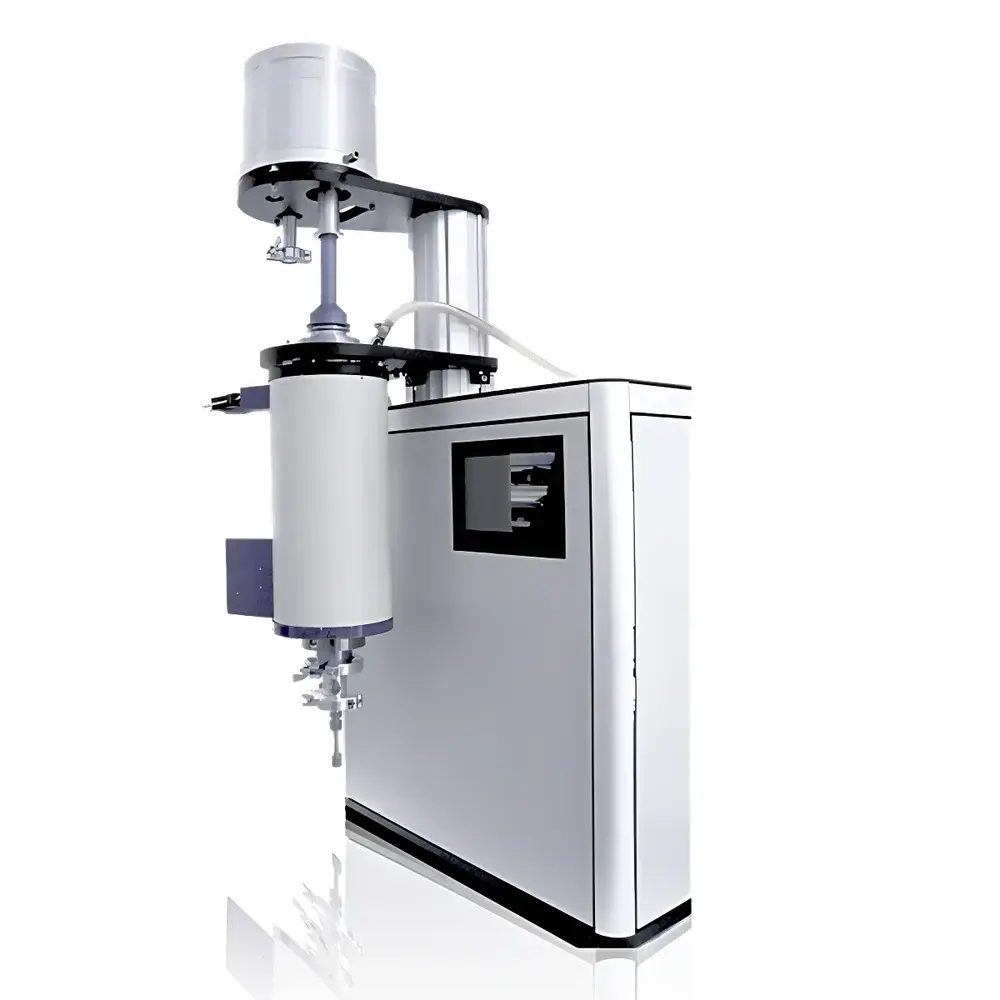
LINSEIS STA/TGA L86 Suspended-Balance Simultaneous Thermal Analyzer
| Brand | LINSEIS |
|---|---|
| Origin | Germany |
| Model | STA/TGA L86 |
| Temperature Range | −150 °C to 500 / 700 / 1000 °C |
| Heating Rate | 0.01–100 K/min |
| Temperature Stability | ±0.001 °C |
| Maximum Sample Mass | 35 g |
| TG Resolution | 0.01–0.1 µg |
| DSC Resolution | 0.3–1.2 µW |
| DTA Resolution | 0.03 nV |
| Vacuum Capability | 10⁻² mbar (pump-dependent) |
| Pressure Range (optional) | up to 5 bar |
| Atmosphere Control | Inert, oxidizing, reducing, corrosive, and vacuum-compatible |
| Sensor Options | E/K/S/B/C (C-type for DTA only) |
Overview
The LINSEIS STA/TGA L86 is a high-precision suspended-balance simultaneous thermal analyzer engineered for rigorous laboratory environments requiring concurrent thermogravimetric analysis (TGA), differential thermal analysis (DTA), and differential scanning calorimetry (DSC) under tightly controlled thermal and atmospheric conditions. Its core measurement architecture employs a patented electromagnetic force compensation balance mounted in a vertically suspended configuration—minimizing mechanical coupling, eliminating friction-related drift, and ensuring exceptional long-term mass stability. This design enables true microgram-level resolution across extended temperature ramps while maintaining full compliance with ISO 11358, ASTM E1131, ASTM E1641, and USP for quantitative thermal decomposition and phase transition characterization. The instrument operates across an industry-leading thermal span—from cryogenic −150 °C up to 2400 °C—making it suitable for advanced ceramics, refractory metals, battery cathode materials, polymer composites, and geochemical samples where extreme thermal fidelity is non-negotiable.
Key Features
- Suspended electromagnetic force-compensation balance with auto-zeroing and real-time mass feedback, delivering TG resolution down to 0.01 µg and long-term baseline stability ≤±0.1 µg over 24 h.
- Modular sensor platform supporting interchangeable DSC/DTA crucibles and thermocouple configurations—including E-, K-, S-, B-, and C-type sensors—enabling application-specific optimization for sensitivity, dynamic range, and corrosion resistance.
- Multi-zone furnace with independent PID-controlled heating elements and active cooling, achieving programmable heating rates from 0.01 to 100 K/min with temperature stability better than ±0.001 °C at isothermal holds.
- Integrated atmosphere management system supporting inert (N₂, Ar), oxidative (air, O₂), reducing (H₂, CO), and corrosive (Cl₂, HCl, SO₂) gas environments—with pressure regulation up to 5 bar (optional) and base vacuum down to 10⁻² mbar.
- Corrosion-resistant DTA shielding and ceramic-insulated furnace linings for extended operational lifetime in aggressive chemical environments, including cement hydration studies and sulfur-bearing mineral analysis.
- Automated calibration routines for mass, temperature, and enthalpy—traceable to NIST-certified standards—and integrated purge gas flow control with mass flow meters for reproducible gas delivery.
Sample Compatibility & Compliance
The STA/TGA L86 accommodates solid, powder, and granular samples up to 35 g in standard crucibles (Al₂O₃, Pt, Ir, graphite, or custom alloys), with optional high-temperature crucibles rated for continuous use at 2000 °C. It supports standardized sample geometries per ISO 11357 and ASTM E2009, and is validated for GLP/GMP-regulated workflows through audit-trail-enabled software (21 CFR Part 11 compliant). Instrument qualification includes IQ/OQ/PQ documentation packages, and all thermal data meet requirements for regulatory submissions in pharmaceutical development (ICH Q5C), battery safety testing (UN 38.3), and building material certification (EN 1992-1-2, ASTM C150).
Software & Data Management
Control and analysis are executed via LINSEIS ThermoSoft™ v6.x—a Windows-based platform featuring real-time multi-channel visualization, automated peak deconvolution, kinetic modeling (e.g., Kissinger, Ozawa-Flynn-Wall), and customizable report generation. Raw data are stored in vendor-neutral ASCII and HDF5 formats, enabling third-party integration with MATLAB, Python (via PyLISEIS), and LIMS systems. The software enforces role-based access control, electronic signatures, and immutable audit trails for all method edits, run executions, and data exports—fully satisfying FDA 21 CFR Part 11 and EU Annex 11 requirements.
Applications
The STA/TGA L86 delivers critical insights across diverse domains: quantifying dehydration kinetics and polymorphic transitions in pharmaceutical hydrates; characterizing thermal stability and oxidative degradation of Li-ion battery cathodes (e.g., NMC, LFP); evaluating decomposition pathways and residual carbon content in carbon-fiber composites; assessing phase evolution and sintering behavior in alumina-zirconia ceramics; monitoring gypsum–quartz mortar hydration, carbonation, and sulfate attack mechanisms under simulated environmental cycling; and performing evolved gas analysis (EGA) coupled with FTIR or MS for identification of volatile decomposition products in polymers and biofuels.
FAQ
What is the maximum operating temperature for the STA/TGA L86 with standard furnace configuration?
Standard configuration supports up to 1000 °C; high-temperature variants extend to 2400 °C using tungsten–rhenium thermocouples and specialized insulation.
Can the instrument perform quantitative DSC on samples with low thermal mass?
Yes—the E- and K-type DSC sensors provide sub-microwatt resolution (0.3 µW typical) and support baseline correction algorithms optimized for nanogram-scale heat flow detection.
Is the system compatible with hyphenated techniques such as TGA-FTIR or TGA-MS?
Yes—integrated heated transfer lines (up to 300 °C), calibrated gas flow splitting, and TTL-synchronized data acquisition enable seamless coupling with external spectroscopic or mass spectrometric detectors.
How is temperature calibration performed and validated?
Calibration uses certified reference materials (In, Sn, Zn, Al, Ag, Au) per ASTM E967 and ISO 11357-1, with automated melting point detection and uncertainty reporting per GUM guidelines.
Does the software support automated method validation per ICH Q2(R2)?
ThermoSoft™ includes built-in tools for precision, accuracy, linearity, and robustness assessment—generating validation reports aligned with ICH Q2(R2) analytical procedure lifecycle requirements.



