
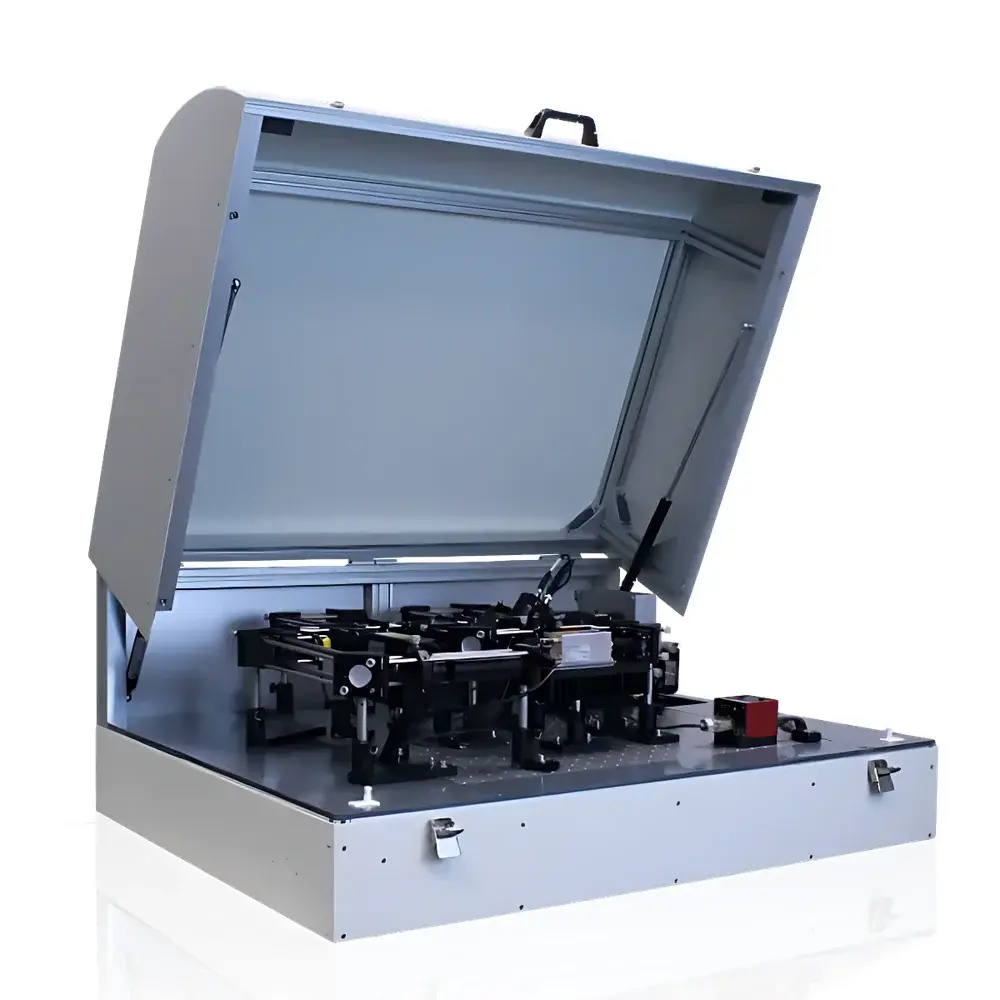
LINSEIS TF-LFA L54 Frequency-Domain Thermoreflectance Thermal Conductivity Analyzer
| Brand | LINSEIS |
|---|---|
| Origin | Germany |
| Model | TF-LFA L54 |
| Sample Size Range | 2 mm × 2 mm to 25 mm × 25 mm (arbitrary shape) |
| Thin-Film Thickness Range | 10 nm – 20 µm (sample-dependent) |
| Temperature Range | RT, RT–200 °C, or RT–500 °C |
| Atmosphere | Inert, oxidative, reductive, or vacuum down to 10⁻⁴ mbar |
| Thermal Diffusivity Range | 0.01 – 1200 mm²/s (sample-dependent) |
| Pump Laser | 405 nm, 300 mW, modulation frequency up to 200 MHz |
| Probe Laser | CW 532 nm, 25 mW |
| Detector | Si-based photodetector, active diameter 0.2 mm, bandwidth DC–400 MHz |
| Software | Integrated multilayer thermal modeling suite for extraction of κ, α, Cᵥ, η, and TBC |
Overview
The LINSEIS TF-LFA L54 is a high-precision, frequency-domain thermoreflectance (FDTR) thermal conductivity analyzer engineered for non-contact, quantitative characterization of thin-film thermal transport properties. Unlike conventional laser flash analyzers (LFA) operating in time domain, the TF-LFA L54 implements FDTR—a modulated photothermal technique wherein a pump laser (405 nm) periodically heats the sample surface while a probe laser (532 nm) monitors the resulting thermoreflectance signal. The phase lag and amplitude decay of the reflected probe light, measured across a broad modulation frequency range (up to 200 MHz), are fitted to a multi-layer heat diffusion model. This enables simultaneous extraction of thermal conductivity (κ), volumetric heat capacity (Cv), thermal diffusivity (α), interfacial transmission efficiency (η), and boundary conductance (TBC) — without requiring prior knowledge of film density or specific heat. Designed in collaboration with RWTH Aachen University, the system meets the metrological demands of advanced microelectronics, thermoelectrics, and next-generation memory devices where nanoscale thermal management dictates functional reliability.
Key Features
- Full thin-film thermal property extraction (κ, α, Cv, η, TBC) from single FDTR measurement—no independent calorimetric input required
- Non-contact, sub-micron lateral resolution mapping enabled by automated beam focusing and optional high-resolution camera integration
- Multi-configuration temperature control: ambient-only (4″ wafer stage), RT–200 °C, or RT–500 °C furnace options with programmable ramping
- Controlled atmosphere compatibility: inert (Ar, N₂), oxidative (air, O₂), reductive (H₂/N₂), or high vacuum (≤10⁻⁴ mbar)
- Anisotropic thermal transport analysis: selectable out-of-plane (cross-plane) and in-plane (lateral) thermal conductivity modes
- Automated optical alignment and real-time beam optimization algorithms ensure repeatability and minimize operator dependency
- Modular detector architecture with Si photodiode (DC–400 MHz bandwidth, 0.2 mm active diameter) optimized for low-noise phase-sensitive detection
Sample Compatibility & Compliance
The TF-LFA L54 accommodates freestanding films, supported substrates (e.g., SiO₂/Si, sapphire, quartz), and patterned wafers within 2–25 mm lateral dimensions. It supports thicknesses from 10 nm (e.g., ALD Al₂O₃) to 20 µm (e.g., CVD diamond, polyimide), with performance validated per ISO 18755 (thermophysical property measurement of thin films) and ASTM E2957 (standard guide for thermoreflectance-based thermal characterization). System design conforms to CE marking requirements and supports GLP-compliant operation through audit-trail-enabled software logging, electronic signatures, and 21 CFR Part 11–ready configuration (optional). All thermal models are traceable to fundamental heat conduction equations (Fourier–Keller formulation) and validated against NIST-traceable reference standards including certified SiO₂-on-Si and Au-coated Si wafers.
Software & Data Management
The integrated LINSEIS Thermal Analysis Suite provides full experimental control, real-time signal acquisition, and physics-based parameter inversion. Core modules include: (1) Multi-layer FDTR forward solver implementing finite-difference time-domain (FDTD) and semi-analytical Green’s function approaches; (2) Non-linear least-squares fitting engine with confidence interval estimation (Levenberg–Marquardt + Monte Carlo uncertainty propagation); (3) Spatial mapping module enabling region-of-interest (ROI) thermal profiling via synchronized camera overlay; (4) Export-ready reporting compliant with ASTM E2658 (data format for thermal property databases). Raw data (phase/amplitude vs. frequency) and fitted parameters are stored in HDF5 format with embedded metadata (instrument settings, calibration history, environmental logs), ensuring FAIR (Findable, Accessible, Interoperable, Reusable) data stewardship.
Applications
The TF-LFA L54 is routinely deployed in R&D and quality assurance labs for: thermal validation of dielectric layers (e.g., SiO₂, SiNx, HfO₂) in CMOS gate stacks; interfacial thermal resistance quantification at metal/dielectric (e.g., TiN/SiO₂) and semiconductor/metal (e.g., diamond/Au) junctions; anisotropy assessment of oriented 2D materials (MoS₂, h-BN); thermal homogeneity screening of large-area CVD graphene and transition metal dichalcogenides; and process monitoring of ALD/CVD thermal barrier coatings for MEMS and power electronics. Case studies include quantitative κ mapping of 150 nm AlN films on silicon (κ = 210 ± 8 W·m⁻¹·K⁻¹, cross-plane) and TBC determination at the Au/CVD-diamond interface (TBC ≈ 42 MW·m⁻²·K⁻¹), both critical for thermal budget management in GaN HEMTs and high-power laser diodes.
FAQ
What distinguishes FDTR from time-domain LFA for thin-film measurements?
FDTR provides superior signal-to-noise ratio and depth resolution for films <100 nm by exploiting frequency-domain phase information, whereas time-domain LFA suffers from pulse dispersion and substrate interference below ~1 µm.
Can the TF-LFA L54 measure thermal conductivity of transparent substrates like sapphire or fused silica?
Yes—optical configuration includes polarization-selective detection and pump/probe wavelength tuning to mitigate substrate absorption artifacts and isolate film-specific response.
Is calibration required before each measurement?
No routine recalibration is needed; the system employs factory-characterized laser power stability, detector linearity, and thermal stage accuracy—verified annually per ISO/IEC 17025 accredited procedures.
Does the software support custom thermal modeling?
Yes—the API allows user-defined thermal boundary conditions and multi-interface models (e.g., phonon mismatch, Kapitza resistance layers), with Python and MATLAB interfaces available upon request.
How is vacuum compatibility achieved during high-temperature operation?
The furnace chamber uses double-walled, water-cooled stainless-steel construction with metal-sealed feedthroughs for lasers and detectors, maintaining ≤10⁻⁴ mbar at 500 °C for extended durations without outgassing-induced signal drift.



