
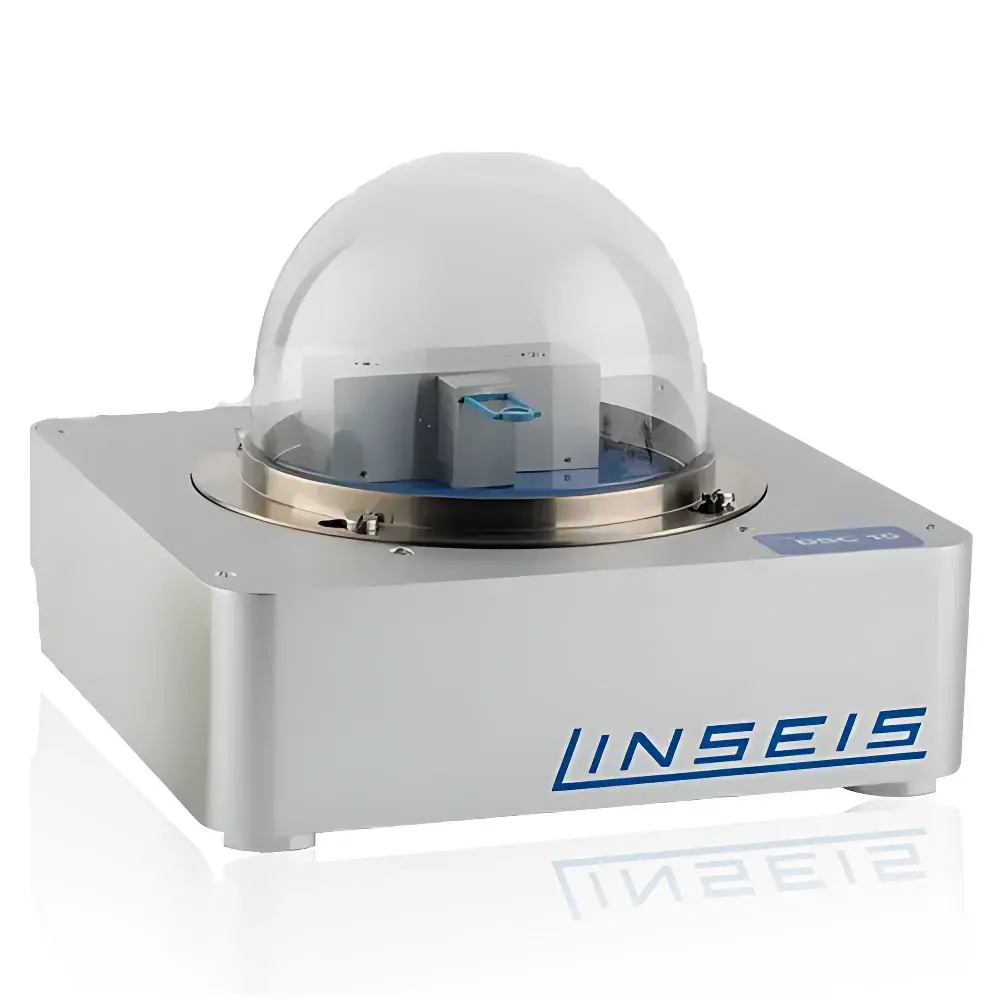
LINSEIS Chip-DSC 1 Differential Scanning Calorimeter
| Brand | LINSEIS |
|---|---|
| Origin | Germany |
| Model | Chip-DSC 1 (Chip-DSC L66 Basic) |
| Instrument Type | DSC |
| Temperature Range | RT to 450 °C (no active cooling unit) |
| Heating/Cooling Rate | 0.001–100 K/min |
| Temperature Accuracy | ±0.2 K |
| DSC Signal Range | ±2.5–±1000 mW |
| Temperature Repeatability | ±0.02 K |
| Heat Flow Resolution | 0.03 µW |
| Atmosphere Options | Inert or oxidative (static/dynamic) |
| Calibration | Supplied with certified reference materials |
Overview
The LINSEIS Chip-DSC 1 is a compact, high-performance differential scanning calorimeter engineered for precision thermal analysis of small-mass samples across academic, industrial, and quality control laboratories. Unlike conventional DSC systems relying on macro-scale furnace assemblies and separate sensor platforms, the Chip-DSC 1 integrates the heater, temperature sensor, and signal conditioning electronics into a single monolithic silicon-based microchip sensor. This chip architecture operates on the principle of heat-flux DSC—measuring the differential power required to maintain identical temperatures between a sample and an inert reference as both are subjected to a controlled thermal program. The ultra-low thermal mass (<10 mg) of the integrated chip enables exceptional dynamic response, rapid heating/cooling transitions, and intrinsic immunity to thermal lag effects. As a result, the system delivers high-fidelity raw thermograms without requiring baseline subtraction, mathematical deconvolution, or post-acquisition correction algorithms—making it particularly suitable for kinetic studies, fast-phase transition analysis, and hazardous material screening where data integrity and measurement speed are critical.
Key Features
- Monolithic chip sensor design integrating heater, RTD temperature sensor, and analog front-end electronics in a single Si substrate
- Thermal mass <10 mg ensures sub-second thermal response time and true isothermal stability at ramp rates up to 100 K/min
- Temperature accuracy of ±0.2 K and repeatability of ±0.02 K across the full operating range (RT to 450 °C)
- Heat flow resolution of 0.03 µW supports detection of subtle enthalpic events in polymers, pharmaceuticals, and biomolecules
- USB-powered operation—no external power supply required; compatible with laptops and portable workstations
- Field-replaceable chip modules reduce downtime and eliminate costly recalibration after sensor replacement
- Low-power consumption (<2 W typical) enables safe operation with reactive, pyrophoric, or corrosive samples under inert or oxidative atmospheres
Sample Compatibility & Compliance
The Chip-DSC 1 accommodates standard 20–50 µL aluminum crucibles (hermetic or vented), as well as custom micro-pallets for volatile or air-sensitive materials. Its chip-based architecture eliminates thermal inertia artifacts common in conventional DSC, enabling reliable characterization of low-mass samples (0.1–5 mg) including energetic materials (e.g., propellants, explosives), lithium battery electrolytes, and catalytic precursors. The system complies with ISO 11357-1 (General Principles of DSC), ASTM E794 (Melting and Crystallization Temperatures by DSC), and supports GLP/GMP workflows through audit-trail-enabled software logging. Optional purge gas control (N₂, Ar, O₂) allows static or dynamic atmosphere operation per USP & Ph. Eur. requirements for pharmaceutical thermal stability testing.
Software & Data Management
Controlled via LINSEIS ThermoSoft™ v5.x, the Chip-DSC 1 supports real-time data acquisition at 10 Hz sampling rate, multi-step temperature programming (isothermal, linear, modulated), and automated peak identification using derivative-based onset detection. Raw DSC curves are stored in vendor-neutral ASCII format with embedded metadata (timestamp, operator ID, calibration status). The software includes built-in kinetic analysis tools (Ozawa-Flynn-Wall, Kissinger), crystallinity quantification (based on enthalpy integration), and comparative overlay functionality for batch consistency evaluation. All instrument parameters and user actions are logged with time-stamped entries compliant with FDA 21 CFR Part 11 requirements when configured with electronic signature and role-based access controls.
Applications
- Polymers: Glass transition (Tg), cold crystallization, melting point determination, and curing kinetics
- Pharmaceuticals: Polymorph screening, excipient compatibility, dehydration behavior, and amorphous content quantification
- Batteries: Solid-electrolyte interphase (SEI) formation, thermal runaway onset, and cathode/anode decomposition profiling
- Food Science: Starch gelatinization, fat crystallization, and protein denaturation thermodynamics
- Materials R&D: Nanoparticle surface ligand desorption, metal-organic framework (MOF) thermal stability, and catalyst deactivation studies
FAQ
Does the Chip-DSC 1 support active cooling below ambient temperature?
No—the base configuration operates from room temperature to 450 °C without cryogenic or mechanical cooling. For sub-ambient measurements, external Peltier or liquid nitrogen accessories must be integrated separately.
What is the recommended calibration frequency and methodology?
Certified reference materials (indium, zinc, tin) are included with each system. LINSEIS recommends temperature and enthalpy calibration every six months—or after any chip sensor replacement—to ensure traceability to NIST standards.
Can the Chip-DSC 1 be used for quantitative analysis of crystallinity?
Yes—using the enthalpy of fusion method with appropriate reference standards (e.g., pure polyethylene or poly(ethylene terephthalate)), crystallinity can be calculated directly from unprocessed DSC thermograms due to the system’s inherent baseline stability.
Is the chip sensor compatible with aggressive chemical environments?
The silicon chip is coated with chemically inert alumina and platinum traces, permitting direct analysis of acidic, basic, or halogenated samples in sealed crucibles—provided appropriate containment and gas purging protocols are followed.
How does the chip architecture improve measurement reproducibility compared to conventional DSC?
By eliminating mechanical thermal interfaces (e.g., furnace-to-sensor mounts), the monolithic design removes hysteresis and drift sources. Each chip is individually laser-trimmed and calibrated, ensuring batch-to-batch consistency and reducing inter-instrument variability to <0.5% RSD for Tg and ΔH measurements.



