
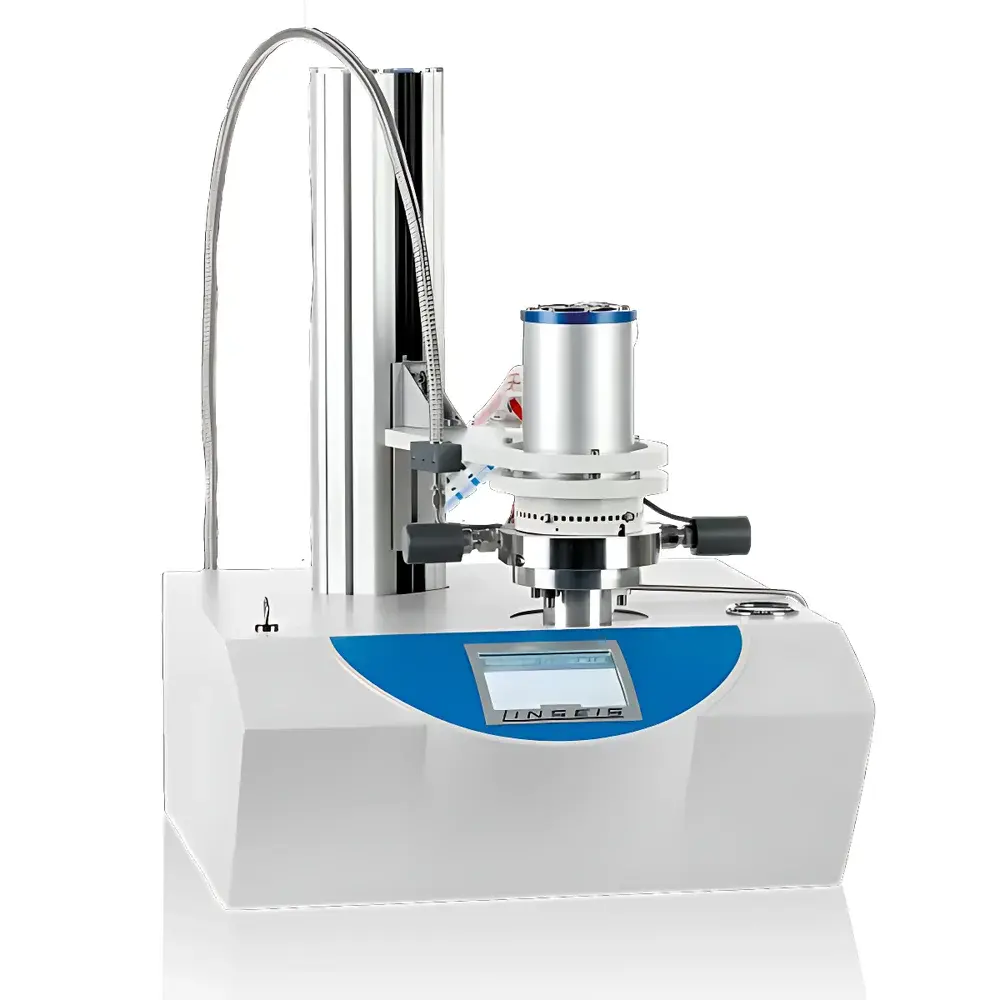
LINSEIS TGA HP L85 High-Pressure Thermogravimetric Analyzer (Desktop)
| Brand | LINSEIS |
|---|---|
| Origin | Germany |
| Model | TGA HP L85 |
| Temperature Range | RT to 1200 °C |
| Pressure Range | up to 150 bar |
| Balance Sensitivity | 0.1 µg |
| Maximum Sample Mass | 5 g |
| Vacuum Level | 10⁻⁴ mbar |
| Heating Rate | up to 300 K/min |
| Cooling Rate | up to 150 K/min |
| TG Sensor Types | E, K, S, B, C |
| TG-DSC Sensor Types | E, K, S, B, C |
| Interface | USB or Ethernet |
| Gas Configuration | 1–3 configurable gas channels (customizable) |
| Optional Accessories | Steam Generator, H₂/HC Auto-Vent & Gas Safety System |
Overview
The LINSEIS TGA HP L85 is a high-precision, desktop-configured high-pressure thermogravimetric analyzer engineered for quantitative mass change measurements under controlled elevated pressure and temperature conditions. It operates on the fundamental principle of thermogravimetry—monitoring real-time sample mass variation as a function of temperature, time, and ambient gas composition—while extending classical TGA capabilities into the high-pressure regime (up to 150 bar). Unlike conventional suspension-type or magnetic levitation balances, the TGA HP L85 employs a top-loading microbalance with direct-contact thermocouple placement at the sample holder, eliminating thermal lag and positional uncertainty in temperature measurement. This design ensures traceable, spatially resolved thermal input directly at the sample site—critical for kinetic modeling and reaction mechanism validation under non-ambient pressure. The integrated high-speed miniature furnace enables rapid thermal transients (heating up to 300 K/min, cooling up to 150 K/min), while its compact cavity volume (< 15 mL) supports fast gas exchange (< 30 s for full atmosphere purge) and minimizes consumables usage—reducing both operational gas costs and energy demand per test cycle.
Key Features
- Top-loading ultra-microbalance with 0.1 µg resolution and 5 g maximum capacity, optimized for high reproducibility under dynamic pressure loading
- Direct-contact thermocouple integration (E/K/S/B/C types) at the sample stage—ensuring ISO/IEC 17025-compliant temperature accuracy without extrapolation error
- High-pressure chamber rated to 150 bar, fully compatible with reactive (H₂, CO, CH₄, NH₃), corrosive (H₂O, HCl, SO₂), and inert (Ar, He, N₂) atmospheres
- Modular gas delivery system supporting 1–3 independently controlled gas channels; optional steam generator for precise H₂O partial pressure control (0.01–100% RH)
- Integrated gas safety architecture including automatic venting, leak detection, overpressure relief, and fail-safe shut-off for H₂ and hydrocarbon service
- Compact desktop footprint (W × D × H: 600 × 550 × 480 mm) with front-accessible sample chamber and tool-free sensor exchange
- Dual-mode operation: standalone unit or seamless integration into automated lab networks via Ethernet (TCP/IP) or USB 2.0 interface
Sample Compatibility & Compliance
The TGA HP L85 accommodates solid powders, granules, monoliths, catalyst pellets, and thin-film substrates (max. Ø 8 mm × 3 mm height) across diverse material classes—including metallurgical alloys, battery cathode precursors, biomass chars, MOFs, zeolites, and polymer composites. Its pressure-tight ceramic crucible system (Al₂O₃ or Pt) maintains chemical integrity up to 1200 °C under oxidizing, reducing, or carburizing environments. The instrument complies with ASTM E1131 (standard test method for compositional analysis by TGA), ISO 11358 (polymer thermal degradation), and supports GLP/GMP workflows through audit-trail-enabled software (21 CFR Part 11 compliant configuration available). All pressure components conform to PED 2014/68/EU and ASME BPVC Section VIII Div. 1 certification requirements.
Software & Data Management
Control and analysis are performed using LINSEIS ThermoSoft™ v5.x—a modular, Windows-based platform supporting real-time visualization, multi-step temperature/pressure ramping, and synchronized DSC signal acquisition (when equipped with TG-DSC sensor). Raw data are stored in vendor-neutral ASCII (.txt) and HDF5 formats, enabling third-party kinetic analysis (e.g., Kinetics Neo, NETZSCH Thermokinetics). The software implements automated baseline correction, derivative (DTG) calculation, peak deconvolution, and mass-loss step quantification with uncertainty propagation. Audit trails log all parameter changes, user actions, calibration events, and instrument status—fully traceable for regulatory submissions. Remote monitoring and scheduled runs are supported via Ethernet API integration with LIMS or MES platforms.
Applications
The TGA HP L85 is routinely deployed in catalysis research (e.g., steam reforming kinetics of Ni/Al₂O₃), carbon capture material screening (CO₂ adsorption/desorption hysteresis under pressurized flue gas simulants), high-temperature corrosion studies (oxidation of Fe-Cr-Al alloys in H₂O/O₂ mixtures), and advanced nuclear fuel behavior (UO₂ reduction in H₂ atmospheres). In energy conversion, it quantifies char gasification rates (C + H₂O → CO + H₂) under industrially relevant pressures (20–100 bar), enabling equilibrium shift analysis per Le Chatelier’s principle. It also supports hydride formation/decomposition thermodynamics (e.g., MgH₂ ↔ Mg + H₂), polymer pyrolysis under simulated landfill gas, and thermal stability assessment of electrolytes for solid-state batteries under inert pressurized Ar.
FAQ
What pressure media are compatible with the TGA HP L85?
Nitrogen, argon, helium, hydrogen, carbon monoxide, methane, carbon dioxide, water vapor, oxygen, and custom gas mixtures—including corrosive species such as HCl and SO₂—provided appropriate wetted materials (e.g., Hastelloy C-276 seals) are selected.
Can the instrument perform simultaneous TG-DSC measurements?
Yes—when equipped with a dual-sensor head (E/K/S/B/C-type TG-DSC module), it delivers synchronized mass loss and heat flow signals under identical pressure/temperature conditions.
Is vacuum capability built-in?
Yes—the system achieves base vacuum down to 10⁻⁴ mbar using an integrated turbomolecular pump, enabling low-background oxidation studies and moisture desorption profiling.
How is temperature calibrated under pressure?
Calibration follows ISO 11358 Annex A using certified reference materials (e.g., Ni, Cu, Al₂O₃) at multiple setpoints; pressure-induced thermocouple drift is compensated via in-situ reference junction monitoring.
Does the software support kinetic modeling?
Yes—ThermoSoft™ includes model-free (Friedman, Ozawa-Flynn-Wall) and model-fitting (n-th order, Avrami, diffusion-controlled) algorithms, with export-ready parameter tables for peer-reviewed publication.



