
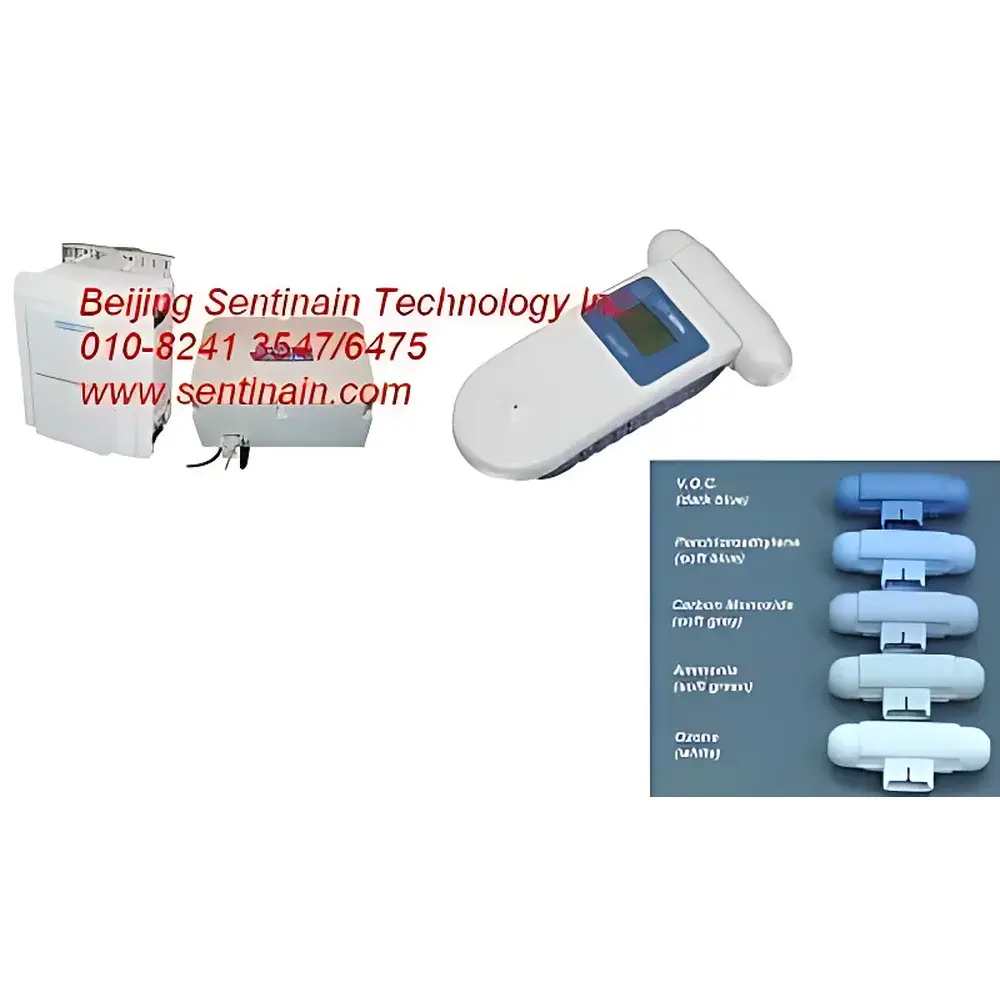
Gas Concentration Analyzer for Perchloroethylene, Trichloroethylene, Isopropanol, Ethyl Acetate and Hydrogen Peroxide – Model 100/200/300 Series
| [Origin | Imported |
|---|---|
| Manufacturer Type | Authorized Distributor |
| Model | 100/200/300 Series |
| Measurement Units | ppm |
| Power Supply | 12 VDC, 800 mA |
| Battery Options | 9.6 V Ni-Cd (940 mAh) or 9.6 V Ni-MH (2100 mAh) |
| Dimensions | 195 × 122 × 54 mm (with probe) |
| Weight | < 460 g (with probe and battery) |
| Enclosure Rating | IP20 / NEMA 1 |
| Operating Temperature | −20 °C to +50 °C (varies by sensor) |
| Operating Humidity | 5–95% RH (non-condensing) |
| Certifications | UL 2034, BS 7860, FCC Part 15, EN 50082-1:1997, EN 50081-1:1992 |
| Sensor Type | GSS (Gas Sensing Semiconductor) |
| Max Probe-to-Host Distance | 14 m |
| Display | Backlit LCD |
| Standby Mode | Supported |
| Low-Battery Alert | Yes |
| Sensor Status Indicator | Yes] |
Overview
The Model 100/200/300 Series Gas Concentration Analyzer is a portable, multi-analyte detection platform engineered for real-time, quantitative monitoring of volatile organic compounds (VOCs) and reactive oxidants in industrial hygiene, laboratory safety, and environmental compliance applications. Unlike single-gas fixed-point monitors, this system employs a modular architecture wherein a universal host unit interfaces with interchangeable, application-specific sensor probes—each calibrated and characterized for a defined target analyte: perchloroethylene (PCE), trichloroethylene (TCE), isopropanol (IPA), ethyl acetate (EtOAc), or hydrogen peroxide (H2O2). Detection is based on gas-sensitive semiconductor (GSS) transduction, where adsorption-induced changes in surface conductivity are linearized and temperature-compensated to yield stable, repeatable concentration readings in parts per million (ppm). The analyzer operates under ambient conditions without requiring carrier gas, external calibration gases, or heated sample lines—making it suitable for rapid screening, leak detection, workplace exposure assessment, and routine verification of ventilation efficacy in solvent-handling areas.
Key Features
- Modular probe-host architecture enabling field-swappable sensor modules for five distinct chemical species without hardware modification
- Ultra-compact form factor (<460 g total mass) and ergonomic design optimized for handheld operation during extended shift monitoring
- Backlit LCD interface providing real-time concentration values, sensor health status, battery level, and operational mode indicators
- Extended probe-to-host cable length (up to 14 m) supporting remote sampling in confined spaces, ductwork, or fume hoods while maintaining operator safety
- Dual battery options: standard Ni-Cd (940 mAh) for general use; high-capacity Ni-MH (2100 mAh) for extended-duration surveys or low-maintenance deployments
- Configurable standby mode reducing power consumption during idle periods while preserving sensor readiness and memory state
- Robust mechanical design compliant with IP20 and NEMA 1 specifications for indoor industrial environments
Sample Compatibility & Compliance
This analyzer supports direct, unmodified sampling of ambient air for the specified analytes without pre-concentration, scrubbing, or thermal desorption. Each probe is factory-calibrated against NIST-traceable reference standards and includes individual calibration certificates. While not certified for continuous emission monitoring (CEM) under EPA Method 25A or ISO 16000-6, the instrument meets occupational exposure assessment requirements aligned with OSHA PELs and ACGIH TLVs for TCE (25 ppm), PCE (100 ppm), IPA (400 ppm), EtOAc (400 ppm), and H2O2 (1.0 ppm). Electrical safety and electromagnetic compatibility conform to UL 2034 (residential/commercial gas alarms), BS 7860 (UK gas detection standards), FCC Part 15 Class B, and EN 50081-1/50082-1 for industrial environments. It is intended for use in non-hazardous locations only and does not carry ATEX, IECEx, or CSA hazardous area certifications.
Software & Data Management
The device operates as a standalone, embedded-system analyzer with no proprietary software dependency. All configuration, zeroing, span adjustment (where applicable), and alarm threshold setting are performed via intuitive on-device menu navigation. Real-time data logging is not supported onboard; however, analog output (0–5 V or 4–20 mA) is available on select models (e.g., Model 300) for integration into SCADA or DCS platforms. For auditability, each unit retains internal timestamps for power-on events and manual zero procedures. While native data export is absent, the system supports GLP-aligned documentation practices when used in conjunction with external lab notebooks or electronic quality management systems (eQMS). No FDA 21 CFR Part 11 compliance is claimed, as the instrument is not deployed in regulated pharmaceutical manufacturing process control.
Applications
- Workplace air monitoring for solvent exposure compliance in dry cleaning facilities (PCE/TCE), electronics manufacturing (IPA/EtOAc), and sterilization labs (H2O2)
- Routine verification of local exhaust ventilation (LEV) performance at solvent dispensing stations and dip tanks
- Leak detection and source identification during maintenance of solvent recovery systems or vapor degreasers
- Pre-entry atmospheric testing in confined spaces where residual VOCs or oxidants may persist after cleaning cycles
- Educational demonstrations of gas sensing principles and occupational toxicology thresholds in university chemistry and industrial hygiene laboratories
FAQ
Is this instrument suitable for continuous, unattended monitoring?
No—it is designed for intermittent, operator-guided measurement. Continuous operation may accelerate sensor drift and reduce functional lifespan due to cumulative exposure effects inherent to GSS technology.
Can the same probe be used for multiple analytes?
No. Each probe is chemically selective and factory-calibrated for one specific compound. Cross-sensitivity between analytes is documented in the technical datasheet but not compensated algorithmically.
Does the analyzer require periodic recalibration with certified gas standards?
Yes. Recommended recalibration interval is every 6 months or after exposure to concentrations exceeding 80% of full scale, whichever occurs first. Zero checks should be performed before each daily use.
What is the expected service life of the GSS sensors?
Typical functional lifetime is 18–24 months under normal indoor operating conditions (25 °C, <60% RH, <5 ppm average exposure). Lifetime decreases significantly under high-humidity, high-concentration, or high-temperature conditions.
Is firmware upgrade capability available?
Firmware updates are provided exclusively by the authorized distributor and require physical connection to a dedicated programming interface. No over-the-air (OTA) update functionality is implemented.







