
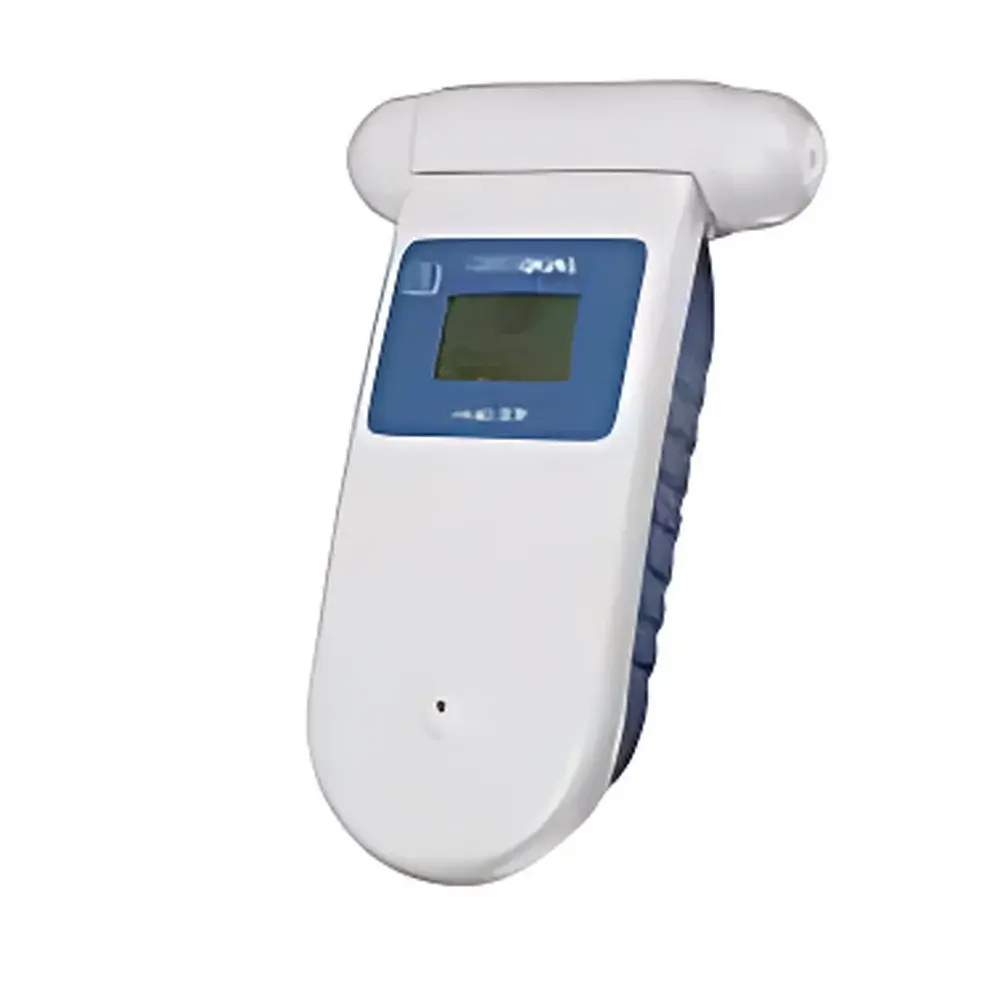
Gas Sensitive Semiconductor (GSS) H₂S Detector Model 200 – Portable & Fixed-Installation Hydrogen Sulfide Monitor
| Origin | Imported |
|---|---|
| Manufacturer Type | Authorized Distributor |
| Model | 200 |
| Price | Upon Request |
| Measurement Range (Low) | 0–1.0 ppm |
| Measurement Range (Medium) | 0–25.00 ppm |
| Measurement Range (Leak Detection) | 0–50.0 ppm |
| Accuracy | ±10% (0–0.10 ppm), <±0.5 ppm (0–10.0 ppm), <±2 ppm (10–50.0 ppm) |
| Resolution | 0.001 ppm / 0.01 ppm / 0.1 ppm (per range) |
| T90 Response Time | <60 s (all ranges) |
| Sensing Principle | Gas-Sensitive Semiconductor (GSS) |
| Operating Temperature | −20°C to +50°C |
| Operating Humidity | 5–95% RH (non-condensing) |
| Power Supply | 12 VDC, 800 mA |
| Rechargeable Battery Options | 9.4 V Ni-Cd (940 mAh) or 9.6 V Ni-MH (2100 mAh) |
| Enclosure Rating | IP20 & NEMA 1 |
| Dimensions (w/ probe) | 195 × 122 × 54 mm |
| Weight (w/ probe & battery) | <460 g |
| Compliance | FCC Part 15, EN 50082-1:1997, EN 50081-1:1992 |
Overview
The Gas Sensitive Semiconductor (GSS) H₂S Detector Model 200 is a dual-mode hydrogen sulfide monitoring solution engineered for both portable field deployment and semi-permanent fixed installation in industrial, municipal, and environmental safety applications. Utilizing gas-sensitive semiconductor (GSS) sensing technology, the instrument detects H₂S via surface conductivity modulation induced by adsorption of target gas molecules on a metal oxide film—enabling rapid, stable, and repeatable detection across three calibrated concentration domains: low-level ambient monitoring (0–1.0 ppm), occupational exposure assessment (0–25.00 ppm), and high-range leak identification (0–50.0 ppm). Its modular architecture separates the sensor head from the base unit via a shielded 14-meter cable, allowing flexible placement in confined spaces, ducts, or hazardous zones while maintaining operator proximity to the display and controls. Designed for continuous operation in non-explosive environments, the Model 200 complies with electromagnetic compatibility (EMC) and emissions standards per EN 50082-1:1997 and EN 50081-1:1992, and meets FCC Part 15 Class B requirements for commercial use.
Key Features
- Triple-range H₂S detection capability with independent resolution and accuracy specifications optimized for distinct operational contexts—ambient air quality, OSHA-compliant exposure monitoring, and emergency leak response.
- Modular probe-to-base architecture supporting up to 14 meters of separation distance, enabling remote sensor mounting without signal degradation or calibration drift.
- Backlit LCD display with real-time concentration readout in ppm, battery status indicator, sensor health diagnostics, and low-battery alert—designed for readability under variable lighting conditions.
- Two rechargeable battery options: standard Ni-Cd (940 mAh) for routine shift-based use, and extended-life Ni-MH (2100 mAh) for multi-shift or unattended logging deployments.
- FRP (fiberglass-reinforced polymer) optional enclosure kit transforms the handheld unit into a wall- or pole-mounted fixed monitor suitable for perimeter monitoring at wastewater treatment plants, biogas facilities, and sour gas processing sites.
- IP20/NEMA 1-rated housing provides protection against solid ingress and limited dust exposure—suitable for indoor control rooms, pump stations, and maintenance workshops where condensation is not expected.
Sample Compatibility & Compliance
The Model 200 is validated exclusively for hydrogen sulfide (H₂S) detection in ambient air matrices. Cross-sensitivity to common interferents—including CO, SO₂, NO₂, CH₄, and volatile organic compounds—is characterized and documented per manufacturer test reports; compensation algorithms are embedded in firmware to minimize false positives in mixed-gas environments typical of sewage infrastructure or landfill off-gas streams. While not certified for use in Class I, Division 1 hazardous locations, the device meets general-purpose safety requirements for non-incendive operation under normal atmospheric conditions. It supports periodic bump testing and full calibration using certified H₂S span gases traceable to NIST standards. Documentation packages include calibration certificates, EMC test summaries, and RoHS compliance statements—facilitating integration into facility-level environmental management systems aligned with ISO 14001 and OSHA 1910.120.
Software & Data Management
Data logging functionality is supported via optional USB interface and proprietary configuration software compatible with Windows 10/11. The system records time-stamped concentration values at user-defined intervals (1–300 seconds), stores up to 32,000 data points internally, and exports CSV-formatted files for trend analysis in Excel or LIMS platforms. Audit trails include calibration history, sensor zero/bump events, and firmware version logs—supporting GLP-aligned recordkeeping. Though not FDA 21 CFR Part 11 compliant out-of-the-box, the device’s deterministic timestamping, immutable event logging, and password-protected configuration mode provide foundational elements for internal validation protocols in regulated utility operations.
Applications
- Real-time H₂S monitoring in municipal wastewater collection systems, lift stations, and headworks facilities.
- Worker safety screening during confined space entry (CSE) in oilfield service, pipeline maintenance, and tank cleaning operations.
- Biogas upgrading and anaerobic digestion process oversight in agricultural and industrial digesters.
- Ambient air quality surveillance near landfills, composting facilities, and pulp & paper mills.
- Preventive maintenance support for corrosion-prone infrastructure where sulfide-induced stress cracking poses material integrity risks.
FAQ
Can the Model 200 be used in explosive atmospheres?
No. It is not intrinsically safe or ATEX-certified. Use only in non-hazardous, ventilated areas meeting IP20 environmental classification.
What calibration gases are required?
Certified H₂S in nitrogen at concentrations matching your intended operating range—e.g., 0.5 ppm for low-range verification, 10 ppm for mid-range, and 30 ppm for high-range linearity checks.
Is sensor replacement user-serviceable?
Yes. The GSS sensor module is field-replaceable using standard Torx tools; no soldering or firmware reprogramming is required.
Does the device support analog output?
Not natively. Analog 4–20 mA output requires an external signal converter connected via the USB or serial port interface.
How often should bump testing be performed?
Prior to each day’s use when deployed for personnel protection, or before every critical measurement cycle in fixed-installation mode.
Related Products







