
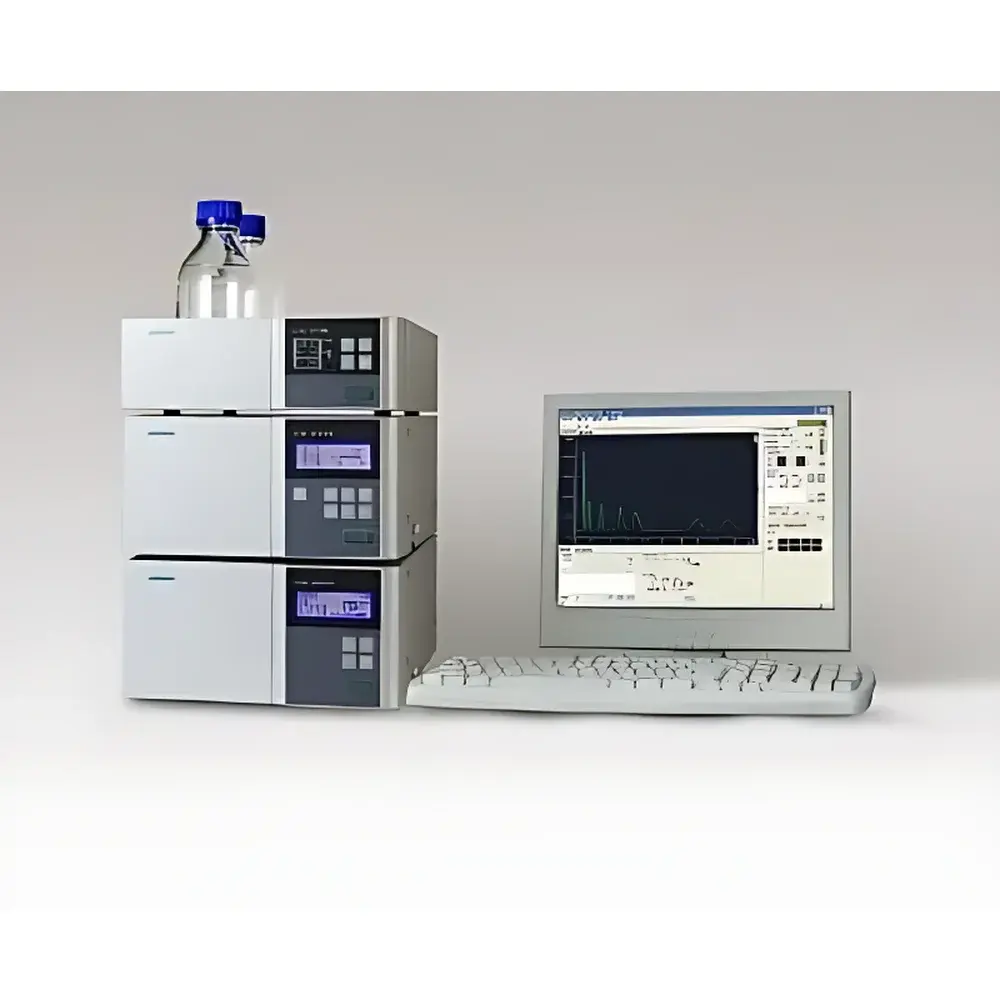
Wufeng LC-100 Isocratic High-Performance Liquid Chromatograph
| Brand | Wufeng |
|---|---|
| Origin | Shanghai, China |
| Model | LC-100 (Isocratic Configuration) |
| Pump Flow Range | 0.001–9.999 mL/min |
| Max Pressure | 42 MPa |
| Sample Injection Volume | 1–200 µL |
| Injection Tray Capacity | 108 × 2 mL vials |
| Column Oven Temperature Range | 5 °C above ambient to 80 °C |
| UV Detector Wavelength Range | 190–680 nm |
| Data Acquisition Rate | 10 Hz |
| Baseline Noise (UV) | ≤2×10⁻⁵ AU (peak-to-peak, methanol, 1 mL/min, 254 nm) |
| Detection Limit | ≤5×10⁻⁹ g/mL (naphthalene in methanol) |
| Wavelength Accuracy | ≤±2 nm |
| Wavelength Repeatability | <0.1 nm |
| Flow Precision | ±0.3% RSD |
| Flow Accuracy | ±2% |
| Cell Volume | 8 µL |
| Path Length | 8 mm |
Overview
The Wufeng LC-100 Isocratic High-Performance Liquid Chromatograph is an engineered solution for routine and method-developed quantitative analysis in pharmaceutical QC, environmental testing, food safety, and academic research laboratories. Based on classical reversed-phase HPLC architecture, the system employs a high-precision dual-plunger parallel reciprocating pump, a digitally controlled UV-Vis absorbance detector with a dual-conical flow cell, and a fully integrated workstation capable of bidirectional instrument control and GLP-compliant data handling. Designed and manufactured in Shanghai since 2004, the LC-100 platform reflects over two decades of iterative refinement in core fluidic mechanics, optical detection stability, and software-driven operational integrity. Its isocratic configuration delivers robust performance for standardized assays where gradient elution is not required—such as residual solvent analysis, preservative quantification, or monosaccharide profiling—while maintaining full compatibility with future upgrades to gradient capability, additional detectors (e.g., RI, PDA), or semi-preparative operation.
Key Features
- Parallel dual-plunger pump architecture with auto-retracting plunger rods—enabling seal replacement without chassis disassembly and extending seal life by up to 100% versus serial configurations.
- Patented monolithic sapphire-ball check valve assembly ensuring long-term flow accuracy (<±0.3% RSD) and pressure stability (<0.1 MPa pulsation at 1 mL/min, 5–10 MPa).
- Digital UV-Vis detector with full-range deuterium lamp (2000-hour rated lifetime) and optional tungsten-halogen source, covering 190–680 nm with 1 nm wavelength resolution and ±2 nm absolute accuracy.
- Optimized flow cell geometry: parallel dual-conical design enhances signal-to-noise ratio by >40% relative to conventional rectangular cells, validated per ASTM E260 and ISO 17025 traceable protocols.
- Integrated column oven (LC-CO100, optional) with ±0.1 °C temperature uniformity across 10–80 °C range; accommodates two columns simultaneously for tandem or heart-cutting applications.
- Full bidirectional control via WS-100 chromatography workstation—supporting method scheduling, real-time pressure/flow monitoring, event-triggered valve switching, and spectral scanning for lamp validation (e.g., 486.6 nm & 656.1 nm hydrogen lines).
Sample Compatibility & Compliance
The LC-100 supports standard 3.9–4.6 mm ID analytical columns (up to 250 mm length) and is compatible with common reversed-phase (C18, C8), HILIC, ion-exchange, and size-exclusion media. Mobile phases include aqueous buffers (e.g., phosphate, acetate), organic modifiers (acetonitrile, methanol), and low-concentration TFA or formic acid additives. The system meets mechanical and electrical safety requirements per IEC 61010-1 and electromagnetic compatibility per EN 61326-1. For regulated environments, WS-100 software supports audit trail logging, electronic signatures (per FDA 21 CFR Part 11 Annex 11), and raw-data archiving compliant with ISO/IEC 17025 and GLP documentation workflows. All hardware components—including tubing, fittings, and seals—are certified for compatibility with USP Class VI solvents and meet RoHS Directive 2011/65/EU material restrictions.
Software & Data Management
WS-100 is a native Windows-based chromatography data system (CDS) built on a deterministic real-time kernel. It acquires data at up to 10 Hz with 24-bit ADC resolution, stores raw detector signals in vendor-neutral .cdf format (compatible with OpenChrom and Chromeleon import), and applies digital filtering algorithms to suppress high-frequency noise without phase distortion. Key modules include: (i) Gradient Editor with visual flow-rate vs. time curve overlay; (ii) Spectral Scanner for wavelength calibration verification and lamp health assessment; (iii) Event Relay Scheduler enabling timed actuation of external devices (e.g., fraction collectors, valve switches); and (iv) Report Generator supporting customizable templates with embedded metadata (instrument ID, operator, method version, audit trail hash). All processing parameters are stored within method files, ensuring full traceability from acquisition through peak integration to final report export (PDF, CSV, Excel).
Applications
The LC-100 is routinely deployed in quality control laboratories for pharmacopeial assays (USP , EP 2.2.46), including assay of active pharmaceutical ingredients (APIs), related substances testing, and dissolution profile analysis. In food and beverage labs, it quantifies synthetic dyes (e.g., Allura Red AC), preservatives (sorbic acid, benzoic acid), and mycotoxins (aflatoxin B1) following AOAC 2012.01 and ISO 14501 protocols. Environmental applications include EPA Method 8330B (PAHs in soil extracts) and ISO 17993 (pesticide residues in water). Academic users leverage its reproducible retention time stability (<0.1% RSD over 24 h) for method development training, polymer molecular weight distribution studies (SEC mode), and natural product fingerprinting using UV spectral libraries.
FAQ
Does the LC-100 support gradient elution?
No—the base LC-100 configuration is isocratic only. Gradient capability requires upgrade to the LC-100 Plus variant with quaternary low-pressure mixing module.
Is the UV detector compliant with pharmacopeial wavelength accuracy requirements?
Yes—wavelength accuracy is verified at ±2 nm (per USP and EP 2.2.25) using certified holmium oxide and didymium filters, with repeatability <0.1 nm.
Can the system be integrated into a LIMS environment?
Yes—WS-100 provides ODBC-compliant database connectivity and supports ASTM E1467-compliant data export for direct ingestion into enterprise LIMS platforms.
What maintenance intervals are recommended for the pump seals?
Under normal use with aqueous/organic mobile phases, pump seals require replacement every 6–12 months; extended life is achieved using the optional post-column wash kit for buffer-containing methods.
Is remote monitoring supported?
Yes—WS-100 includes secure TCP/IP communication protocol support, enabling real-time status viewing and limited parameter adjustment via authenticated network access.



