
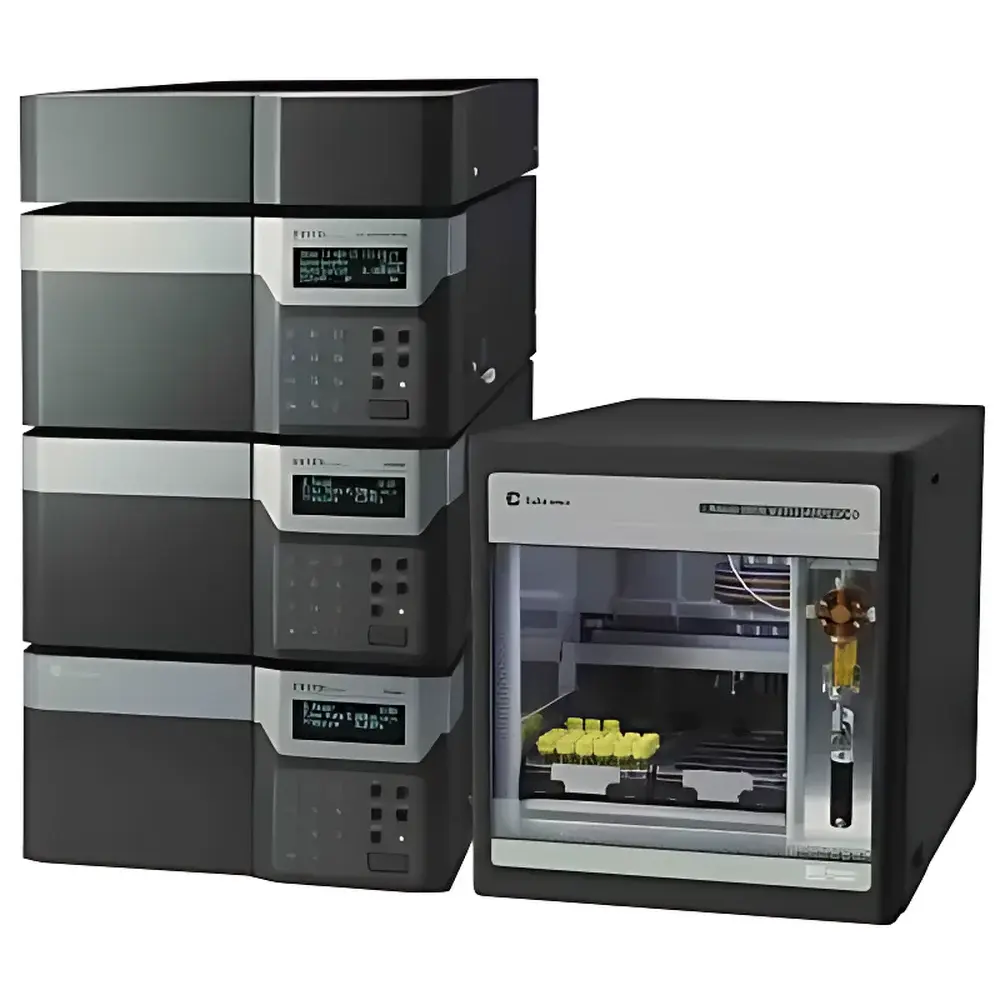
Wufeng EX1700 Ultra-High-Performance Liquid Chromatography System
| Brand | Wufeng |
|---|---|
| Origin | Shanghai, China |
| Model | EX1700 |
| Instrument Type | Conventional HPLC (UHPLC-capable) |
| Flow Rate Range | 0.0001–5 mL/min |
| Maximum Pressure | 60 MPa |
| Autosampler Capacity | 96 positions (2 mL vials) |
| Injection Volume Range | 1–50 µL |
| Column Oven Temperature Range | 4–85 °C |
| UV-Vis Wavelength Range | 170–700 nm |
| Data Acquisition Rate | 100 Hz |
Overview
The Wufeng EX1700 Ultra-High-Performance Liquid Chromatography (UHPLC) System is an integrated, modular chromatographic platform engineered for high-resolution, high-throughput small-molecule analysis in regulated and research laboratories. Designed in collaboration with U.S.-based Yima Instruments, the EX1700 implements core UHPLC principles—including high-pressure solvent delivery (up to 60 MPa), low-dispersion flow paths, and sub-2 µm particle column compatibility—to deliver significantly enhanced peak capacity, reduced analysis time, and improved mass sensitivity compared to conventional HPLC systems operating at ≤40 MPa. Its architecture supports both isocratic and gradient elution modes, with dual-piston parallel reciprocating pumps featuring active pulse damping for exceptional flow stability (RSD < 0.07% at 1 mL/min). The system adheres to fundamental chromatographic performance criteria defined in ISO 17025 and ASTM E2631, and its operational parameters align with method development requirements outlined in USP and ICH Q2(R2) for analytical method validation.
Key Features
- High-pressure binary or quaternary gradient system with programmable solvent selection (2–4 channels via optional solvent selector valve)
- Dual-beam UV-Vis detector with deuterium and tungsten lamp sources, covering 170–700 nm (extendable to 900 nm with optional VIS lamp)
- Low-volume optical cell (3.5 µL, 6 mm path length) optimized for sensitivity and minimal band broadening
- Column oven with precise air-circulation temperature control (±0.1 °C accuracy), supporting dual-column mounting and extended thermal range (4–85 °C)
- Autosampler with 96-position 2 mL vial capacity, 1–50 µL injection volume range, and low carryover design (<0.005%)
- Modular hardware architecture enabling flexible configuration—e.g., coupling with mass spectrometry interfaces, fraction collectors, or additional detectors
- Real-time data acquisition at up to 100 Hz, supporting fast-eluting peaks and narrow chromatographic bands
Sample Compatibility & Compliance
The EX1700 accommodates a broad spectrum of analytes including pharmaceutical actives, metabolites, natural products, peptides, and environmental contaminants. It is fully compatible with reversed-phase C18, phenyl-hexyl, HILIC, and porous graphitic carbon columns down to 1.7 µm particle size. All fluidic components—including pump heads, injector rotor seals, and detector flow cells—are chemically resistant to common mobile phases (acetonitrile, methanol, aqueous buffers, 0.1% TFA). The system meets essential regulatory expectations for data integrity: audit trail functionality (including lamp usage hours, pressure logs, and calibration history), electronic signature support, and compliance-ready documentation aligned with FDA 21 CFR Part 11 and EU Annex 11 principles. Routine operation satisfies GLP and GMP environmental monitoring and QC testing requirements when configured with validated methods and controlled instrument qualification protocols.
Software & Data Management
Controlled via Wufeng ChromaLink™ software (v3.x), the EX1700 provides intuitive method building, real-time chromatogram visualization, peak integration with baseline correction algorithms, and customizable report templates. The software supports AIA (.cdf) file export for third-party processing (e.g., Chromeleon, OpenLab CDS) and includes built-in tools for system suitability assessment (tailing factor, resolution, plate count, RSD of retention time). Raw data files are stored with metadata embedding (instrument ID, operator, timestamp, method version), ensuring traceability across laboratory information management systems (LIMS). For enterprise deployment, optional network licensing and centralized database archiving modules enable multi-user access control and long-term data retention per ISO/IEC 27001 guidelines.
Applications
- Pharmaceutical quality control: assay, related substances, residual solvents per ICH Q3C/Q5C
- Biopharmaceutical purity assessment: peptide mapping, monoclonal antibody fragment analysis
- Clinical research: therapeutic drug monitoring (TDM), biomarker quantification in plasma/urine
- Food safety: pesticide residue screening, mycotoxin detection, vitamin profiling
- Environmental analysis: PAHs, PCBs, endocrine disruptors in water and soil extracts
- Academic method development: robustness testing, forced degradation studies, column selectivity evaluation
FAQ
What column dimensions and particle sizes are recommended for optimal EX1700 performance?
Columns with internal diameters of 2.1 mm or 3.0 mm and lengths of 30–150 mm are ideal; sub-2 µm particles (e.g., 1.7–1.9 µm) maximize resolution and speed under 60 MPa pressure.
Is the EX1700 compatible with mass spectrometry interfaces?
Yes—the system features standard 1/16″ stainless-steel tubing connections and low-dead-volume fittings, enabling seamless integration with ESI and APCI sources from major MS vendors.
Does the autosampler support needle wash and injection precision verification?
Yes—integrated needle wash station (dual-solvent option available) and automated precision test routines (n = 6 injections) are embedded in ChromaLink™ software.
Can the UV detector perform wavelength scanning during a run?
Yes—time-programmable wavelength switching allows dynamic optimization (e.g., 210 nm for early eluters, 254 nm for aromatics) without interrupting acquisition.
What validation documentation is provided with the EX1700 system?
Factory-installed IQ/OQ documentation, certified calibration certificates for flow rate, pressure, wavelength, and temperature, plus a full set of SOP templates for PQ execution and periodic requalification.






