
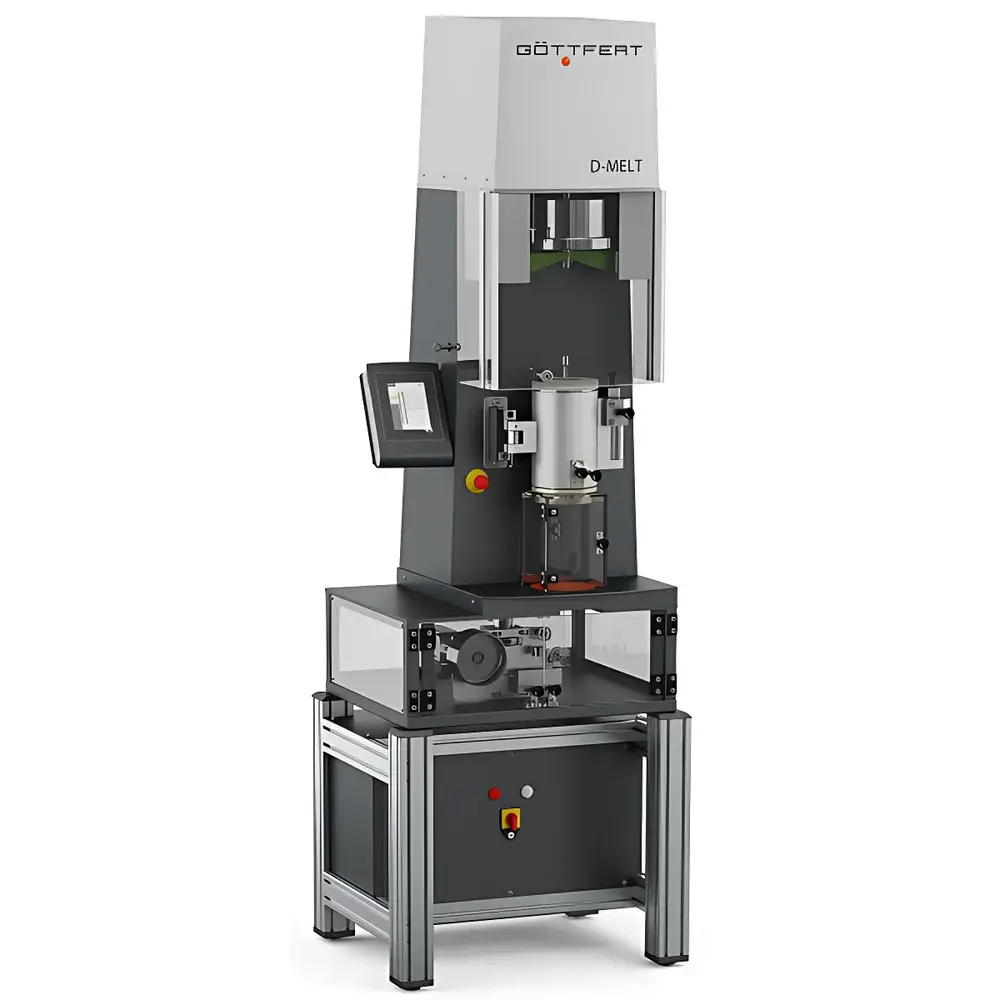
Goettfert D-melt Melt Flow Indexer with Melt Elasticity Extension Module
| Brand | Goettfert |
|---|---|
| Origin | Germany |
| Model | D-melt |
| Capillary Diameter | 9.555 ± 0.01 mm |
| Piston Diameter | 9.48 ± 0.01 mm |
| Temperature Range | 60.00–400.00 °C (optional up to 500 °C), Accuracy: ±0.1 °C |
| Die Diameter | 2.095 ± 0.003 mm, Length: 8.00 ± 0.025 mm |
| Die Material | Tungsten Carbide |
| Standard Weights | 1.200 kg, 2.16 kg, 3.8 kg, 5.0 kg, 10.0 kg, 21.6 kg (±0.5 % tolerance) |
| Timer Resolution | < 0.001 s |
| Position Sensor Resolution | 0.006 mm/pulse |
| Draw Speed Range | 0–44.8 m/min |
| Force Measurement Range | 0–3 N |
Overview
The Goettfert D-melt is an integrated melt flow indexer and melt elasticity extension system engineered for simultaneous determination of standardized melt flow rate (MFR/MFI) and melt elasticity (ME) under controlled rheological conditions. Based on the principle of capillary rheometry—governed by ASTM D1238, ISO 1133, and GB/T 3682—the D-melt combines a precision-controlled MI40 melt indexer with a synchronized haul-off module featuring ceramic-coated draw rollers. This architecture enables real-time measurement of extensional force during uniaxial melt drawing, delivering both shear-dominated (MFR) and extension-dominated (ME) response data in a single test cycle. Unlike conventional melt indexers, the D-melt captures dynamic viscoelastic behavior critical for predicting extrusion stability, die swell, melt fracture onset, and fiber spinnability—parameters directly linked to polymer processability in blown film, pipe extrusion, and thermoforming applications.
Key Features
- Integrated dual-function design: Performs ASTM/ISO-compliant melt flow index testing while concurrently measuring melt elasticity (ME) as force at defined draw ratios.
- Ceramic-coated draw rollers minimize melt adhesion and ensure consistent surface interaction across thermoplastics including polyolefins, engineering resins, and biopolymers.
- High-resolution digital position sensing (0.006 mm/pulse) and sub-millisecond timing (<0.001 s) enable precise velocity profiling and strain-rate control during extension.
- Thermal stability maintained via PID-controlled heating zones with ±0.1 °C accuracy over 60–400 °C (optionally extended to 500 °C), ensuring repeatability across thermal-sensitive polymers.
- Modular weight set (1.200–21.6 kg, ±0.5 % tolerance) supports multi-load MFR determinations and shear stress sweep protocols per ISO 1147.
- Automated test sequence execution eliminates operator intervention from loading to data export, reducing inter-operator variability and supporting GLP-aligned workflows.
Sample Compatibility & Compliance
The D-melt accommodates granules, pellets, and pre-dried powders of thermoplastic polymers—including PP, PE, PS, ABS, PC, PA6/66, PBT, and PLA—with minimal sample preparation. Its tungsten carbide die (2.095 ± 0.003 mm × 8.00 ± 0.025 mm) ensures dimensional stability and wear resistance under prolonged high-temperature operation. The system complies with ISO 1133-1/-2 (MFR/MVR), ASTM D1238 (with multi-weight options), and supports method development aligned with USP for polymer characterization in regulated pharmaceutical packaging applications. All thermal and mechanical calibrations are traceable to national metrology institutes; audit trails and user-access logs meet FDA 21 CFR Part 11 requirements when operated with compliant software configurations.
Software & Data Management
The D-melt operates via Goettfert’s proprietary WinRheo software platform, which provides real-time visualization of piston displacement, draw speed, tensile force, and temperature profiles. Raw data—including time-stamped force vs. draw length curves, calculated ME values (in cN), and MFR results (g/10 min)—are stored in ASCII-compatible .csv and structured .xml formats. Software modules support statistical process control (SPC) charting, batch comparison overlays, and automated report generation compliant with ISO/IEC 17025 documentation standards. Optional integration with LIMS environments enables direct data routing to enterprise quality databases, supporting continuous monitoring in production QA/QC labs.
Applications
- Quality assurance of incoming polymer lots via rapid MFR + ME fingerprinting to detect molecular weight distribution shifts or long-chain branching anomalies.
- Process troubleshooting in extrusion lines: correlating elevated ME values with observed die swell instability or sharkskin defects.
- R&D screening of novel polymer blends and compatibilized systems where extensional viscosity dominates final part morphology.
- Regulatory documentation for medical-grade polymer suppliers requiring ISO 10993-12 extractables and processing validation data.
- Academic research on transient extensional rheology of low-viscosity melts where traditional filament stretching rheometers lack throughput.
FAQ
What does “ME” stand for, and how is it quantified?
ME (Melt Elasticity) is defined as the tensile force (in cN) measured at a specified draw ratio (e.g., 10× or 20×) during constant-speed uniaxial extension of the extrudate. It reflects the recoverable elastic energy stored in the molten polymer chain network.
Can the D-melt replace a dedicated extensional rheometer?
It is not intended for fundamental extensional viscosity (ηE) modeling but delivers robust, comparative ME metrics for industrial process correlation—offering higher throughput and lower operational complexity than capillary breakup or filament stretching methods.
Is calibration verification supported for ISO/IEC 17025 accreditation?
Yes: certified reference materials (CRMs) for MFR and traceable force calibration kits are available; full calibration records, uncertainty budgets, and equipment history logs are exportable via WinRheo.
How is sample degradation minimized during testing?
Precise temperature zoning, nitrogen purge compatibility (optional), and programmable dwell times before extrusion reduce thermal history effects—critical for heat-sensitive biopolymers and recycled feedstocks.
What maintenance intervals are recommended for routine operation?
Daily cleaning of die and piston; monthly verification of weight calibration and roller alignment; annual recalibration of load cell and temperature sensors by authorized Goettfert service engineers.



