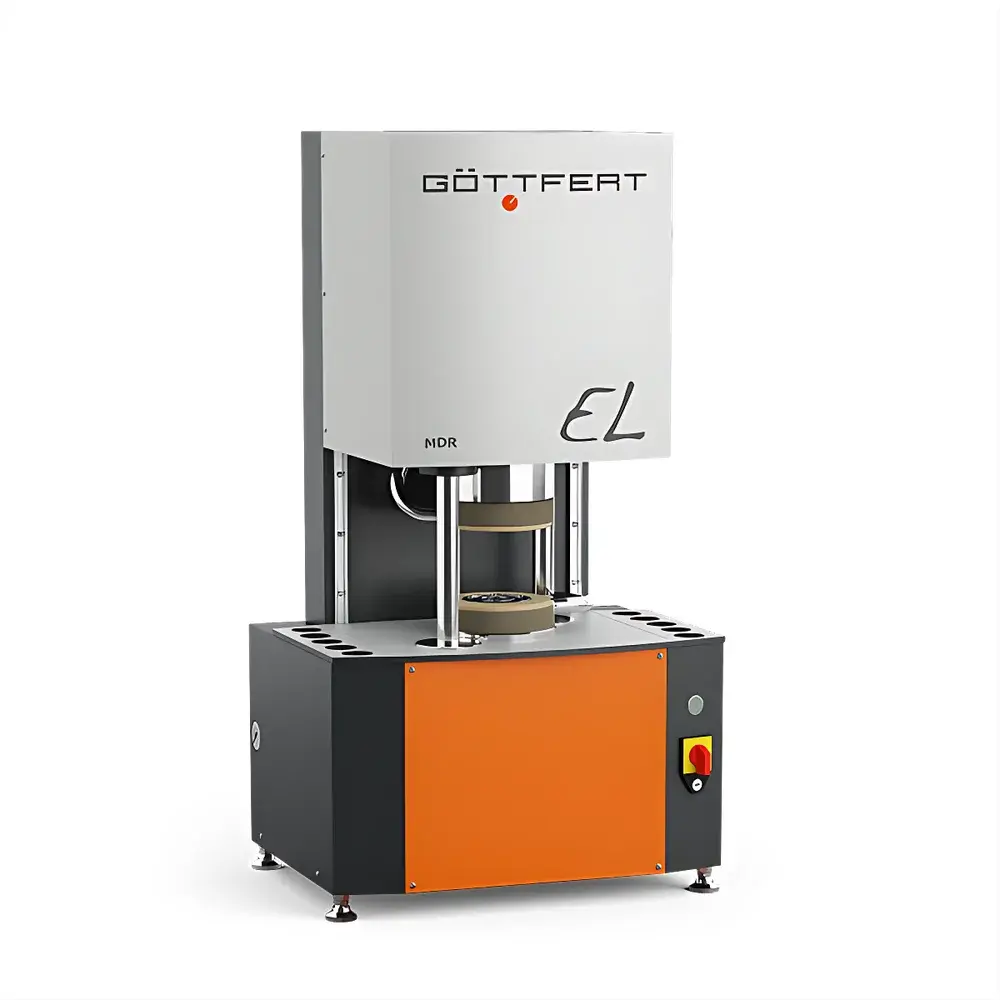
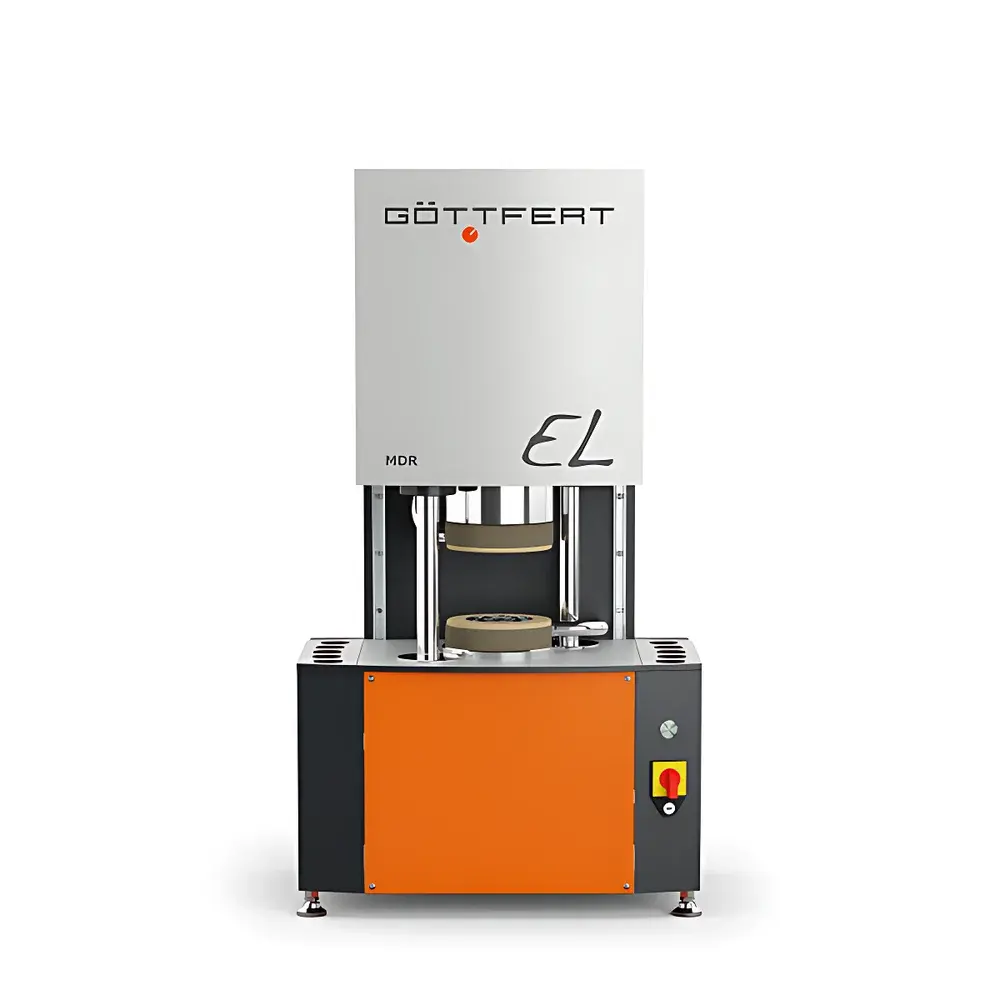
Goettfert ELASTOGRAPH Vulcanizometer
| Brand | Goettfert |
|---|---|
| Origin | Germany |
| Model | ELASTOGRAPH |
| Oscillation Frequency | 50 rpm or 100 rpm (0.83 Hz or 1.67 Hz) |
| Oscillation Amplitude | ±0.5° (optional ±0.1° to ±4.0°) |
| Temperature Range | 5–230.0 °C (resolution: 0.01 °C) |
| Torque Range | 1×10⁻⁴–20 N·m (standard 5 N·m or optional 20 N·m) |
| Clamping Force | 12 kN |
| Pressure Capability | up to 20 kN (optional) |
| Compressed Air Requirement | 6–10 bar |
| Dimensions (W×H×D) | 540 × 980 × 410 mm |
| Weight | 150 kg |
| Compliance | ISO 6502, ASTM D5289, DIN 53529, GB/T 16584 |
Overview
The Goettfert ELASTOGRAPH Vulcanizometer is a precision-engineered rotational cure meter designed for the quantitative characterization of uncured and thermosetting rubber compounds under controlled thermal and mechanical conditions. Based on the principle of oscillating disc rheometry (ODR), it applies a small sinusoidal torsional strain to a rubber sample confined between two parallel plates—one stationary and one oscillating—while maintaining precise temperature control. The resulting torque response is measured in real time, enabling derivation of critical vulcanization parameters including scorch time (ts1, ts2), optimum cure time (t90), minimum and maximum torque (ML, MH), and cure rate index (CRI). With over 45 years of dedicated development in elastomer characterization, the ELASTOGRAPH delivers high reproducibility, long-term stability, and metrological traceability essential for R&D laboratories, quality control departments, and compound formulation teams operating under GLP, GMP, or ISO/IEC 17025 frameworks.
Key Features
- Integrated desktop platform with embedded industrial PC—no external controller or mechanical calibration required
- Precision temperature control from 5 °C to 230.0 °C at 0.01 °C resolution, compliant with ASTM D5289 and ISO 6502 thermal ramping protocols
- Programmable oscillation frequency: standard 50 rpm (0.83 Hz) or 100 rpm (1.67 Hz), adjustable in 0.01 Hz increments
- Fixed oscillation amplitude of ±0.5° (with optional range of ±0.1° to ±4.0° for extended viscoelastic profiling)
- High-dynamic torque transducer with full-scale range from 1×10⁻⁴ N·m to 20 N·m, supporting both low-viscosity dispersions and highly filled compounds
- 12 kN hydraulic clamping system ensuring uniform sample compression and eliminating edge effects during measurement
- Optional integrated cooling module for post-cure rapid quenching—critical for kinetic modeling and stop-point analysis
- Optional normal force sensor for concurrent measurement of axial load, enabling foam expansion kinetics and blowing agent efficacy assessment
Sample Compatibility & Compliance
The ELASTOGRAPH accommodates standard ASTM D5289 and ISO 6502 test geometries using interchangeable cavities (eight cavity options available). It supports raw, compounded, and pre-heated rubber specimens—including natural rubber (NR), styrene-butadiene rubber (SBR), ethylene propylene diene monomer (EPDM), silicone (VMQ), fluoroelastomers (FKM), and thermoplastic elastomers (TPEs). All measurements are fully compliant with international standards: ISO 6502:2017, ASTM D5289–22, DIN 53529 Parts 1–3, and GB/T 16584–2022. Data acquisition meets audit requirements for FDA 21 CFR Part 11 when paired with validated RubberView software configurations, including electronic signatures, user access levels, and immutable audit trails.
Software & Data Management
RubberView software serves as the central interface for method definition, real-time monitoring, automated reporting, and advanced curve analysis. It supports multi-step temperature profiles (e.g., isothermal cure followed by dynamic ramp), statistical batch comparison, and derivative-based parameter extraction (e.g., dM/dt max for cure rate). Raw torque vs. time datasets are exportable in CSV, XML, and ASTM E1447-compliant formats. Version-controlled method templates ensure inter-laboratory consistency, while built-in uncertainty estimation tools assist in ISO/IEC 17025 uncertainty budgeting. Software validation documentation (IQ/OQ/PQ) is available upon request for regulated environments.
Applications
- Optimization of accelerator systems and sulfur donor ratios in tire tread compounds
- Accelerated aging studies via time–temperature superposition (TTS) modeling
- Quality assurance of incoming polymer batches and filler dispersion homogeneity
- Development of low-NOx, low-VOC curing systems for sustainable rubber manufacturing
- Characterization of self-healing elastomers and dynamic covalent networks
- Correlation of rheometric data with mechanical properties (e.g., tensile strength, elongation at break) through DoE-driven correlation matrices
FAQ
What standards does the ELASTOGRAPH support for regulatory submissions?
It natively complies with ISO 6502, ASTM D5289, DIN 53529, and GB/T 16584. With RubberView’s 21 CFR Part 11 mode enabled, it satisfies data integrity requirements for FDA-regulated rubber product development.
Can the instrument measure foaming behavior during vulcanization?
Yes—when equipped with the optional normal force sensor and pressure test unit, it quantifies axial expansion and gas evolution kinetics in blowing-agent-containing formulations.
Is remote operation supported?
RubberView supports secure LAN/WAN connectivity for supervised remote monitoring; however, test initiation and hardware configuration require local authenticated access per IEC 62443-3-3 guidelines.
How is calibration maintained across extended operation?
The system includes automated torque zeroing routines and NIST-traceable reference standards for periodic verification; annual calibration services are available directly from Goettfert’s EU-accredited service centers.
What sample preparation considerations apply for accurate results?
Specimens must be pre-conditioned at 23 °C/50% RH for ≥16 h, cut to exact cavity dimensions (typically Ø 40 mm × 5 mm), and free of surface contaminants or air entrapment—full guidance is provided in the included ISO/IEC 17025-aligned SOP library.