
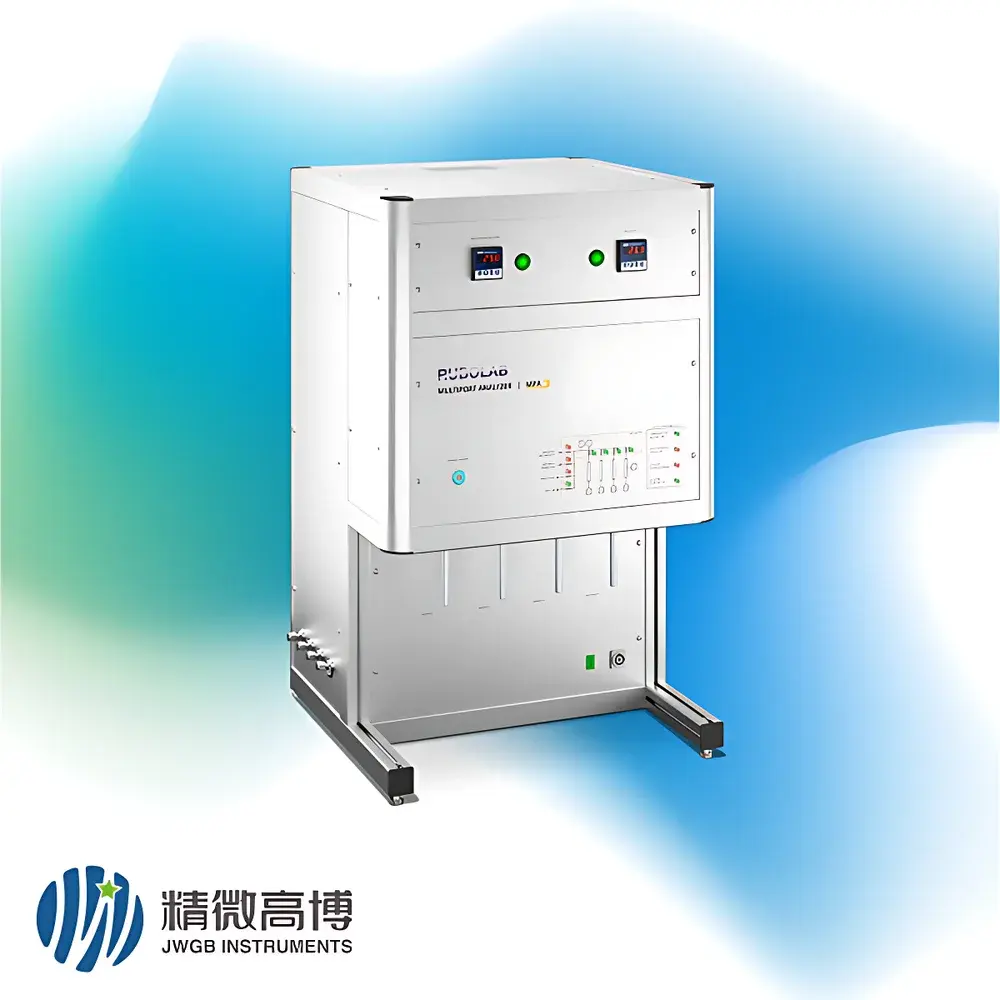
RuboLab RuboSORP MPA Volumetric High-Pressure Adsorption Analyzer (200 bar)
| Brand | RuboLab |
|---|---|
| Origin | Germany |
| Measurement Principle | Volumetric (Manometric) Method |
| Temperature Range | 0–300 °C (optional: –196 °C or up to 500 °C upon consultation) |
| Pressure Range | Up to 200 bar (standard configuration: 100 bar |
| Sample Capacity | 1, 3, or 5 parallel sample stations |
| Compliance | Designed and validated per DIN EN ISO 9001 requirements for measurement uncertainty quantification |
| Automation Level | Fully automated operation with real-time data acquisition and in-situ isotherm fitting |
Overview
The RuboLab RuboSORP MPA is a high-precision volumetric high-pressure adsorption analyzer engineered for the quantitative characterization of gas adsorption behavior in porous and functional materials under extreme thermodynamic conditions. Operating on the gravimetrically referenced volumetric (manometric) principle, the system determines absolute adsorbed phase quantity by precisely measuring pressure differentials across calibrated reference volumes before and after gas dosing into the sample cell—corrected for thermal expansion, compressibility, and dead volume contributions. This methodology ensures traceable, reproducible results aligned with fundamental thermodynamic definitions of excess and absolute adsorption. The instrument supports systematic investigation of adsorption isotherms (e.g., Type I–V according to IUPAC classification), pressure-composition-temperature (PCT) curves, and thermodynamic parameters such as isosteric heat of adsorption via van’t Hoff analysis. Its operational envelope spans 0–300 °C and up to 200 bar, enabling studies relevant to hydrogen storage, CO2 capture, methane sorption in MOFs/zeolites, and catalytic support characterization.
Key Features
- Modular multi-sample architecture supporting 1, 3, or 5 independent sample stations—each equipped with individual temperature-controlled ovens and pressure transducers for true parallel testing
- High-fidelity pressure measurement with dual-range transducers (0–10 bar and 0–200 bar) offering <0.05% full-scale accuracy and long-term stability
- Integrated cryogenic and high-temperature options: liquid nitrogen cooling (–196 °C) and extended heating capability up to 500 °C (subject to material compatibility and safety validation)
- Automated gas dosing sequence with programmable stepwise or continuous pressure ramping, including purge cycles, equilibration monitoring, and automatic drift correction
- RuboLab’s proprietary control software implements real-time thermodynamic corrections—including virial coefficient estimation for non-ideal gases (N2, H2, CH4, CO2, Ar)—based on NIST REFPROP or user-defined EOS models
- Comprehensive uncertainty budget generation per DIN EN ISO 9001, incorporating contributions from temperature sensors (Pt100, ±0.1 K), pressure transducers, volume calibration, and timing synchronization
Sample Compatibility & Compliance
The RuboSORP MPA accommodates a broad range of solid adsorbents, including metal–organic frameworks (MOFs), activated carbons, zeolites, silica gels, carbon nanotubes, and engineered catalysts. Sample cells are constructed from high-strength stainless steel (AISI 316) with gold-plated sealing surfaces to ensure chemical inertness and helium-tight integrity at elevated pressures. All hardware and firmware comply with CE marking requirements (2014/30/EU EMC Directive and 2014/35/EU Low Voltage Directive). The system supports audit-ready operation in regulated environments: raw data files include timestamps, operator ID, instrument configuration logs, and checksum-verified metadata—facilitating alignment with GLP, GMP, and FDA 21 CFR Part 11 data integrity expectations when deployed with optional electronic signature modules.
Software & Data Management
The RuboLab Control Suite provides an intuitive, role-based interface for method development, execution, and post-processing. Users define temperature–pressure protocols, equilibration criteria (e.g., ΔP/Δt < 0.01 bar/min over 10 min), and gas selection (single or multi-gas sequences) via drag-and-drop workflow editors. During acquisition, the software computes excess adsorption in real time using the ideal gas law or Peng–Robinson EOS, displays live isotherm plots, and applies nonlinear regression to fit experimental points to Langmuir, Dual-Site Langmuir, Toth, or Sips models. Export formats include CSV, Excel (.xlsx), and ASTM E2978-compliant XML for LIMS integration. All datasets are stored in a timestamped, immutable archive with SHA-256 hash verification—enabling full traceability from raw sensor output to final fitted parameters.
Applications
- Hydrogen storage capacity assessment of nanoporous materials for fuel cell applications (ISO 16111, SAE J2718)
- CO2 adsorption kinetics and selectivity evaluation in amine-functionalized sorbents for post-combustion capture
- Methane working capacity determination in activated carbons for ANG (adsorbed natural gas) vehicle tanks (SAE J1616)
- PCT hysteresis analysis of intermetallic hydride systems under dynamic loading/unloading conditions
- Thermodynamic consistency validation of adsorption models across wide P–T domains
- Quality control of batch-to-batch reproducibility in industrial sorbent manufacturing
FAQ
What gases are supported for adsorption measurements?
The system is validated for N2, Ar, H2, CH4, CO2, and O2. Other gases (e.g., C2H6, SF6) may be used subject to compatibility assessment of seals, transducers, and software EOS libraries.
Is calibration traceable to national standards?
Yes—volumetric calibration is performed using NIST-traceable piston provers; temperature sensors are certified per DIN EN 60751 Class A; pressure transducers are factory-calibrated against deadweight testers accredited to ISO/IEC 17025.
Can the instrument operate unattended overnight?
Yes—fully autonomous sequencing, fault detection (e.g., overpressure, thermal runaway), and email/SMS alerts ensure safe 24/7 operation without manual intervention.
How is dead volume determined and corrected?
Dead volume is measured experimentally via helium expansion at multiple temperatures and pressures, then modeled as a function of T and P using polynomial regression. Corrections are applied automatically during each adsorption step.
Does the software support custom model implementation?
Yes—the fitting engine accepts user-defined Python or MATLAB scripts via API integration, enabling advanced modeling such as DFT-based isotherm prediction or kinetic Monte Carlo simulations.



