
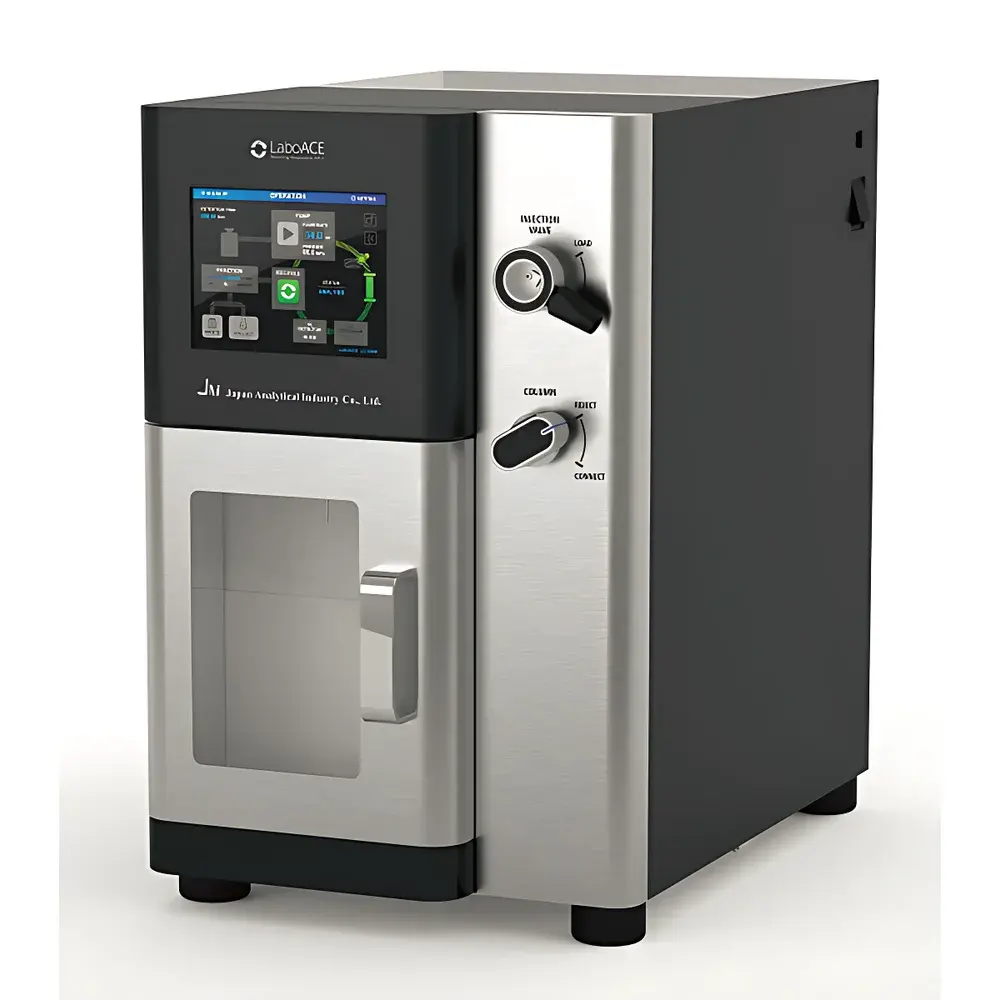
JAI LaboACE LC-5060 Preparative High-Performance Liquid Chromatography System
| Brand | JAI |
|---|---|
| Origin | Japan |
| Manufacturer Type | Authorized Distributor |
| Product Origin | Imported |
| Model | LaboACE LC-5060 |
| Application Level | Laboratory-Scale |
| Instrument Type | High-Pressure Preparative HPLC System |
| Flow Rate Range | 0.1–60.0 mL/min |
| Flow Accuracy | RSD ≤ 0.5% |
| Flow Precision (Repeatability) | RSD ≤ 0.1% |
| Maximum Operating Pressure | 20 MPa |
| Wavelength Range | ±1 nm |
| Wavelength Repeatability | 1 nm |
| Baseline Noise | 0.001 AU/hr |
| Data Acquisition Frequency | 50 Hz |
Overview
The JAI LaboACE LC-5060 is a high-pressure preparative liquid chromatography system engineered for robust, reproducible separation and purification of small- to medium-scale compounds in academic research laboratories, pharmaceutical development units, and fine chemical synthesis facilities. Built upon JAI’s decades-long expertise in chromatographic instrumentation design, the LC-5060 employs conventional reversed-phase, normal-phase, and ion-exchange chromatographic principles—utilizing high-pressure gradient or isocratic elution to resolve target analytes from complex mixtures. Its core architecture integrates a dual-plunger reciprocating pump, low-dead-volume fluidic pathways, and a UV-Vis detector with real-time spectral monitoring capability. Designed specifically for laboratory-scale purification (typically 1–100 mg per injection), the system supports method transfer from analytical to preparative conditions while maintaining retention time stability and peak shape fidelity under variable load conditions.
Key Features
- Redesigned low-dead-volume flow path: Minimizes band broadening and improves recovery yield by reducing internal volume in all critical zones—including pump head, injector loop, column interface, and detector cell.
- Patented backflow prevention system: A mechanically actuated, pressure-responsive valve prevents solvent backflow into the detector cell during pressure transients or column blockage events—eliminating risk of optical window damage and ensuring long-term detector integrity.
- High-precision binary gradient delivery: Dual independent piston pumps deliver flow rates from 0.1 to 60.0 mL/min with accuracy ≤0.5% RSD and repeatability ≤0.1% RSD across the full range—validated per ISO 11735 and ASTM D7842 protocols.
- UV-Vis detection with enhanced photometric stability: Fixed-wavelength or wavelength-scanning operation within ±1 nm tolerance; baseline noise <0.001 AU/hr at 254 nm enables sensitive fraction collection even for low-absorbing species.
- Modular scalability: Compatible with standard 10–50 mm ID preparative columns and optional add-ons including automated fraction collector, solvent degasser, column oven, and mass-directed triggering interface.
Sample Compatibility & Compliance
The LC-5060 accommodates a wide range of sample matrices—including natural product extracts, synthetic intermediates, peptide libraries, and chiral racemates—provided they are soluble in common HPLC-grade solvents (e.g., acetonitrile, methanol, water, THF, dichloromethane). Column compatibility spans silica-based, polymer-based, and hybrid stationary phases up to 50 mm internal diameter. The system meets essential regulatory expectations for laboratory instrumentation: hardware and firmware support audit trail logging, user access control, and electronic signature functionality aligned with FDA 21 CFR Part 11 requirements when operated with compliant software. It also conforms to IEC 61010-1 for electrical safety and ISO/IEC 17025 traceability frameworks applicable to method validation workflows.
Software & Data Management
Control and data acquisition are managed via JAI’s proprietary LaboACE Control Software v4.x—a Windows-based application supporting method building, real-time chromatogram visualization, peak integration, and fraction trigger logic. All raw detector signals are acquired at 50 Hz with 24-bit ADC resolution and stored in vendor-neutral .CDF format compliant with ASTM E1947 and AnIML standards. Software modules include batch processing, calibration curve management, and GLP-compliant report generation with embedded metadata (operator ID, timestamp, instrument configuration snapshot). Optional integration with LIMS platforms is supported through OPC UA and RESTful API interfaces.
Applications
- Purification of active pharmaceutical ingredients (APIs) and impurity standards for reference material qualification.
- Isolation of bioactive compounds from plant or microbial extracts for structural elucidation (NMR, MS).
- Chiral separation and enantiomer isolation using polysaccharide- or cyclodextrin-based columns.
- Preparative-scale desalting and buffer exchange of peptides and oligonucleotides.
- Method development support for downstream process scale-up—leveraging linear velocity and loading capacity correlation models.
FAQ
What is the maximum column backpressure the LC-5060 can sustain continuously?
The system is rated for continuous operation up to 20 MPa (2900 psi), with pressure sensors and safety interlocks configured to halt pumping if thresholds exceed 21 MPa.
Can the UV detector be used for wavelength scanning during preparative runs?
Yes—the detector supports both fixed-wavelength monitoring and full-spectrum scanning (190–700 nm) at 1 nm resolution; however, scan mode reduces effective acquisition rate and is typically reserved for analytical scouting prior to method translation.
Is method validation documentation available for the LC-5060?
JAI provides IQ/OQ documentation templates and factory-verified performance qualification reports covering flow accuracy, pressure linearity, UV absorbance linearity, and dwell volume—fully traceable to NIST-certified standards.
Does the system support automated fraction collection based on peak area or threshold crossing?
Yes—fraction triggers may be defined by absolute absorbance threshold, derivative-based apex detection, or integrated peak area, with programmable delay and volume-based cut windows.
What maintenance intervals are recommended for routine operation?
Pump seals require replacement every 6–12 months depending on solvent aggressiveness; UV lamp lifetime is rated at ≥2000 hours; inline filter cartridges should be inspected weekly and replaced biweekly under high-particulate load conditions.




