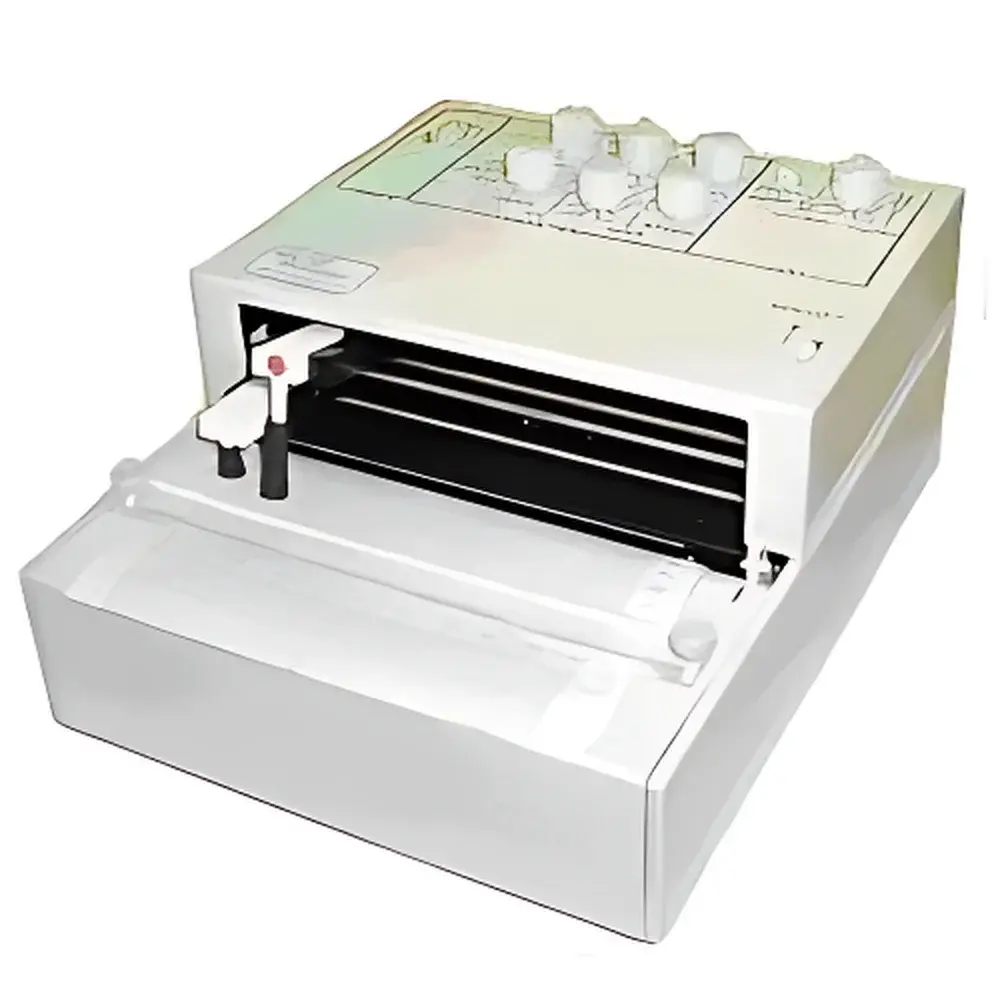
JAI MDL-101/102 Analog Chart Recorder
| Brand | JAI |
|---|---|
| Origin | Japan |
| Model | MDL-101 / MDL-102 |
| Recording Pens | 1 (MDL-101, red only) / 2 (MDL-102, red + blue) |
| Operating Principle | DC-powered automatic balancing potentiometric system |
| Input Range | 1 mV to 5 V (12 selectable ranges) |
| Chart Speed | 1, 2, 5, 10, 20, or 30 cm/min |
| Chart Width | 100 mm |
| Recording Method | Fine-tip mechanical pen |
| Dimensions (W×H×D) | 155 × 95 × 160 mm (MDL-101: 155 × 85 × 160 mm) |
| Power Supply | AC 100 V, 50/60 Hz, 0.06 A |
| Weight | 1.0 kg |
Overview
The JAI MDL-101 and MDL-102 Analog Chart Recorders are precision-engineered electro-mechanical instruments designed for continuous, real-time analog signal recording in laboratory, industrial process monitoring, and quality assurance environments. Based on the automatic balancing potentiometric principle, these recorders convert incoming DC voltage signals—ranging from 1 mV to 5 V—into proportional mechanical deflections of a fine-tip recording pen(s) moving across thermally stable chart paper. Unlike digital data loggers, the MDL series provides an immutable, time-synchronized hardcopy output trace with inherent traceability, making it suitable for applications where regulatory documentation, audit readiness, and visual trend interpretation remain critical requirements. The instrument’s galvanometer-driven pen mechanism ensures high linearity and minimal hysteresis across all 12 calibrated input ranges, while its robust chassis and low-power AC operation support reliable deployment in fixed-location monitoring stations or mobile calibration labs.
Key Features
- DC-powered automatic balancing circuitry ensures stable zero-point retention and high reproducibility over extended operating periods.
- Two model variants: MDL-101 (single red pen) for univariate monitoring; MDL-102 (dual red/blue pens) enabling simultaneous dual-channel comparison without signal multiplexing or time-division artifacts.
- Six selectable chart speeds (1–30 cm/min) allow optimization for both rapid transient capture (e.g., thermal shock testing) and long-term stability assessment (e.g., environmental chamber drift verification).
- 100 mm wide chart paper accommodates clear labeling, annotation margins, and standardized time-axis scaling per ISO 8573-1 and ASTM E2234 compliance protocols.
- Compact footprint (155 × 95 × 160 mm) and lightweight design (1.0 kg) facilitate integration into crowded control panels or portable test rigs without structural reinforcement.
- Thermally compensated pen drive assembly minimizes baseline drift under ambient temperature fluctuations between 15°C and 35°C.
Sample Compatibility & Compliance
The MDL-101/102 accepts only DC voltage inputs within its specified range and is not intended for AC, pulse, or high-impedance sensor outputs without external signal conditioning. It is compatible with standard industrial transducers—including thermocouples (with appropriate cold-junction compensation modules), strain gauge bridges (via 10 V excitation and mV/V amplification), and pH/mV electrodes—when interfaced through certified isolation amplifiers. While the recorder itself does not carry CE, UL, or IEC 61000-4 certifications as a standalone unit, its use within validated systems complies with GLP (Good Laboratory Practice) and GMP (Good Manufacturing Practice) documentation requirements when paired with auditable chart paper lot traceability, manual operator sign-offs, and controlled archive storage. Its permanent analog trace satisfies FDA 21 CFR Part 11 predicate rule conditions for non-electronic records, provided handwritten annotations and timestamped chart changes are maintained per SOP-REC-07.
Software & Data Management
The MDL-101/102 operates independently of software or computer interfaces, functioning as a self-contained analog recording system. This architecture eliminates firmware dependencies, cybersecurity vulnerabilities, and driver compatibility constraints associated with USB- or Ethernet-connected loggers. Chart archives are managed physically: each roll includes batch-coded paper stock identifiers, and recorded charts are filed chronologically with metadata (date, operator ID, process ID, instrument serial number) entered manually in bound logbooks. For digital archiving, high-resolution flatbed scanning at ≥300 dpi preserves pen stroke fidelity and enables OCR-assisted keyword indexing of handwritten annotations. JAI provides optional chart paper calibration templates and NIST-traceable verification kits (sold separately) to support annual metrological validation per ISO/IEC 17025 Clause 6.5.
Applications
- Continuous monitoring of temperature, pressure, or flow outputs from analog sensors in HVAC commissioning and cleanroom qualification.
- Calibration lab verification of DC signal sources, including precision voltage standards and multifunction calibrators.
- Long-duration stability testing of power supply ripple, battery discharge profiles, or amplifier offset drift.
- Regulatory submission support for legacy pharmaceutical manufacturing lines still operating under pre-digital validation frameworks.
- Educational demonstrations of analog signal behavior, time-domain response, and measurement uncertainty propagation in undergraduate instrumentation labs.
FAQ
Can the MDL-102 record two independent signals simultaneously?
Yes—the dual-pen configuration supports true parallel recording of two isolated DC inputs, provided each channel is conditioned to fall within the 1 mV–5 V range and referenced to the same common ground.
Is chart paper supplied with the instrument?
No—standard 100 mm wide thermal or ink-sensitive chart paper must be procured separately; JAI recommends part number CP-100T-30M for optimal pen adhesion and archival stability.
Does the recorder support battery backup or DC input?
No—it requires AC 100 V, 50/60 Hz mains power exclusively; no internal battery or alternative power interface is available.
How often does the pen mechanism require maintenance?
Under normal use (≤8 hrs/day), the pen arm and drive gear assembly require cleaning and light lubrication every 12 months using JAI-recommended silicone-free micro-lubricant (LUB-MK2).
Can I replace the red/blue pens with custom-colored tips?
Only JAI OEM replacement pens (PN: PEN-RD for red, PEN-BL for blue) are dimensionally and chemically compatible; third-party pens may cause clogging or inconsistent line width due to incompatible ink viscosity.