
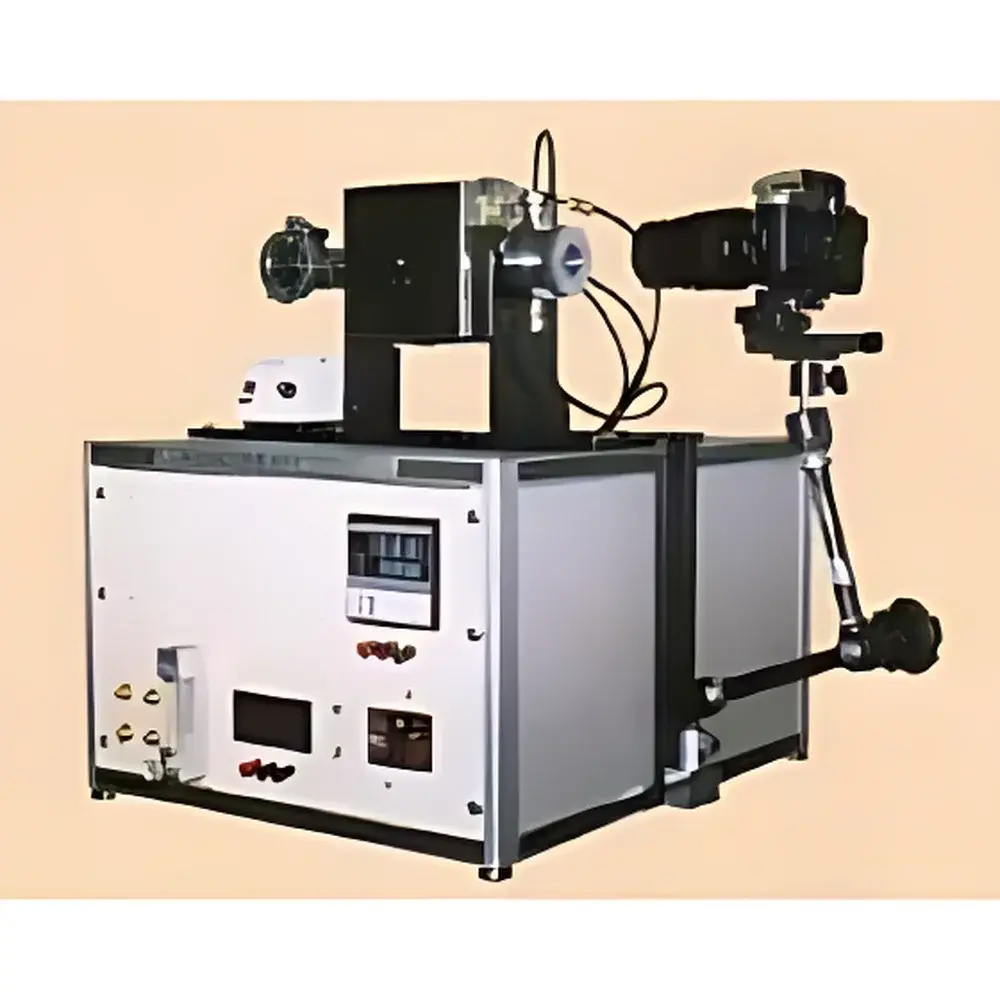
Tohei MODEL HM410 Single-Fiber Composite Interfacial Shear Strength Tester
| Brand | Tohei Industry Co., Ltd. |
|---|---|
| Origin | Japan |
| Manufacturer Type | Authorized Distributor |
| Origin Category | Imported Instrument |
| Model | MODEL HM410 |
| Price | Upon Request |
| Fiber Diameter Range | Φ5 µm and above |
| Matrix Compatibility | Thermoplastic resins, thermosetting resins, elastomers |
| Test Temperature Range | Ambient to 400 °C |
| Test Atmosphere | Air or N₂ |
| Imaging System | Microscope-integrated CCD camera |
| Tensile Load Capacity | Up to 500 gf (≈4.9 N) |
| Crosshead Speed | 0.06 mm/min adjustable |
| Dimensions (W×D×H) | 770 × 600 × 750 mm |
| Power Supply | AC 100 V, 50/60 Hz, 500 VA |
Overview
The Tohei MODEL HM410 Single-Fiber Composite Interfacial Shear Strength Tester is a precision-engineered instrument designed for quantitative evaluation of fiber–matrix interfacial adhesion in advanced composite systems. It operates on the principle of the microbond test—a standardized single-fiber pull-out methodology widely adopted in ASTM D7264/D7264M and ISO 11359-2 for interfacial property characterization. The system enables controlled deposition of liquid resin onto an individual filament—typically glass, carbon, aramid, ceramic, or metallic fibers with diameters ≥5 µm—followed by thermal curing to form a micron-scale cylindrical matrix sleeve. A calibrated tensile force is then applied axially to the embedded fiber while simultaneously recording load–displacement response and high-resolution video of interfacial debonding and pull-out behavior. This yields the critical interfacial shear strength (IFSS), a fundamental parameter governing stress transfer efficiency, crack propagation resistance, and overall composite mechanical performance.
Key Features
- High-stability micro-tensile actuation system with fine-resolution crosshead control (0.06 mm/min minimum speed) ensuring reproducible strain rates during interfacial failure events.
- Integrated optical imaging platform combining high-magnification metallurgical microscope with synchronized CCD camera for real-time visualization of interfacial fracture initiation, matrix plastic deformation, and fiber slippage dynamics.
- Thermally regulated environmental chamber supporting tests from ambient temperature up to 400 °C under controlled atmospheres (air or inert N₂), enabling evaluation of temperature-dependent interfacial degradation, post-cure effects, and thermo-oxidative stability.
- Dual-mode sample mounting configuration accommodating both vertically oriented single-fiber specimens and horizontally aligned micro-droplet configurations for comparative IFSS analysis across resin chemistries.
- Robust mechanical architecture with vibration-damped base plate and rigid aluminum frame to minimize parasitic motion during low-force (<5 N) measurements, essential for nanoscale interfacial mechanics fidelity.
Sample Compatibility & Compliance
The HM410 supports a broad spectrum of reinforcing fibers—including E-glass, PAN-based carbon, poly(p-phenylene terephthalamide) (PPTA), silicon carbide, and stainless steel monofilaments—as well as diverse matrix systems such as epoxy, vinyl ester, polyimide, polyetheretherketone (PEEK), and silicone rubber formulations. Its design conforms to core requirements outlined in ASTM D3379 (tensile properties of high-modulus single filaments), ISO 11566 (determination of interfacial shear strength by microbond test), and supports traceable calibration per ISO/IEC 17025 guidelines. When operated with documented SOPs and audit-ready log files, the system meets GLP-compliant data integrity expectations for R&D labs conducting pre-regulatory material qualification.
Software & Data Management
The HM410 interfaces with proprietary acquisition software capable of synchronized multi-channel capture: real-time load cell output (±0.2% FS accuracy), displacement transducer signal, and time-stamped video metadata. All raw data are stored in vendor-neutral HDF5 format with embedded experimental metadata (temperature setpoint, atmosphere, fiber ID, resin batch, operator name). Software includes built-in IFSS calculation modules applying the Kelly–Tyson analytical model and accounts for fiber curvature, matrix compliance, and interfacial friction contributions. Export options include CSV, MATLAB .mat, and PDF reports compliant with FDA 21 CFR Part 11 requirements when configured with electronic signature and audit trail modules.
Applications
- Quantitative screening of coupling agents (e.g., silanes, titanates) and surface treatments (plasma, ozone, sizing chemistry) on fiber wettability and chemical bonding efficacy.
- Interfacial aging studies under thermal cycling, humidity exposure, or UV irradiation to assess long-term durability of fiber–matrix bonding.
- Development and validation of novel bio-based or recycled thermoset matrices where interfacial compatibility remains a key bottleneck.
- Correlation of IFSS values with bulk composite performance metrics (flexural modulus, ILSS, fatigue life) for predictive modeling in aerospace and automotive structural design.
- Academic research into fundamental interfacial physics—including van der Waals, covalent, and mechanical interlocking mechanisms—in hybrid and hierarchical composite architectures.
FAQ
What fiber diameter range is supported by the HM410?
The system is optimized for single filaments with diameters ≥5 µm; standard operation covers 5–20 µm, with optional accessories enabling stable handling down to 3 µm for ultrafine specialty fibers.
Can the HM410 perform tests under vacuum conditions?
No—the standard configuration supports only ambient air or nitrogen-purged environments; vacuum capability requires third-party chamber integration and is not factory-supported.
Is ASTM D7264 compliance verified for this instrument?
While the HM410 implements the microbond test geometry and loading protocol referenced in ASTM D7264 Annex A4, full standard compliance requires user-defined validation per Section 8.2 of the standard, including uncertainty budgeting and reference material calibration.
Does the system support automated batch testing?
Yes—software scripting allows sequential execution of up to 99 predefined test protocols with auto-sampling triggers and pass/fail logic based on real-time IFSS thresholds.
What maintenance intervals are recommended for the load cell and optical components?
Annual recalibration of the 500 gf load cell is advised; microscope objective cleaning and CCD sensor inspection should occur quarterly under continuous use, with lens alignment verification before each high-precision campaign.



