
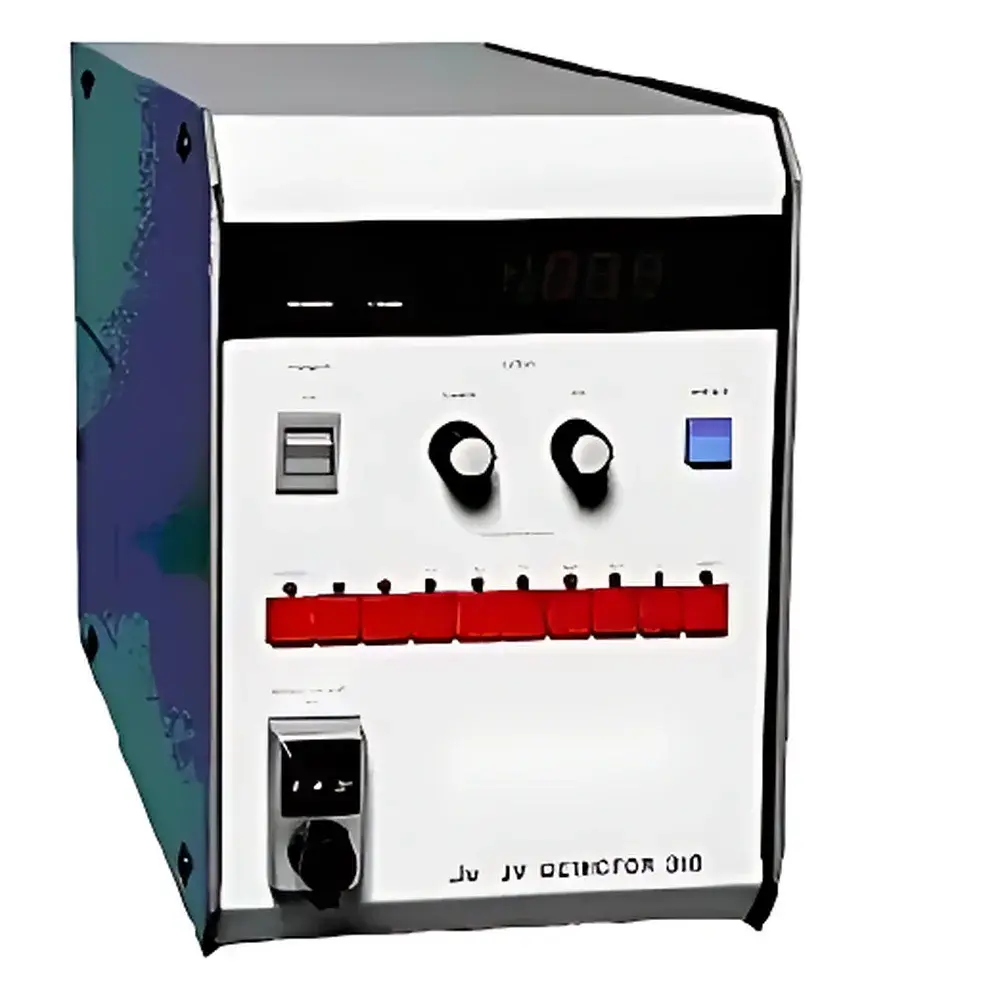
JAI UV-310 Variable Wavelength Ultraviolet Detector
| Brand | JAI |
|---|---|
| Origin | Japan |
| Model | UV-310 |
| Wavelength Range | 195–370 nm |
| Detection Principle | Dual-Beam UV Absorbance |
| Light Source | Deuterium Lamp |
| Noise | ≤0.00005 AU |
| Drift | ≤0.002 AU/hr |
| Flow Cell Pathlength | 0.5 mm (standard), optional 0.2 mm and 1.0 mm |
| Flow Cell Volume | 20 µL |
| Maximum Sample Concentration Tolerance | 4% (with 0.5 mm cell) |
| Output Signals | 100 mV and 10 mV analog outputs |
| Zero Adjustment | Dual-stage coarse + fine tuning |
| Dimensions (W×H×D) | 156 × 225 × 450 mm |
| Power Supply | AC 85–135 V, 50/60 Hz, 200 VA |
| Weight | 14 kg |
Overview
The JAI UV-310 Variable Wavelength Ultraviolet Detector is a precision optical detection module engineered for integration with high-performance liquid chromatography (HPLC) systems—specifically designed as a dedicated detector for the LC-9100 series. It operates on the dual-beam absorbance principle, where sample and reference beams pass through matched optical paths to compensate for lamp intensity fluctuations and solvent baseline drift. The deuterium lamp provides stable, continuous UV output across a broad spectral range from 195 nm to 370 nm, enabling selective detection of analytes based on their characteristic absorption maxima. This wavelength tunability supports method development, peak identification, and multi-analyte quantification without hardware modification. Its optical architecture minimizes stray light and ensures high photometric linearity over extended operation, making it suitable for both routine QC analysis and research-grade separation workflows.
Key Features
- Dual-beam optical design with real-time reference beam compensation for enhanced baseline stability and long-term signal reproducibility.
- Deuterium lamp source delivering consistent UV irradiance across the full 195–370 nm range, optimized for sensitivity in low-wavelength applications such as nucleic acid or aromatic compound detection.
- Modular flow cell configuration: standard 0.5 mm pathlength / 20 µL volume cell; optional 0.2 mm (low-volume, high-concentration) and 1.0 mm (enhanced sensitivity for trace analytes) variants support method flexibility.
- Low electronic noise floor (≤0.00005 AU) and minimal baseline drift (≤0.002 AU/hr), critical for gradient elution and low-abundance peak resolution.
- Dual-range analog output (10 mV and 100 mV) compatible with legacy chart recorders and modern data acquisition systems, facilitating seamless integration into existing lab infrastructure.
- Mechanical zero adjustment with independent coarse and fine tuning knobs allows precise baseline offset correction without software dependency—essential for GLP-compliant manual validation procedures.
Sample Compatibility & Compliance
The UV-310 is compatible with standard HPLC mobile phases including aqueous buffers, acetonitrile, methanol, and tetrahydrofuran—provided they exhibit adequate UV transparency at the selected detection wavelength. Its 20 µL flow cell accommodates typical analytical column flow rates (0.5–2.0 mL/min) while maintaining laminar flow and minimizing band broadening. The detector meets general electrical safety requirements per IEC 61010-1 and is constructed to operate reliably under ISO 17025 laboratory environmental conditions (temperature: 15–30 °C; humidity: 30–80% RH, non-condensing). While not certified to FDA 21 CFR Part 11 out-of-the-box, its analog output architecture supports traceable data capture when paired with compliant chromatography data systems (CDS) that implement audit trail, electronic signature, and user access control protocols.
Software & Data Management
As a hardware-level detector, the UV-310 does not include embedded firmware or proprietary software. It functions as a signal transducer, delivering analog voltage outputs proportional to absorbance. Integration with chromatography data systems—including Agilent ChemStation, Waters Empower, Thermo Chromeleon, and open-source platforms like OpenChrom—is achieved via standard BNC or screw-terminal analog interfaces. All calibration, integration, and reporting functions are handled externally by the host CDS. Laboratories implementing GxP workflows may configure the CDS to log detector status (e.g., lamp hours, wavelength setting, zero point) alongside chromatographic data, satisfying ALCOA+ data integrity principles when validated per internal SOPs.
Applications
- Pharmaceutical QC testing of active pharmaceutical ingredients (APIs) and excipients per USP and EP 2.2.46 methods requiring UV detection at specific λmax values.
- Environmental analysis of polycyclic aromatic hydrocarbons (PAHs), phenols, and nitroaromatics in water and soil extracts using EPA Method 8330B.
- Food and beverage quality control, including preservative (e.g., benzoic acid, sorbic acid) and antioxidant (e.g., BHT, BHA) quantification.
- Academic and industrial research involving natural product isolation, where variable-wavelength scanning aids in peak purity assessment and spectral library matching.
- Method transfer between laboratories due to its mechanical robustness, standardized analog interface, and absence of vendor-locked digital protocols.
FAQ
Is the UV-310 compatible with HPLC systems other than the LC-9100 series?
Yes—it can be interfaced with any HPLC system equipped with a compatible flow cell holder and analog input capability, though mechanical mounting and electrical cabling may require custom adaptation.
Does the detector support wavelength scanning or spectral acquisition?
No—the UV-310 is a fixed-wavelength or manually tuned single-wavelength detector; it does not perform full-spectrum acquisition like a photodiode array (PDA) detector.
What maintenance is required for the deuterium lamp?
Lamp replacement is recommended after 1,000–2,000 hours of operation; users should monitor intensity output and noise levels during routine performance qualification.
Can the 0.2 mm or 1.0 mm flow cells be installed in the field?
Yes—flow cell modules are user-replaceable using standard tools; no optical recalibration is required post-installation.
Is remote wavelength adjustment possible via external control signals?
No—wavelength selection is performed manually via front-panel dial; no RS-232, USB, or Ethernet interface is provided.




