
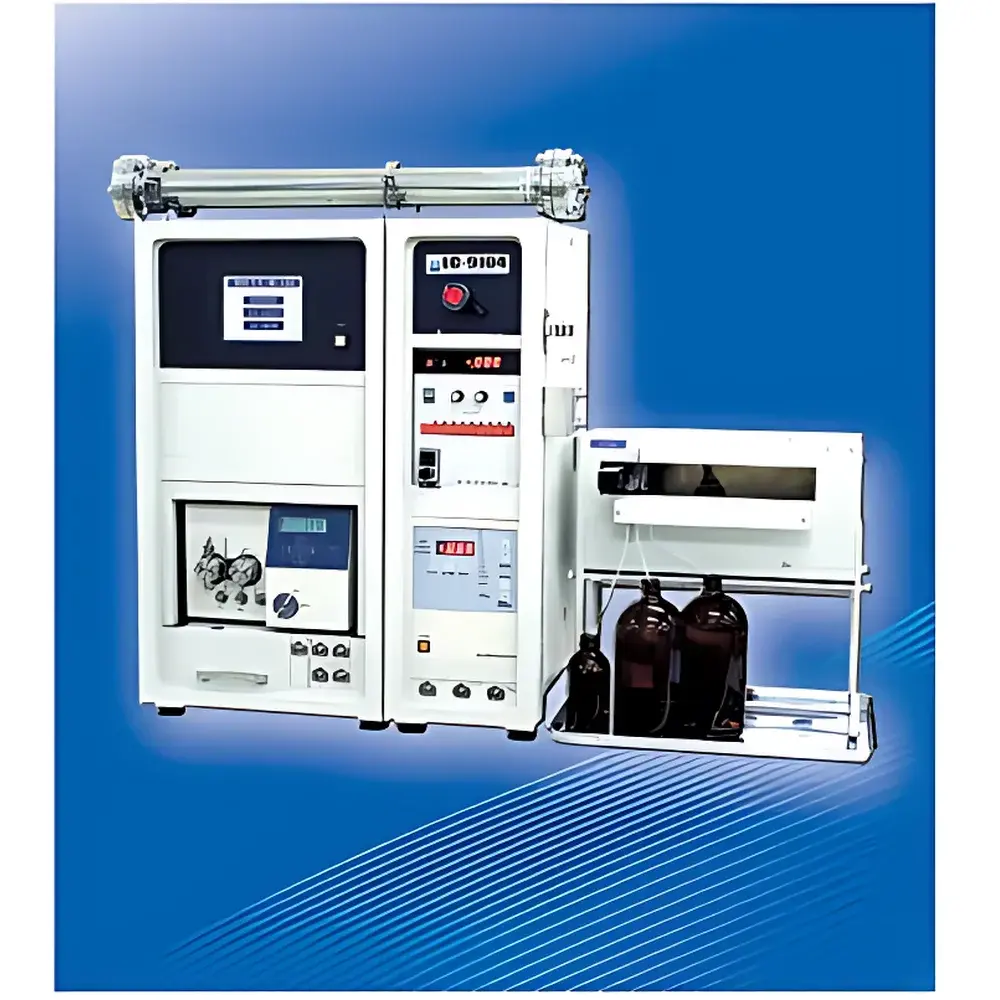
JAI LC-9104 High-Capacity Recirculating Preparative Liquid Chromatography System
| Brand | JAI |
|---|---|
| Origin | Japan |
| Model | LC-9104 |
| Pump Type | Dual-piston reciprocating high-pressure solvent delivery system |
| Max. Pressure | 20 MPa (0.01–15.00 mL/min), 15 MPa (15.01–25.00 mL/min), 10 MPa (25.01–30.00 mL/min) |
| Flow Rate Range | 0.01–30.00 mL/min |
| Injection Volume | 100 µL–50 mL (manual Rheodyne 7725i with 10 mL loop standard) |
| Column Compatibility | Up to four 20×600 mm or four 40×600 mm preparative columns |
| Fraction Collector | FC-339, touchscreen-controlled, up to 33 fractions, waste/fraction flow switching |
| Solvent Reservoir | One 5 L bottle |
| Wetted Materials | SUS316 stainless steel, ruby/sapphire, ceramic, PTFE, fluororesin, fused silica |
| Dimensions (W×H×D) | 560×675×500 mm |
| Power | AC 100–115 V / 200–240 V, 50/60 Hz, 800 VA |
| Weight | 70 kg (fully loaded) |
Overview
The JAI LC-9104 High-Capacity Recirculating Preparative Liquid Chromatography System is an engineered solution for gram-scale purification of complex organic and chiral compounds where conventional analytical or semi-preparative HPLC fails to deliver sufficient mass yield or resolution. Unlike standard gradient-based preparative systems, the LC-9104 implements a true recirculation mode—reinjecting incompletely resolved fractions back into the same column without solvent replenishment—enabling iterative separation cycles within a single run. This principle leverages retention time reproducibility and peak sharpening through repeated passage, particularly effective for closely eluting isomers, enantiomers, and labile natural products. Designed for synthetic chemistry labs, medicinal chemistry workflows, and natural product isolation, the system operates at pressures up to 20 MPa and supports flow rates from 0.01 to 30.00 mL/min, accommodating both high-resolution separations using 20 mm ID columns and high-throughput purification with 40 mm ID GEL H-40 polymer-based columns.
Key Features
- Integrated recirculation function as standard equipment—not optional—engineered for minimal mobile phase consumption and zero dilution across cycles.
- High-capacity polymer-based preparative columns (e.g., JAI GEL H-40, 40 mm ID × 600 mm), offering superior sample loading capacity (up to 1 g per injection), >95% recovery for acid/base-labile compounds, and operational lifetime exceeding six years under routine use.
- Dual-piston reciprocating high-pressure pump (L-9104A) with three pressure/flow regimes, ensuring stable gradient delivery and pulse-free flow critical for baseline-sensitive UV detection and reproducible fraction collection.
- Touchscreen-controlled FC-339 fraction collector supporting time-based, threshold-triggered, and programmable collection modes; capable of directing effluent to waste or up to 33 discrete vials per run.
- Compact footprint (560 × 675 × 500 mm) optimized for installation inside standard laboratory fume hoods; all fluidic pathways constructed from chemically inert materials including SUS316, sapphire, ceramic, PTFE, fluororesin, and fused silica.
- Full-system automation via LCD control panel: coordinated sequence from manual or automated injection (Rheodyne 7725i with 10 mL loop), column switching, UV monitoring (200–400 nm), to fraction triggering and collection.
Sample Compatibility & Compliance
The LC-9104 accommodates a broad range of compound classes—including unprotected peptides, glycosides, alkaloids, organometallics, and chiral pharmaceutical intermediates—without degradation or irreversible adsorption, thanks to its non-silica, cross-linked polystyrene-divinylbenzene stationary phase. Column compatibility extends to reversed-phase, size-exclusion, and ion-exchange chemistries when configured with appropriate packing materials. The system meets core requirements for GLP-compliant purification workflows: audit-trail-capable parameter logging (via optional PC interface), traceable fraction labeling, and full documentation of injection history, pressure profiles, and UV chromatograms. While not FDA 21 CFR Part 11–certified out-of-the-box, the architecture supports integration with validated LIMS or ELN platforms for regulated environments requiring electronic records and signature controls (e.g., USP , ISO/IEC 17025).
Software & Data Management
Data acquisition and method control are managed through the embedded LCD interface with real-time display of pressure, flow rate, UV absorbance (254 nm standard), and elapsed run time. Chromatograms are stored internally in ASCII-compatible format for export to third-party analysis tools (e.g., Chromeleon, OpenChrom, or MATLAB). Optional RS-232 or USB connectivity enables remote monitoring, batch method sequencing, and integration with laboratory informatics systems. All method parameters—including flow gradient, recirculation count, collection thresholds, and dwell volume compensation—are saved as user-defined protocols with version timestamping. No proprietary software license is required for basic operation; advanced reporting (e.g., peak purity assessment, mass balance calculation) may be performed externally using exported .csv or .txt files.
Applications
- Purification of synthetic intermediates prior to NMR characterization—delivering ≥100 mg of >99.5% pure material per run for 13C-NMR, HRMS, or X-ray crystallography.
- Chiral resolution of racemates where conventional chiral SFC or HPLC yields insufficient mass; recirculation enables baseline separation of enantiomers with ΔtR < 0.2 min.
- Isolation of unstable metabolites or photolabile compounds that degrade during multi-step offline fraction pooling.
- Process development support for API purification—scalable from mg-to-g quantities while maintaining identical selectivity as analytical methods.
- Preparative cleanup of crude reaction mixtures directly injected post-workup, eliminating intermediate lyophilization or extraction steps.
FAQ
What distinguishes recirculating preparative HPLC from conventional gradient-based systems?
Recirculation reprocesses partially resolved peaks through the same column without solvent replacement, enhancing resolution iteratively—particularly valuable for co-eluting species where increasing column length or reducing flow is impractical.
Can the LC-9104 be used for analytical-scale separations?
Yes. With high-sensitivity UV detection and narrow-bore column options (e.g., 20 mm ID), it achieves μg-level detection limits and can serve as a robust platform for method scouting prior to scale-up.
Is column regeneration required between runs?
Polymer-based columns (e.g., GEL H-40) require only mild solvent flushing (e.g., THF → methanol → water) between dissimilar samples; no acidic/basic activation or silanol masking is needed.
How is system performance verified post-installation?
JAI provides factory calibration certificates for pump accuracy (±0.5% RSD at 1 mL/min), pressure transducer linearity (±1% FS), and UV detector noise (< ±0.5 mAU), traceable to NIST standards.
What maintenance intervals are recommended?
Pump seals every 12 months under continuous operation; inlet frits every 6 months; UV lamp replacement every 2,000 hours; no routine column conditioning beyond manufacturer-recommended solvent equilibration protocols.






