
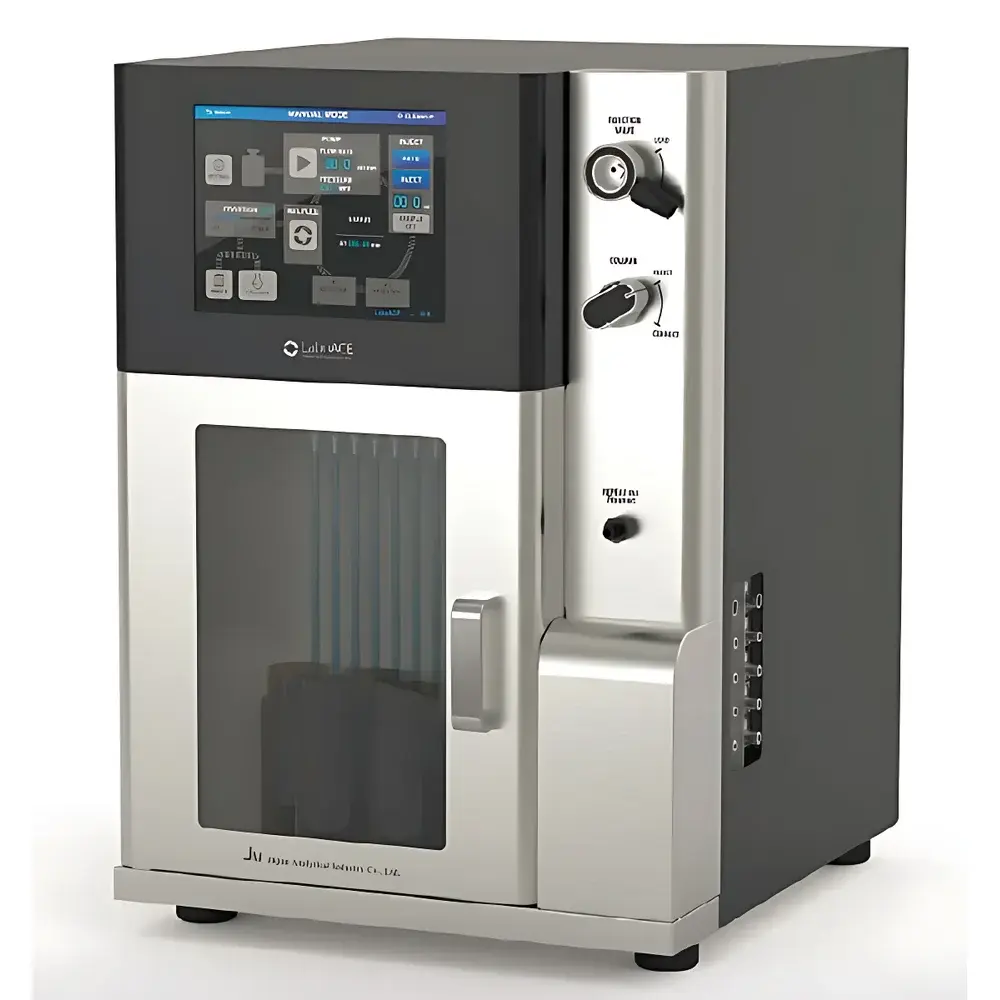
LaboACE LC7080 Automated Recycling Preparative Liquid Chromatograph
| Brand | JAI |
|---|---|
| Origin | Japan |
| Model | LaboACE LC7080 |
| Application Level | Laboratory-grade |
| Instrument Type | Medium-to-Low Pressure Preparative LC |
| Flow Rate Range | 0.1–80.0 mL/min |
| Flow Accuracy | CV < 0.3% |
| Flow Precision (Repeatability) | CV < 0.3% |
| Maximum Operating Pressure | 20 MPa |
| Wavelength Range | 190–700 nm |
| Wavelength Repeatability | ±0.5 nm |
| Baseline Noise | ≤0.00005 AU (at 254 nm, 1 s time constant) |
| Data Acquisition Rate | 50–100 Hz |
| Footprint | 382 mm (W) × 432 mm (D) |
| Recycling Capability | Fully Automated Solvent-Saving Loop Mode with Real-Time Fraction Re-injection Logic |
Overview
The LaboACE LC7080 is a laboratory-grade, medium-to-low pressure automated recycling preparative liquid chromatograph engineered by JAI (Japan Analytical Instrumentation Co., Ltd.) for high-fidelity compound purification and iterative separation workflows. Unlike conventional analytical or semi-preparative systems, the LC7080 implements a closed-loop recycling architecture—enabling repeated passage of unresolved fractions through the same column without manual intervention. This design leverages precise gradient elution control, dual-wavelength UV-Vis detection, and real-time peak tracking to resolve closely eluting compounds with enhanced resolution and yield. Its compact footprint (382 × 432 mm) integrates all core modules—including dual-piston high-pressure pump, column oven, UV-Vis spectrophotometric detector, optional secondary detector interface (e.g., RI or conductivity), and intelligent fraction collector—within a single, space-optimized chassis. The system operates within a maximum pressure limit of 20 MPa, supporting both silica-based and polymer-packed columns up to 30 mm internal diameter, making it suitable for gram-scale isolation of natural products, synthetic intermediates, chiral isomers, and pharmaceutical impurities under non-denaturing conditions.
Key Features
- Automated recycling mode with programmable loop count, retention time window gating, and dynamic re-injection logic based on real-time UV absorbance profiles.
- Dual-detector compatibility: Standard high-sensitivity UV-Vis detector (190–700 nm, ±0.5 nm wavelength repeatability, baseline noise ≤0.00005 AU at 254 nm) plus configurable second-channel input for refractive index, conductivity, or mass-sensitive readouts.
- High-precision binary solvent delivery: Dual-plunger reciprocating pump delivering flow rates from 0.1 to 80.0 mL/min with coefficient of variation (CV) < 0.3% for both accuracy and repeatability.
- Compact integrated platform: All fluidic, optical, and collection subsystems housed in a footprint of only 382 mm (W) × 432 mm (D), minimizing lab space requirements while maintaining service accessibility and thermal stability.
- Intelligent fraction collector with position-coded vial trays, solvent-evaporation mitigation design, and low-volatility solvent handling protocol to reduce ambient VOC emissions and improve operator safety.
- Column oven with PID-controlled temperature regulation (ambient +5°C to 60°C, ±0.5°C stability) to enhance retention time reproducibility and method transfer robustness.
Sample Compatibility & Compliance
The LC7080 accommodates a broad range of sample matrices—including polar and non-polar small molecules, peptides, oligonucleotides, and thermally labile natural extracts—without requiring derivatization or extensive pre-treatment. It supports reversed-phase, normal-phase, ion-exchange, and size-exclusion chromatographic modes via interchangeable column hardware and mobile phase configurations. System validation documentation aligns with ISO/IEC 17025:2017 calibration traceability requirements. Data acquisition and audit trail functions comply with FDA 21 CFR Part 11 principles when operated with JAI’s certified ChromaLink Pro software suite (including electronic signatures, user-level access control, and immutable event logging). Method files and chromatograms meet ASTM E2500-18 and ICH Q2(R2) guidelines for analytical procedure validation in pharmaceutical development laboratories.
Software & Data Management
ChromaLink Pro v4.x serves as the native control and data analysis environment for the LC7080. The software provides synchronized multi-channel acquisition (UV, optional secondary detector, pressure, temperature), real-time chromatogram overlay during recycling cycles, and automated peak integration using adaptive baseline algorithms. All raw data are stored in vendor-neutral .CDF (NetCDF-based) format compliant with ASTM E1946-20 standards. Audit trails record every parameter change, injection event, fraction trigger, and user login with timestamp, IP address, and role-based metadata. Export options include CSV, PDF reports with embedded spectral overlays, and direct import into third-party cheminformatics platforms (e.g., ChemAxon, KNIME, or Spotfire) via open API endpoints. Remote monitoring and method queue scheduling are supported over secure TLS 1.2 connections.
Applications
- Purification of synthetic organic compounds where conventional one-pass prep-LC yields insufficient resolution—particularly for diastereomeric or regioisomeric mixtures.
- Isolation of bioactive constituents from plant extracts or fermentation broths using iterative enrichment strategies without column replacement.
- Preparative chiral separations employing polysaccharide-based CSPs under low-to-medium backpressure constraints.
- Process development support for early-stage API purification, including forced degradation product isolation and impurity spiking studies.
- Academic and contract research labs requiring rapid method scouting, scalability assessment, and seamless transition from analytical to preparative conditions.
FAQ
What types of columns are compatible with the LC7080?
Standard stainless-steel or PEEK-lined columns with 10–30 mm internal diameter and lengths up to 250 mm; both packed and monolithic formats are supported across reversed-phase (C18, C8), HILIC, and chiral stationary phases.
Can the system perform gradient elution during recycling mode?
Yes—full gradient programming (up to 4 solvents) remains active throughout all recycling iterations, enabling progressive resolution enhancement across successive passes.
Is method transfer possible from analytical UHPLC systems?
Method translation tools within ChromaLink Pro allow scaling of retention times, flow rates, and gradient slopes based on column geometry and particle size ratios per USP guidance.
Does the LC7080 support GLP-compliant operation?
When deployed with validated ChromaLink Pro software, instrument qualification documents (IQ/OQ/PQ), and enabled audit trail functionality, the system meets GLP requirements for nonclinical laboratory studies per OECD Principles of Good Laboratory Practice.
What maintenance intervals are recommended for the dual-piston pump?
Pump seal inspection and replacement are advised every 6 months under continuous operation; full pump head calibration is required annually or after any major solvent system change involving high-viscosity modifiers.
Related Products






