
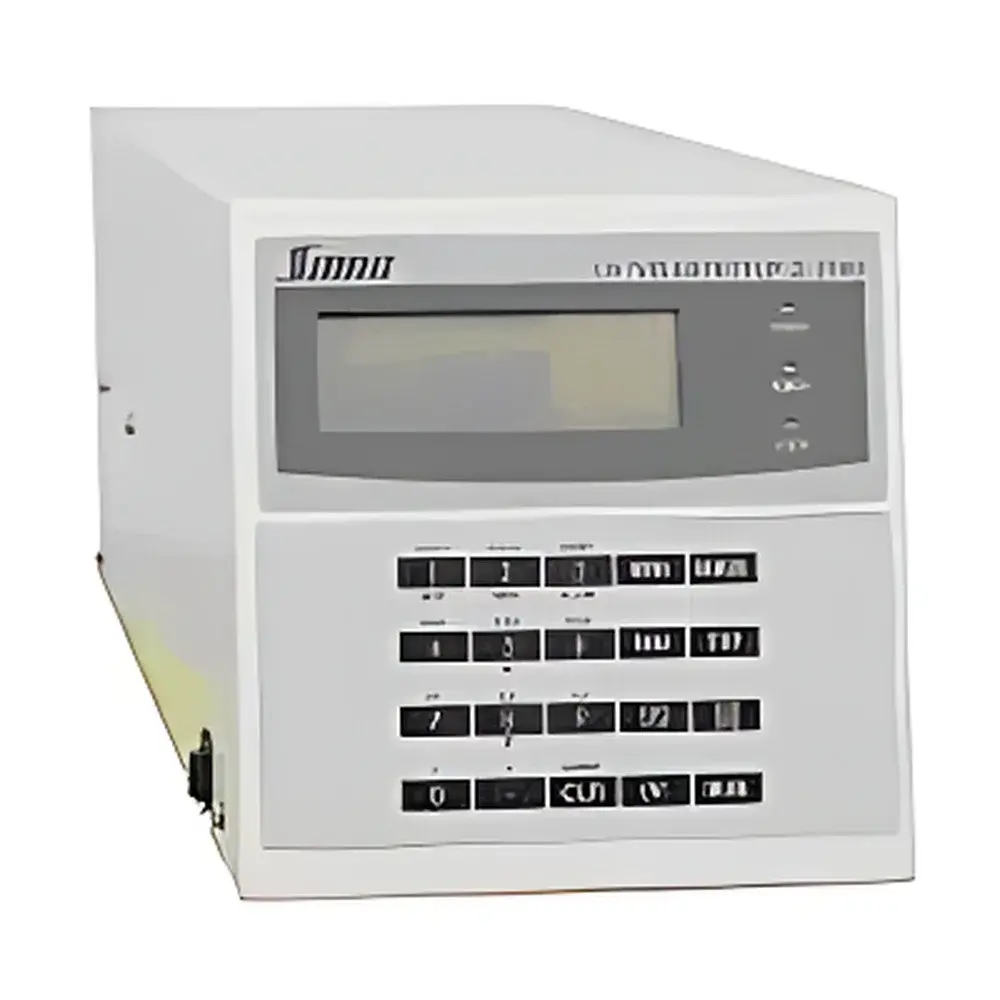
JAI UV-3740 Variable Wavelength UV-Vis Detector
| Brand | JAI |
|---|---|
| Origin | Japan |
| Model | UV-3740 |
| Detector Type | Ultraviolet-Visible (UV-Vis) Detector |
| Wavelength Range | 195–600 nm |
| Optical Design | Dual-beam |
| Light Source | Deuterium Lamp |
| Noise | ≤0.00002 AU |
| Drift | ≤0.0005 AU/hr |
| Flow Cell Pathlength | 0.5 mm (standard), optional 0.2 mm and 1.0 mm |
| Flow Cell Volume | 20 µL |
| Saturation Concentration | 4% (with 0.5 mm cell) |
| Output Signal | 10 mV full scale |
| Auto-zero Function | Yes |
| Dimensions (W×H×D) | 140 × 140 × 450 mm |
| Power Supply | AC 85–135 V, 50/60 Hz, 100 VA |
| Weight | 8 kg |
Overview
The JAI UV-3740 Variable Wavelength UV-Vis Detector is a precision optical detection system engineered for integration with high-performance liquid chromatography (HPLC) and preparative chromatography platforms. It operates on the principle of absorbance photometry in the ultraviolet and visible spectral region (195–600 nm), utilizing a stable deuterium lamp as its primary broadband light source and a dual-beam optical architecture to compensate for lamp intensity fluctuations and environmental drift. This design ensures high baseline stability and long-term signal reproducibility—critical requirements for quantitative analysis in regulated environments. The detector’s variable wavelength capability enables method flexibility across diverse analytes, including aromatic compounds, conjugated systems, nucleic acids, and pharmaceutical intermediates, without hardware modification. Its compact footprint (140 × 140 × 450 mm) and low power consumption (100 VA) support seamless installation in multi-instrument laboratories or automated analytical workflows.
Key Features
- Dual-beam optical path with real-time reference beam correction for enhanced baseline stability and reduced sensitivity to lamp aging or ambient temperature variation.
- Deuterium lamp illumination delivering consistent spectral output from 195 nm—enabling reliable detection of low-wavelength-absorbing species such as carbonyl-containing compounds and small organic molecules.
- Low-noise analog electronics achieving ≤0.00002 AU peak-to-peak noise (measured at 254 nm, 1 sec time constant), supporting high-sensitivity trace quantitation.
- Drift performance of ≤0.0005 AU/hr under stabilized operating conditions, meeting stringent requirements for extended gradient runs and unattended overnight analyses.
- Modular flow cell design with standard 0.5 mm pathlength (20 µL volume); optional 0.2 mm (low-volume) and 1.0 mm (high-sensitivity) cells accommodate varied column formats—from capillary to preparative scale.
- Integrated auto-zero function eliminates manual baseline offset adjustments and supports rapid method reconfiguration between injections.
- Wide-format LCD display with real-time chromatogram plotting capability, enabling immediate visual verification of retention time, peak shape, and baseline behavior during method development.
Sample Compatibility & Compliance
The UV-3740 is compatible with standard HPLC mobile phases—including aqueous buffers, acetonitrile, methanol, and tetrahydrofuran—as well as common column chemistries (C18, C8, phenyl-hexyl, HILIC, and ion-exchange). Its 20 µL flow cell volume and 0.5 mm pathlength are optimized for analytical-scale separations (2.1–4.6 mm ID columns), while optional flow cells extend applicability to microbore (1.0 mm ID) and preparative (≥10 mm ID) configurations. The detector conforms to general safety standards for laboratory electrical equipment (IEC 61010-1) and supports GLP/GMP-aligned operation through stable analog output (10 mV full scale) compatible with legacy chart recorders and modern data acquisition systems. While not inherently 21 CFR Part 11 compliant, its analog signal interface permits integration into validated chromatography data systems (CDS) that implement audit trail, electronic signature, and data integrity controls per FDA and EMA guidance.
Software & Data Management
The UV-3740 operates as a standalone analog detector and does not include embedded firmware-based data storage or USB/Ethernet connectivity. It delivers a calibrated 0–10 mV analog output proportional to absorbance, which is directly compatible with third-party chromatography data systems (e.g., Waters Empower, Agilent OpenLab, Thermo Chromeleon) and programmable logic controllers (PLCs) used in process analytical technology (PAT) applications. When paired with compliant CDS software, the detector supports full traceability—including acquisition timestamps, wavelength settings, and event markers—essential for regulatory submissions under ICH M4, USP , and ISO/IEC 17025. Raw signal integrity is preserved via low-impedance output buffering, minimizing signal degradation over cable runs up to 50 meters.
Applications
- Pharmaceutical QC/QA: Quantitative assay of active pharmaceutical ingredients (APIs) per USP monographs requiring UV detection at specified wavelengths (e.g., 210 nm for β-lactams, 254 nm for aromatics).
- Biopharmaceutical analysis: Monitoring protein elution profiles during size-exclusion chromatography (SEC) and purification steps using 280 nm detection.
- Environmental testing: Detection of polycyclic aromatic hydrocarbons (PAHs), nitroaromatics, and pesticide residues in water and soil extracts.
- Food & beverage quality control: Measurement of preservatives (e.g., benzoic acid, sorbic acid), colorants, and antioxidant content.
- Academic research: Method development for novel separation protocols where wavelength optimization is required prior to method transfer to production systems.
FAQ
What is the minimum detectable absorbance for the UV-3740?
The detector’s noise specification (≤0.00002 AU) defines its practical lower limit for reliable peak detection under standard conditions; actual detection limits depend on injection volume, analyte molar absorptivity, and column efficiency.
Can the UV-3740 be used with gradient elution methods?
Yes—the dual-beam design and low drift performance ensure stable baseline response during solvent composition changes typical of gradient HPLC.
Is the flow cell replaceable in the field?
Yes—flow cells are user-serviceable modules; replacement requires only standard hex-key tools and does not necessitate optical realignment.
Does the detector support wavelength scanning or spectral acquisition?
No—the UV-3740 is a fixed-wavelength or single-wavelength-variable detector; it does not perform full-spectrum acquisition like a photodiode array (PDA) detector.
What maintenance is required for the deuterium lamp?
Lamp lifetime is typically 1,000–2,000 hours; replacement is recommended when output intensity drops below 70% of initial value or when noise increases significantly—monitoring is performed via system diagnostics in connected CDS software.
Related Products





