
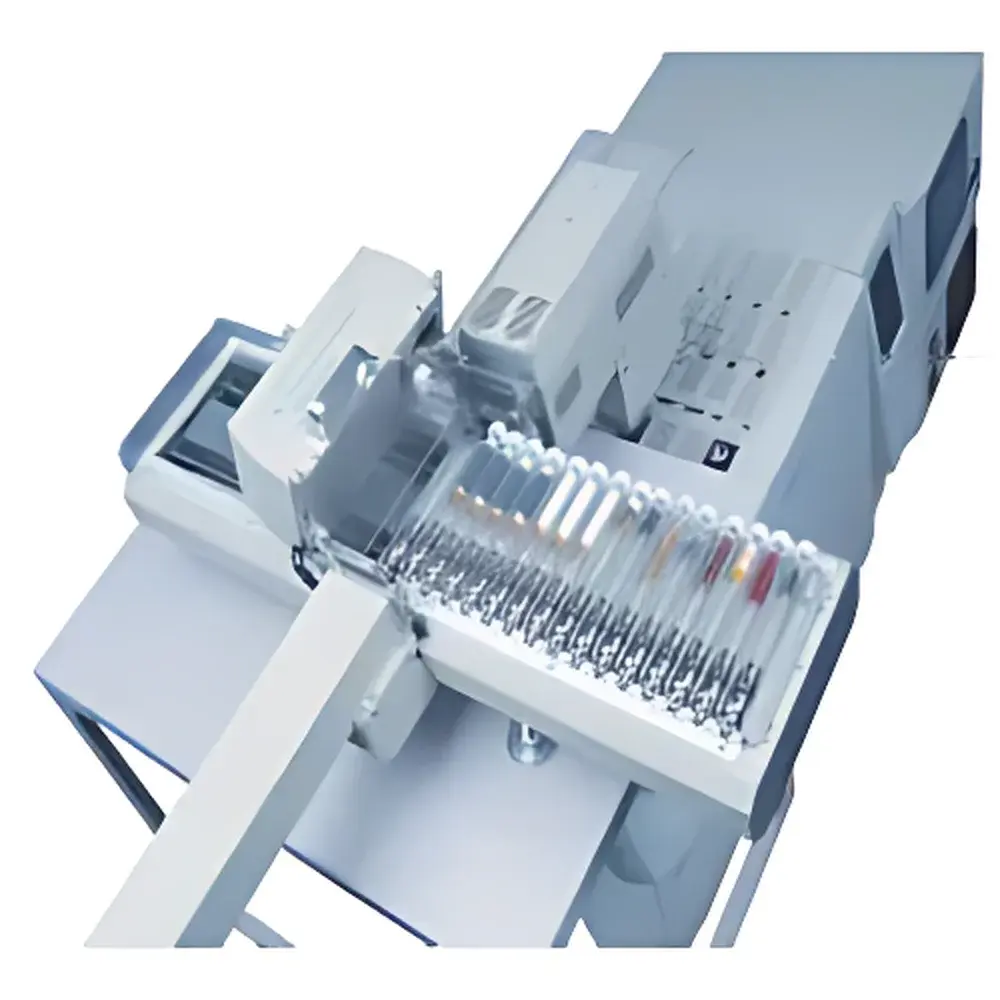
JAI JTD-505III / JTD-505MIII Curie-Point Automated Purge-and-Trap Thermal Desorber
| Brand | JAI |
|---|---|
| Origin | Japan |
| Instrument Type | Dual-Stage Thermal Desorber |
| Heating Method | Curie-Point (Standard 280 °C) + Resistive (–99 °C to 350 °C) |
| Cooling | Liquid Nitrogen (–99 °C) |
| Sample Capacity | Up to 48 sequential analyses (15 PAT tubes + programmable repeat/swap logic) |
| PAT Tube Dimensions | 12 mm ID × 50 mm height, 10 mL internal volume |
| Transfer Line Temp Range | Ambient +10 °C to 300 °C |
| GC Interface | Direct column connection or syringe-type injection |
| Power Supply | AC 100 V, 50/60 Hz, 15 A |
| RF Generator | 600 kHz, 48 W |
| Dimensions (Main Unit) | 355 × 210 × 130 mm, 3.1 kg |
| Liquid Nitrogen Dewar | 50 L (JTD-505III) / 20 L (JTD-505MIII), 460 mm Ø × 930 mm H, 24.8 kg |
Overview
The JAI JTD-505III and JTD-505MIII are fully automated, dual-stage thermal desorption systems engineered for high-fidelity volatile organic compound (VOC) and semi-volatile organic compound (SVOC) analysis in environmental, semiconductor, cleanroom, and materials science laboratories. These instruments implement a hybrid thermal desorption architecture combining Curie-point induction heating with precision resistive temperature control and cryogenic focusing—enabling quantitative recovery of analytes ranging from highly volatile C2 compounds (e.g., vinyl chloride, acetaldehyde) to heavier SVOCs (e.g., naphthalene, phenanthrene) without thermal degradation or breakthrough. The core innovation lies in the patented PAT (Programmable Analyte Trap) tube system: a 12-mm internal diameter quartz tube packed with Tenax® GR sorbent, capable of direct insertion of solid, granular, or electronic component samples—eliminating solvent extraction or headspace equilibration steps. Unlike conventional thermal desorbers relying solely on resistive ovens, the Curie-point heating mechanism delivers rapid, uniform, and reproducible thermal energy transfer at precisely defined temperatures (standard 280 °C), minimizing peak broadening and improving chromatographic resolution in downstream GC or GC/MS detection.
Key Features
- Automated unattended operation for up to 48 sequential analyses via intelligent PAT tube sequencing logic—supporting repeat injections, mid-run tube swaps, and blank-interspersed protocols for carryover assessment.
- Dual-stage desorption architecture: primary Curie-point heating of PAT tubes followed by secondary resistive heating of the SAT (Secondary Analyte Trap) and transfer line—ensuring complete analyte elution and sharp, symmetrical peaks.
- Cryogenic focusing at –99 °C using liquid nitrogen-cooled SAT traps, enabling trace-level detection (sub-ppt in air) and retention of low-boiling compounds that would otherwise be lost in hot-desorption-only systems.
- Large-capacity PAT tubes (10 mL volume, 12 mm ID) accommodate bulk solids, wafers, PCB fragments, or polymer pellets directly—facilitating real-time outgassing studies per ASTM E2581 and IEC 62753 standards.
- Two-stage split flow design mitigates column contamination from high-mass desorption events—critical for analyzing adhesives, encapsulants, or molded plastics with elevated VOC emissions.
- Integrated RF generator (600 kHz, 48 W) enables precise Curie-point activation of ferromagnetic foils embedded in PAT tubes—delivering ±0.5 °C thermal accuracy and <1 s rise time.
- Full temperature zoning: PAT heater (–99 °C to 350 °C), SAT heater (up to 200 °C), transfer line (ambient +10 °C to 300 °C), and needle (ambient +10 °C to 300 °C)—all independently controllable via touchscreen interface.
- Onboard data logging stores the last 48 analysis results with timestamps, method IDs, and thermal profiles—supporting GLP-compliant audit trails when paired with validated LIMS integration.
Sample Compatibility & Compliance
The JTD-505 series accommodates gaseous, solid, and particulate matrices without derivatization or pretreatment. Certified applications include indoor air monitoring (ISO 16000-6), semiconductor chamber effluent analysis (SEMI F21), cleanroom airborne molecular contamination (AMC) screening (ISO 14644-8), and electronic component outgassing per NASA ASTM E595 and ECSS-Q-ST-70-02C. PAT tubes comply with USP glass specifications and are compatible with Tenax® GR, Carbopack™, and multi-bed sorbent configurations. All thermal zones meet IEC 61010-1 safety requirements; optional overheat protection includes four redundant thermistors, emergency stop circuitry, and 30 mA residual current detection. The system supports 21 CFR Part 11–compliant electronic signatures when operated with validated third-party chromatography data systems (CDS).
Software & Data Management
Control is executed via an embedded touchscreen HMI with intuitive parameter mapping for temperature ramps, valve timing, gas flows, and desorption dwell times. Sixteen user-defined methods can be saved and recalled—including custom Curie-point offsets, multi-step cooling/heating sequences, and split-ratio modulation. Real-time monitoring displays LN2 consumption via integrated mass-flow sensing, enabling predictive dewar replenishment scheduling. Export formats include CSV and XML for seamless ingestion into Agilent MassHunter, Thermo Chromeleon, or Shimadzu LabSolutions. Audit trail functionality records operator ID, method changes, calibration events, and system error logs—with optional encryption and role-based access control when interfaced with enterprise CDS platforms.
Applications
- Environmental: EPA TO-17 compliant analysis of ambient, workplace, and stack air for BTEX, chlorinated solvents, and carbonyls.
- Electronics: Quantification of outgassed siloxanes, plasticizers, and solder flux residues from IC packages, flex circuits, and display modules.
- Pharmaceuticals: Residual solvent profiling in lyophilized APIs and polymer-based drug delivery devices per ICH Q3C guidelines.
- Materials Science: Thermal stability assessment of composites, adhesives, and battery electrolytes under inert purge conditions.
- Forensics: Trace ignitable liquid residue (ILR) identification in fire debris using ASTM E1412-compliant desorption parameters.
FAQ
What distinguishes Curie-point heating from conventional resistive heating in thermal desorption?
Curie-point heating uses high-frequency induction to excite ferromagnetic foil inside the PAT tube, achieving instantaneous, spatially uniform thermal energy delivery at a fixed, material-specific temperature—eliminating thermal lag, overshoot, and gradient-induced fractionation.
Can the JTD-505III interface with legacy GC systems lacking dedicated thermal desorption ports?
Yes—the system supports both direct column coupling (for capillary GC) and syringe-style injection via heated transfer needle, ensuring compatibility with Agilent 6890/7890, Shimadzu GC-2010, and Thermo Trace 1300 series instruments.
Is method validation support available for regulated environments?
JAI provides IQ/OQ documentation templates aligned with ISO/IEC 17025 and ASTM D6196, including temperature uniformity mapping, carryover testing protocols, and limit-of-detection verification procedures.
How is carryover minimized during high-concentration sample analysis?
The PAT swap function allows automatic replacement of spent tubes with blanks between runs, while the two-stage split flow diverts excess matrix volatiles away from the analytical column—reducing column fouling and memory effects.
What maintenance intervals are recommended for optimal performance?
Liquid nitrogen dewar inspection every 6 months; PAT tube bake-out at 350 °C for 30 minutes weekly; RF coil impedance verification annually; and sorbent bed integrity testing per ASTM D5197 every 200 runs.




